

Most B2B companies invest heavily in events, with 20 to 30% of marketing budgets going toward conferences, trade shows, and webinars. Yet many struggle to prove tangible returns. The missing piece isn't the events themselves but how they integrate with marketing automation systems. When events operate in isolation from your automation workflows, you lose the ability to capture intent, nurture leads systematically, and connect activity to revenue. This guide reveals how marketing automation transforms events from costly experiments into measurable growth channels that generate demand and accelerate conversions.
Table of Contents
- Why Proving Event Roi Is So Challenging In B2B Marketing
- How Marketing Automation Transforms Event Follow-Up And Lead Management
- Optimizing Event Roi Through Integrated Marketing Automation Workflows
- Common Pitfalls In Event Marketing Automation And How To Avoid Them
- Boost Your Event Marketing Roi With Sandbox Solutions
- Frequently Asked Questions About Events In Marketing Automation
Key takeaways
| Point | Details |
|---|---|
| Automation drives conversion | Automating event follow-up sequences can increase conversion rates by 20% through timely, personalized outreach. |
| Budget versus results gap | Companies allocate 20 to 30% of marketing spend to events but often cannot demonstrate clear ROI due to fragmented processes. |
| Massive lead leakage | 73% of event leads never receive follow-up contact, representing enormous missed opportunities for demand capture. |
| Pre-event targeting matters | Identifying and targeting your ideal customer profile before events significantly improves attendance quality and revenue potential. |
| Workflow integration wins | Connecting event data to CRM and automation platforms streamlines processes and enables accurate revenue attribution. |
Why proving event ROI is so challenging in B2B marketing
Event marketing has traditionally been treated as an art rather than a science. Teams focus on booth design, speaker lineups, and attendee experience while measurement takes a back seat. This approach makes objective ROI assessment nearly impossible. Companies spend 20 to 30% of marketing budgets on events but struggle to connect those investments to pipeline and revenue outcomes.
The root cause lies in manual, fragmented workflows. When event registration data lives in one system, badge scans in another, and CRM records in a third, creating a unified view becomes a nightmare. Sales teams receive spreadsheets of leads days or weeks after events end. By then, momentum has evaporated and competitors have already engaged those prospects.
Consider these common scenarios that undermine event ROI:
- Lead data gets exported manually, causing delays and errors in handoff to sales
- No standardized scoring exists to prioritize high-intent attendees over casual booth visitors
- Follow-up depends on individual rep initiative rather than systematic processes
- Attribution models cannot trace closed deals back to specific event interactions
The statistics reveal the scale of the problem. Research shows that 89% of marketers admit measuring event ROI ranks among their biggest challenges. Even more troubling, 73% of event leads never get contacted at all. That represents an enormous volume of potential customers who expressed interest but received no response.
This lead leakage happens because manual processes cannot scale. A rep might follow up with 10 or 20 high-priority contacts but lacks bandwidth to engage hundreds of attendees systematically. Without automation, the math simply doesn't work. The cost and complexity of capturing reliable data leads many organizations to view events with skepticism, questioning whether the channel justifies continued investment.
The solution requires shifting from art to science by implementing B2B event lead generation strategies that treat events as integrated components of your demand generation engine rather than standalone activities.
How marketing automation transforms event follow-up and lead management
Automation addresses the follow-up crisis by ensuring every lead receives timely, relevant communication based on their event behavior. Instead of relying on manual outreach, you build sequences that trigger automatically when someone registers, attends a session, visits your booth, or downloads content. This systematic approach closes the gap that causes 73% of leads to slip through the cracks.
The impact shows up in conversion metrics. Studies demonstrate that automating event follow-up sequences can improve conversion rates by 20% compared to manual processes. That lift comes from three factors: speed, consistency, and personalization at scale.
Here's how to structure effective automated event workflows:
- Immediate acknowledgment: Send a thank-you email within hours of booth visits or session attendance, reinforcing the connection while your brand remains top of mind.
- Segmented nurture paths: Route attendees into different sequences based on their role, company size, and engagement level rather than treating all leads identically.
- Multi-touch cadence: Deploy a series of 5 to 7 touchpoints over 2 to 3 weeks, mixing educational content with soft calls to action that move prospects toward sales conversations.
- Behavioral triggers: Adjust messaging dynamically based on email opens, content downloads, and website visits that signal rising intent.
- Sales alerts: Notify reps automatically when leads hit scoring thresholds or take high-intent actions, enabling timely human outreach at the right moment.
Pro Tip: Set up triggers based on specific event actions like attending your keynote, visiting your booth multiple times, or downloading case studies. These behaviors indicate stronger intent than passive registration and warrant more aggressive follow-up sequences.
The key is moving beyond generic batch emails to intelligent workflows that adapt based on prospect behavior. Someone who attended three of your sessions and downloaded a whitepaper should receive different messaging than someone who briefly stopped by your booth. Automation makes this level of personalization feasible across hundreds or thousands of leads.

Integrating post-event engagement optimization into your workflows ensures you maintain momentum after events conclude. The goal is transforming one-time interactions into ongoing relationships that progress through your funnel systematically.
Implementing these practices requires connecting your event management platform, marketing automation system, and CRM so data flows seamlessly. When that integration exists, you can track individual journeys from initial event touchpoint through closed deals, finally proving the revenue impact that has eluded most event programs. This foundation enables the event conversion optimization strategies that separate high-performing programs from those that merely generate activity without results.
Optimizing event ROI through integrated marketing automation workflows
Integrating event data deeply into your marketing automation and CRM systems transforms how you plan, execute, and measure events. Rather than treating events as isolated campaigns, this approach embeds them within your broader demand generation strategy where they contribute to pipeline acceleration and revenue growth.
The integration starts before events even begin. Pre-event targeting and ICP identification prove crucial for improving ROI. Instead of promoting events broadly and hoping the right people attend, you target invitations to accounts matching your ideal customer profile. This precision increases the likelihood that attendees have genuine purchase intent and budget authority.
Consider how workflow automation can handle the entire event lifecycle:
- Pre-event: Automated sequences nurture registered attendees with relevant content, build anticipation, and increase show rates while gathering additional qualification data through progressive profiling.
- During event: Real-time data capture from badge scans, session attendance, and booth interactions flows directly into your automation platform, updating lead scores and triggering immediate follow-up workflows.
- Post-event: Sophisticated nurture streams deliver personalized content based on specific sessions attended and materials downloaded, moving prospects toward sales-ready status systematically.
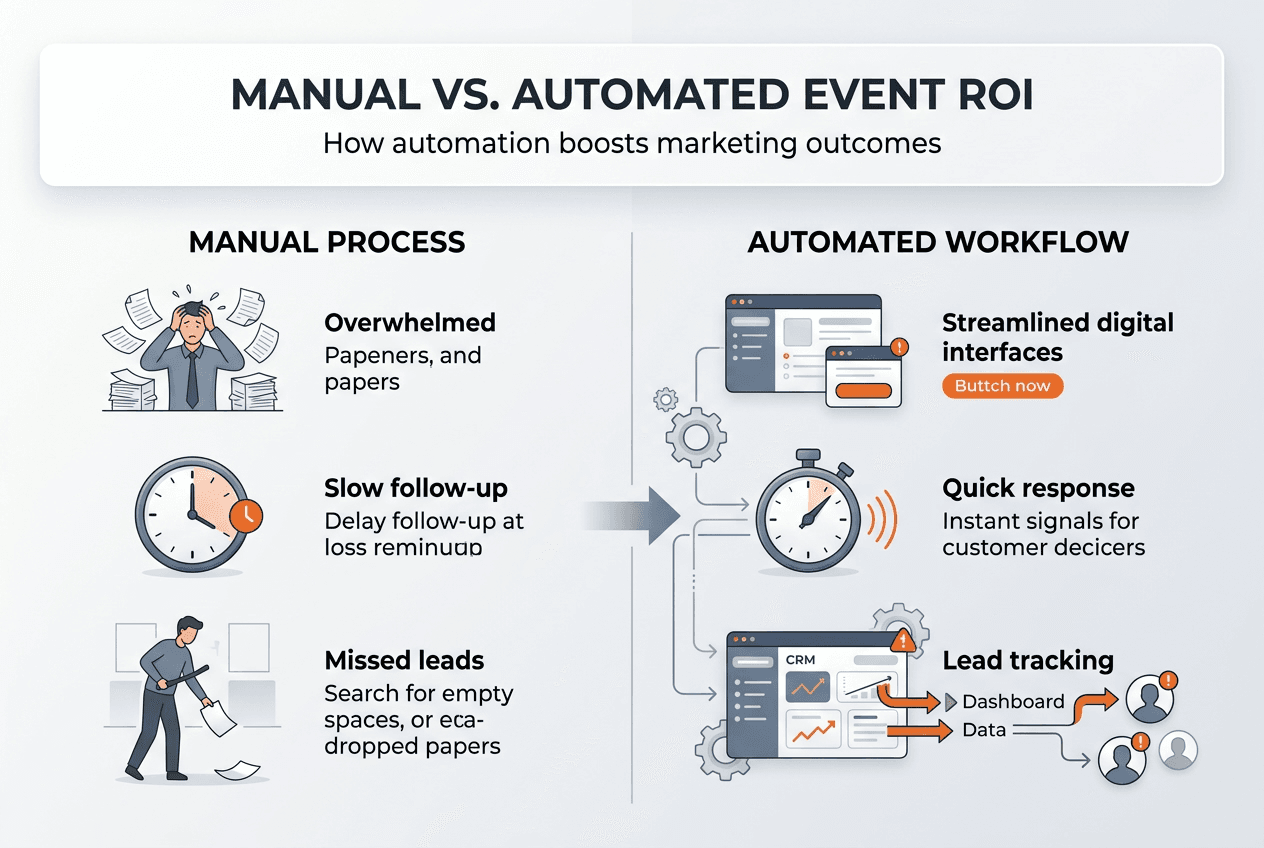
The difference between manual and automated approaches becomes clear when you compare them side by side:
| Aspect | Manual Process | Automated Workflow |
|---|---|---|
| Follow-up speed | 5 to 10 days average | Within 24 hours |
| Lead coverage | 20 to 30% contacted | 100% receive outreach |
| Personalization | Limited by rep capacity | Scaled across all leads |
| Attribution tracking | Fragmented, incomplete | Full journey visibility |
| Resource efficiency | High manual effort | Minimal ongoing maintenance |
Lead scoring plays a critical role in this integrated approach. By incorporating event engagement metrics into your scoring model, you can identify which attendees warrant immediate sales attention versus continued marketing nurture. Someone who attended your product demo, downloaded pricing information, and works at a target account should trigger a high-priority alert to sales.
Pro Tip: Use dynamic scoring models that weight event behaviors differently based on context. Attending a keynote at a large conference signals less intent than requesting a private meeting at your booth. Your automation platform should reflect these nuances in how it prioritizes and routes leads.
The event marketing workflow strategies that drive the best results treat events as ongoing programs rather than one-time activities. You build evergreen nurture streams that incorporate event content, maintain engagement between live events through virtual touchpoints, and use automation to identify when past attendees show renewed interest signals.
This systematic approach finally enables the revenue attribution that has eluded most event programs. When every touchpoint from initial invitation through closed deal exists in your automation platform, you can trace the complete customer journey and assign appropriate credit to event interactions. That visibility transforms events from cost centers with unclear returns into accountable growth channels with measurable impact.
Implementing B2B event lead generation strategies within this integrated framework ensures your events contribute predictably to pipeline rather than generating random activity that may or may not convert.
Common pitfalls in event marketing automation and how to avoid them
Even with automation in place, several common mistakes can undermine your event marketing effectiveness. Recognizing these pitfalls helps you design workflows that actually deliver results rather than simply creating the illusion of progress.
The most damaging error remains failing to follow up promptly and consistently. Despite automation capabilities, some teams still delay launching post-event sequences or send only one or two touchpoints before giving up. This approach wastes the investment in event attendance and allows 73% of leads to disappear without meaningful engagement. Speed matters enormously in event follow-up because attendees evaluate multiple vendors simultaneously and make decisions quickly.
Fragmented data between systems creates another major obstacle. When your event management platform doesn't sync cleanly with your marketing automation system and CRM, you end up with incomplete records, duplicate contacts, and gaps in engagement history. These data quality issues prevent effective segmentation and personalization while making accurate attribution impossible.
Key mistakes to avoid include:
- Generic messaging: Sending identical follow-up emails to all attendees regardless of their specific interests or engagement level reduces relevance and response rates dramatically.
- Vague targeting: Promoting events broadly without ICP focus fills rooms with unqualified attendees who consume resources but rarely convert to opportunities.
- Neglecting nurture: Treating event follow-up as a single email blast rather than a multi-touch sequence that builds relationships over weeks fails to move prospects through the funnel.
- Ignoring scoring: Routing all leads to sales immediately or holding all in marketing indefinitely rather than using behavioral signals to determine readiness wastes time and creates friction.
Pro Tip: Regularly audit your event workflows and data handoffs for gaps. Check that registration data flows correctly, lead scores update based on event behaviors, and sales receives timely alerts for high-intent prospects. Small technical issues can create major leakage if left unaddressed.
The personalization gap represents a particularly insidious problem. Teams implement automation but populate sequences with generic content that could apply to any prospect. True personalization requires tailoring messaging based on the specific sessions someone attended, questions they asked, content they downloaded, and challenges they mentioned. Automation enables this level of customization at scale, but only if you design workflows thoughtfully.
Another common failure involves setting up automation once and never revisiting it. Event programs evolve, buyer behaviors shift, and messaging that worked last year may fall flat today. Successful teams treat their event automation as living systems that require ongoing optimization based on performance data and changing market conditions.
Avoiding these pitfalls requires commitment to post-event engagement optimization as an ongoing discipline rather than a one-time implementation project. The teams that extract maximum value from event marketing view automation as an enabler of better strategy and execution, not a substitute for strategic thinking.
Boost your event marketing ROI with Sandbox solutions
Transforming events from expensive experiments into accountable growth channels requires the right technology foundation and strategic approach. Sandbox specializes in turning high-intent event moments into measurable go-to-market signal that connects directly to pipeline and revenue.
Our platform helps you understand who to follow up with, why they matter, and what to do next by capturing real intent across meetings, content interactions, and live event engagement. We combine opinionated workflows with hands-on execution support, enabling teams to generate demand, accelerate conversions, and prove event ROI with confidence.
Whether you're running your first event program or scaling a flagship conference, Sandbox provides the systems, signal, and support to make events accountable and worth repeating. Explore our event marketing workflow strategies to see how leading B2B teams are leveraging automation to maximize event impact and demonstrate clear returns on their marketing investments.
Frequently asked questions about events in marketing automation
What is the main benefit of integrating events with marketing automation?
Integration creates automated, personalized processes that increase lead conversion and provide ROI transparency. Instead of manual spreadsheets and delayed follow-up, automation ensures every attendee receives timely, relevant outreach based on their specific event behaviors. This systematic approach captures the 73% of leads that typically go uncontacted while enabling accurate attribution from initial touchpoint through closed revenue. You finally gain visibility into which event activities drive actual business outcomes rather than relying on vanity metrics like booth traffic. Implementing post-event engagement optimization through automation transforms events from cost centers into measurable growth channels.
How soon should event follow-up automation be triggered?
Prompt workflows triggered within 24 hours of event close yield the best response rates and conversion outcomes. Speed matters because attendees evaluate multiple vendors simultaneously and make decisions quickly after events end. Delays of even a few days allow competitors to establish relationships while your brand fades from memory. Research shows automated event follow-up sequences improve conversion by 20% compared to manual processes, with much of that lift coming from immediate acknowledgment that reinforces connections while they remain fresh. Your automation platform should send initial touchpoints within hours, then deploy a multi-touch cadence over subsequent weeks that maintains momentum and moves prospects toward sales conversations systematically.
What metrics best prove event marketing ROI?
Focus on lead conversion rates, cost per opportunity, and revenue attribution as your primary indicators of event success. While attendance numbers and booth traffic provide surface-level insights, they don't demonstrate business impact. Track how many event leads convert to opportunities and closed deals, then calculate your cost per converted lead to understand true efficiency. Industry benchmarks show conversion rates from event leads to opportunities typically range between 5% and 10%, giving you a comparison point for your performance. Revenue attribution that traces closed deals back to specific event touchpoints provides the ultimate proof of ROI and justifies continued investment in events as a growth channel.
How can ICP targeting improve event outcomes?
Pre-event focus on your ideal customer profile ensures resources get spent on leads with the highest likelihood to convert rather than filling rooms with unqualified attendees. Identifying and targeting ICP before events proves crucial for improving ROI because it increases the concentration of prospects who have genuine purchase intent, budget authority, and timeline alignment. Instead of broad promotional campaigns that attract casual observers, precision targeting delivers attendees who match your best customer characteristics. This approach may reduce total attendance numbers but dramatically improves conversion rates and revenue per attendee, making events far more efficient and profitable as demand generation channels.
What are common mistakes to avoid in event automation?
The biggest errors include delayed or inconsistent follow-up, generic messaging that ignores attendee-specific behaviors, and poor data integration between event platforms and marketing systems. 73% of leads never receive contact, representing massive lost opportunity that automation should eliminate. Avoid sending identical emails to all attendees regardless of which sessions they attended or content they downloaded. Ensure your event management platform syncs cleanly with your CRM and marketing automation system so engagement data flows accurately and triggers appropriate workflows. Regular audits of your post-event engagement processes help identify gaps where leads leak out of your funnel before reaching sales conversations.
Recommended
- Events in lead generation: B2B success strategies 2026
- Event conversion optimization guide for marketers 2026
- Sandbox-GTM
- Optimize your post-event engagement process for conversions
- Marketing Automation Tools 2026: Boost Efficiency 30% - The data driven marketer
- Marketing Automation ROI for Manufacturers