

Event marketers face a critical challenge: lead generation has dropped to just 27% as a primary objective while networking demands surge. This shift transforms how you must approach post-event engagement. Without a structured follow-up process, your event investments fail to convert attendees into pipeline opportunities. The solution lies in mastering timely, personalized engagement strategies that align with modern buyer expectations. This guide reveals how to build a post-event engagement process that drives measurable conversions, accelerates sales cycles, and maximizes your event ROI through proven multi-channel tactics.
Table of Contents
- Understanding The Shifting Landscape Of B2B Event Objectives
- Preparing For A Successful Post-Event Engagement Process
- Executing The Post-Event Engagement Process For Maximum Impact
- Verifying Results And Optimizing Your Post-Event Engagement Process
- Explore Tools To Enhance Your Post-Event Engagement Process
- FAQ
Key takeaways
| Point | Details |
|---|---|
| Lead generation decline | Only 27% of marketers prioritize lead gen, shifting focus to networking and relationships |
| Timing drives results | Follow-up within 48 hours increases open rates 20-30% and boosts conversions up to 10% |
| Multi-channel advantage | Combining email, social, and calls improves engagement by 40% and lead qualification by 20% |
| CRM integration impact | Connecting event data to CRM systems accelerates sales cycles by 25% |
| Measurement matters | Track engagement rates, conversion metrics, and pipeline velocity to optimize continuously |
Understanding the shifting landscape of B2B event objectives
The traditional playbook for B2B events centered on capturing as many leads as possible. That era has ended. Only 27% of event marketers now claim lead generation as their core objective, down from first place just a few years ago. This dramatic shift reflects changing attendee expectations and market dynamics that demand new post-event strategies.
Networking has emerged as the primary motivator for attendees, fundamentally altering what success looks like. Your post-event engagement process must now prioritize relationship building over transactional lead capture. This means personalizing follow-ups based on genuine interactions rather than generic promotional blasts. The goal shifts from quantity to quality, focusing on meaningful conversations that advance buyer relationships.
Despite these changed priorities, event budgets continue growing. Organizations recognize that events remain powerful growth channels when executed strategically. The key lies in aligning your post-event process with broader go-to-market strategies rather than treating events as isolated campaigns. Sandbox helps teams bridge this gap by connecting event activity directly to pipeline outcomes.
Modern event success requires measuring attendee experience alongside conversion metrics. You need systems that capture engagement signals beyond basic contact information. Consider these evolving priorities:
- Quality of connections formed during the event
- Depth of engagement with content and speakers
- Alignment between attendee interests and your solutions
- Speed and relevance of post-event follow-up
- Integration with existing sales and marketing workflows
This landscape shift demands that you rethink every aspect of post-event engagement. Generic batch emails no longer suffice. You must leverage event data to create personalized, timely touchpoints that respect the networking-first mindset while advancing commercial objectives. The organizations winning in 2026 treat events as integrated growth channels with sophisticated follow-up processes that convert relationships into revenue.
Preparing for a successful post-event engagement process
Effective post-event engagement starts long before your event concludes. Preparation determines whether you capitalize on attendee interest or watch it evaporate. Over 90% of teams prioritize attracting the right audience and enhancing post-event follow-up, yet many lack the systems to execute well. Your preparation phase must address data infrastructure, audience segmentation, and workflow automation.
Start by establishing clear objectives that connect event outcomes to business results. Define what conversion means for your organization: qualified meetings, product trials, partnership discussions, or closed deals. These goals shape your segmentation strategy and follow-up messaging. Without this clarity, your team wastes effort on generic outreach that fails to move prospects through the pipeline.
Audience segmentation forms the foundation of personalized engagement. Group attendees by multiple dimensions:
- Engagement level during the event (sessions attended, booth visits, content downloads)
- Buyer readiness signals (questions asked, product interest expressed)
- Account fit and priority (target accounts, expansion opportunities)
- Role and decision-making authority
- Specific pain points or use cases discussed
Data integration separates high-performing teams from those struggling with manual processes. Integrating event data with CRM systems improves sales cycle velocity by 25% by eliminating delays and enabling immediate action. Ensure your event platform connects seamlessly with your CRM and marketing automation tools before the event begins. This integration allows you to trigger personalized sequences automatically based on attendee behavior.
Plan your multi-channel follow-up sequences in advance. Map out the timing, content, and channels for each audience segment. Your highest-priority accounts deserve customized approaches, while broader segments can receive thoughtful automated sequences. Build templates that allow for personalization without requiring complete rewrites for each contact.
Set measurable KPIs that reflect quality over quantity. Track metrics like response rates, meeting bookings, and pipeline contribution rather than just counting follow-up emails sent. These indicators reveal whether your engagement process actually drives business outcomes. Review event marketing workflows that boost ROI efficiency to understand how leading teams structure their processes.
Pro Tip: Complete your CRM data mapping and test your automation workflows at least one week before the event. This buffer allows you to fix integration issues without compromising your follow-up timing when the event concludes.
Executing the post-event engagement process for maximum impact
Execution speed determines conversion success. Follow-up emails sent within 48 hours increase open rates by 20-30% and conversions up to 10% compared to delayed outreach. Your window of opportunity closes rapidly as attendees return to daily responsibilities and competing priorities. The engagement process you execute immediately after your event makes or breaks your ROI.

Begin with an immediate thank you within the first hour after your event concludes or a session ends. This touchpoint acknowledges the attendee's participation and sets expectations for what comes next. Keep this message brief and focused on appreciation rather than selling. Include a personalized reference to their specific participation, such as a session they attended or a question they asked.
Multi-channel follow-up boosts engagement by up to 40% and improves lead qualification by 20% by meeting prospects where they prefer to communicate. Structure your sequence across these channels:
- Email for detailed content and resources
- LinkedIn for relationship building and social proof
- Direct calls for high-priority accounts
- Retargeting ads to maintain awareness
Personalization transforms generic outreach into relevant conversations. Reference specific interactions from the event: topics discussed at your booth, questions raised during sessions, or interests expressed in surveys. This specificity proves you paid attention and value the individual relationship. Use your CRM data to enrich these insights with account history and previous engagement.
Prioritize your highest-value leads for immediate personal outreach. These accounts deserve customized approaches that go beyond automated sequences. Assign sales team members to reach out directly within 24 hours, armed with context about the prospect's event experience and current business challenges. For these contacts, automation serves as backup rather than the primary touchpoint.
Structure your follow-up sequence in three waves:
- Immediate recap and thank you (within 1 hour to 24 hours)
- Personalized value delivery (24 to 48 hours): Share relevant content, case studies, or tools based on expressed interests
- Next engagement invitation (48 to 72 hours): Offer a demo, consultation, or exclusive resource
The table below illustrates how timing impacts conversion outcomes:
| Follow-up Timing | Open Rate Impact | Conversion Impact | Lead Quality |
|---|---|---|---|
| Within 1 hour | Baseline | Baseline | Highest |
| 24-48 hours | +20-30% | +10% | High |
| 48-72 hours | +10-15% | +5% | Moderate |
| After 72 hours | -40% | -60% | Low |
This data reveals why conversion likelihood drops 60% after 72 hours if no follow-up occurs. Every hour you delay costs you opportunities. Your execution must balance speed with personalization, using automation to ensure timing while customizing content to individual needs.
Explore comprehensive post-event marketing strategies that detail specific tactics for each channel and audience segment. The key lies in maintaining momentum while respecting that relationships, not transactions, drive modern B2B buying. Your follow-up should continue conversations started at the event rather than launching new sales pitches. Learn more about optimizing event marketing workflows for better ROI efficiency to refine your execution approach.
Pro Tip: Automate your initial follow-up sequences but build in manual review points for high-value accounts. This hybrid approach ensures speed without sacrificing the personal touch that closes deals.
Verifying results and optimizing your post-event engagement process
Measurement separates guesswork from strategic improvement. Track KPIs that reveal both engagement quality and business impact. Your metrics should answer whether your post-event process actually drives pipeline growth and revenue, not just activity counts. Focus on engagement rates, conversion percentages, sales cycle velocity, and pipeline contribution from event-sourced opportunities.
Analytics reveal which channels and messages resonate with your audience. Compare performance across email, social media, and direct outreach to identify your most effective tactics. Segment this analysis by audience type: do executives respond better to calls while practitioners prefer email? These insights guide resource allocation for future events and follow-up campaigns.
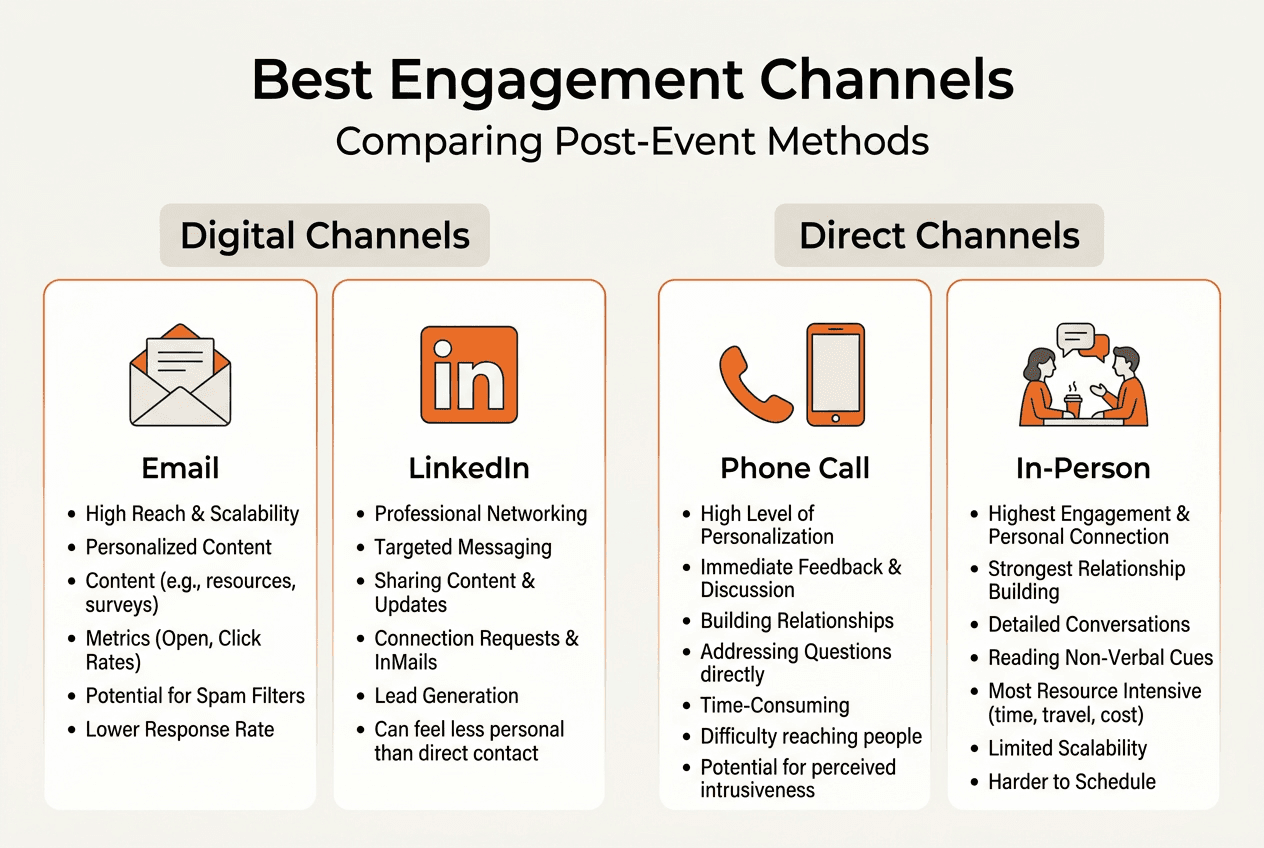
The difference between single-channel and multi-channel approaches becomes clear in your data. Organizations using coordinated sequences across multiple touchpoints consistently outperform those relying on email alone. Engaged attendees are 30% more likely to convert when you maintain consistent, varied contact that reinforces your value proposition without overwhelming prospects.
Beware of common pitfalls that sabotage post-event success:
- Delayed response times that allow competitor outreach to win attention
- Generic messaging that ignores individual attendee interests and interactions
- Failure to integrate event data with CRM, forcing manual processes that slow follow-up
- Treating all attendees identically regardless of engagement level or account priority
- Neglecting to measure and optimize based on actual conversion outcomes
"The speed and relevance of your follow-up determine whether event conversations become business opportunities. Every hour of delay costs you competitive advantage and conversion potential."
High-performing event programs conduct regular reviews to refine their processes. Schedule post-event debriefs within one week to capture fresh insights while data remains accessible. Analyze what worked, what fell short, and how to improve timing, messaging, and technology integration for the next event. This continuous improvement cycle compounds your results over time.
Consider this comparison of engagement metrics by follow-up method:
| Follow-up Method | Average Response Rate | Meeting Conversion | Pipeline Impact |
|---|---|---|---|
| Email only | 12-15% | 3-5% | Low |
| Email + Social | 22-28% | 8-12% | Moderate |
| Multi-channel (Email, Social, Call) | 35-42% | 15-20% | High |
| Personalized multi-channel | 45-55% | 25-30% | Very High |
These benchmarks illustrate why investment in sophisticated follow-up processes pays dividends. The organizations achieving CTA conversion rates up to 69% in high-engagement webinars and hybrid events share common traits: they act quickly, personalize extensively, and measure relentlessly.
Your optimization process should also examine technology effectiveness. Does your current stack enable the speed and personalization your strategy requires? Gaps in integration or automation capabilities limit your team's ability to execute at scale. Sandbox provides the infrastructure to capture event signals and transform them into actionable follow-up workflows that connect directly to revenue outcomes.
Pro Tip: Create a standardized scorecard that tracks the same metrics across all events. This consistency enables meaningful comparisons and reveals trends that inform strategic decisions about event investment and follow-up resource allocation.
Explore tools to enhance your post-event engagement process
The right technology transforms post-event follow-up from a manual scramble into a systematic growth engine. Integrated platforms accelerate your response time, enrich your data for better targeting, and automate workflows while preserving personalization. These capabilities directly impact your conversion rates and pipeline velocity.
Sandbox helps event teams capture high-intent signals and convert them into measurable outcomes. Our platform connects event activity to your CRM and go-to-market workflows, ensuring no opportunity slips through the cracks. You gain visibility into who attended, what they engaged with, and how to prioritize your follow-up for maximum impact. This intelligence enables your sales team to have informed, relevant conversations that advance deals rather than generic pitches that waste everyone's time.
Explore how event marketing workflows boost ROI efficiency when supported by purpose-built technology. The organizations scaling successful event programs rely on systems that treat events as first-class growth channels, not logistics exercises. Sandbox provides the infrastructure, insights, and execution support to make your events accountable and worth repeating.
FAQ
What is the ideal timing to start post-event follow-up?
Begin your follow-up within the first hour to 48 hours after your event concludes for optimal conversion results. This window captures attendee interest while your event remains top of mind. Delays beyond 72 hours reduce conversion likelihood by 60%, making timing your most critical success factor.
How can I personalize follow-ups effectively after an event?
Reference specific attendee interactions such as sessions attended, questions asked, or topics discussed at your booth in every communication. Combine event data with existing CRM insights to tailor your messaging and offers to individual needs. This specificity proves you value the relationship beyond generic promotional outreach.
Which channels work best for post-event engagement?
Use a multi-channel approach combining email for detailed content, LinkedIn for relationship building, direct calls for high-priority accounts, and retargeting ads for awareness. This coordinated strategy increases engagement by up to 40% compared to single-channel outreach. Match channel selection to audience preferences and account priority for best results.
How do I measure the success of my post-event engagement process?
Track engagement rates, conversion percentages, sales cycle velocity, and pipeline contribution from event-sourced opportunities as your primary KPIs. Analyze channel effectiveness and message performance to identify what resonates with your audience. Regular measurement enables continuous optimization that compounds your event ROI over time.