

Many event marketers assume conversion optimization is just about tweaking registration forms or sending more emails. The reality is far more strategic. Event conversion optimization involves systematically using data-driven methods to boost every critical metric: registrations, attendance, engagement, and lead quality. This guide explains what event conversion optimization is, why it matters in 2026, and how to apply core techniques that deliver measurable results for your events.
Table of Contents
- Understanding Event Conversion Optimization: Definition And Importance
- Core Strategies And Metrics For Event Conversion Optimization
- A/B Testing And Technology Use In Conversion Optimization
- Practical Applications And Optimization Tips For 2026 Event Marketers
- Improve Your Event Marketing With Sandbox-GTM
- Frequently Asked Questions
Key takeaways
| Point | Details |
|---|---|
| Event conversion optimization uses testing and analytics | Systematic methods improve registrations, engagement, and lead generation through data-driven decisions. |
| Core metrics include segmented conversion rates | Track lead conversion, MQL rate, SQL rate, and opportunity rate by audience segment and channel. |
| A/B testing requires methodical execution | Test single variables, wait for statistical significance, and run tests through full business cycles. |
| Small strategic changes yield big results | Optimizing call-to-action placement, timing, or messaging can significantly boost attendance and conversions. |
| High-ROI channels outperform mass media | Targeted digital ads, personalized emails, and influencer partnerships deliver better returns than broad campaigns. |
Understanding event conversion optimization: definition and importance
Event conversion optimization is the methodical process of improving key event metrics through analytics and testing. You're not guessing what works. You're using data to systematically boost registrations, increase attendance, enhance engagement, and generate higher quality leads. This approach transforms events from cost centers into accountable revenue drivers.
Why do conversion rates matter so much? Because they directly impact your event marketing ROI and growth trajectory. A 10% improvement in registration conversion can mean hundreds of additional attendees. Better lead quality translates to faster sales cycles and higher close rates. When you optimize conversions, you maximize the return on every dollar spent promoting your event.
A/B testing is a foundational conversion rate optimization best practice for event marketers. This technique lets you compare two versions of an event component to see which performs better. You might test different email subject lines, registration page layouts, or call-to-action buttons. The key is changing one element at a time so you know exactly what drove the improvement.
Here's the surprising part: small, strategic changes can lead to significant increases in event attendance and engagement. Moving a registration button higher on the page, changing the color of a call-to-action, or adjusting email send times can boost conversions by 20% or more. These aren't massive overhauls. They're precise, data-backed tweaks that compound over time.
Essential event components you can optimize include:
- Event landing pages and registration flows
- Promotional email campaigns and sequences
- Digital ad creative and targeting parameters
- Social media messaging and posting schedules
- Post-event follow-up and post-event engagement process conversions
Each component offers opportunities to test, measure, and improve. The goal is creating a systematic optimization framework that continuously enhances performance across your entire event marketing funnel.
Core strategies and metrics for event conversion optimization
Measuring the right metrics is fundamental to optimization success. Start with lead conversion rate, calculated as new leads created divided by attendees or registrants. This primary metric tells you how effectively your event generates business opportunities. Beyond this baseline, track MQL rate (marketing qualified leads), SQL rate (sales qualified leads), and opportunity rate to understand funnel progression.

Segmentation transforms generic metrics into actionable insights. Compute core metrics by segment using operational cuts like day and time, session topic, speaker tier, booth staffing level, and dwell time bands. This granular view reveals which event elements drive the best conversions. You might discover that Tuesday afternoon sessions generate 40% more qualified leads than morning slots, or that certain speaker topics attract higher quality prospects.
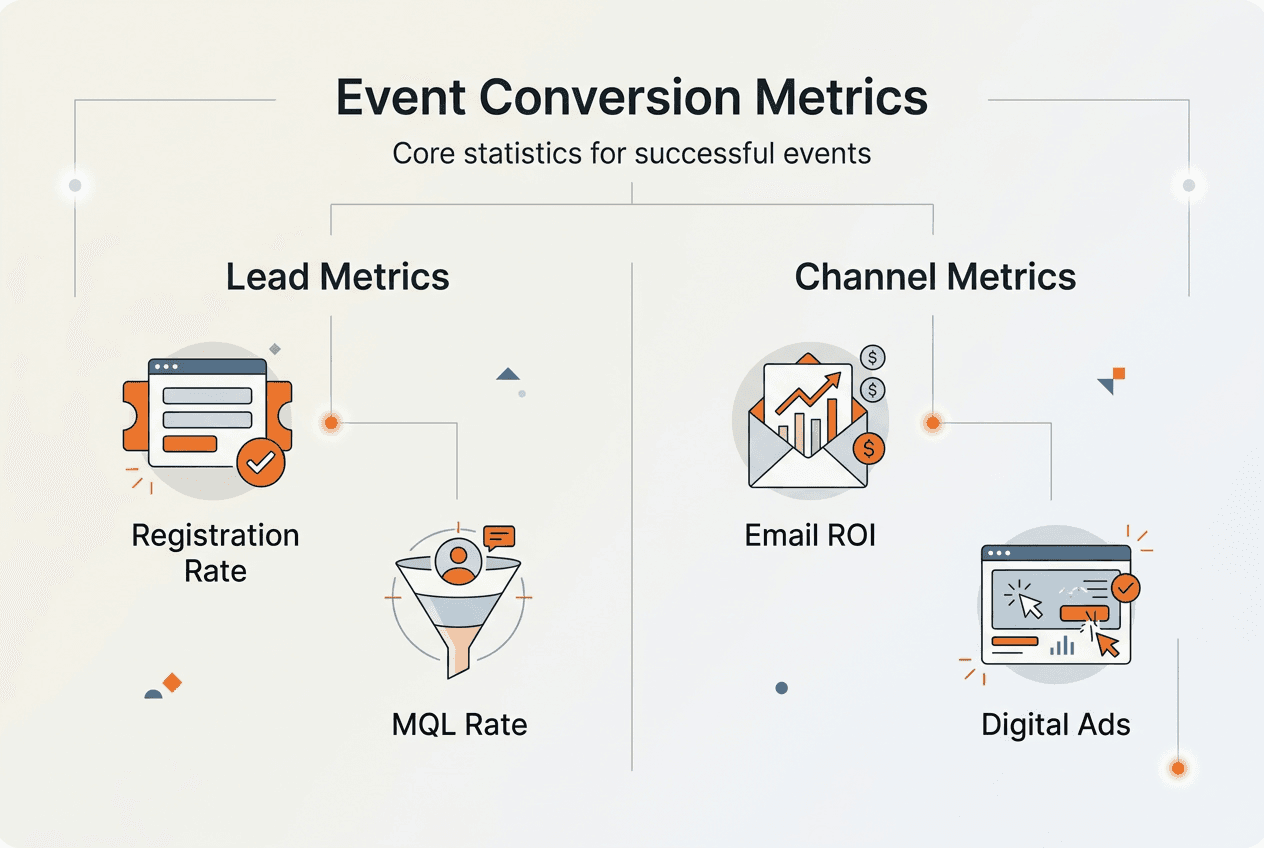
Here's a sample breakdown showing how metrics vary by channel:
| Channel | Lead Conversion Rate | MQL Rate | SQL Rate | Cost Per Lead |
|---|---|---|---|---|
| Targeted Digital Ads | 18% | 45% | 22% | $42 |
| Email Campaigns | 24% | 52% | 28% | $18 |
| Influencer Partnerships | 21% | 48% | 25% | $35 |
| Organic Social | 12% | 38% | 15% | $8 |
| Mass Media | 6% | 22% | 8% | $95 |
This data table illustrates why channel selection matters. Email campaigns deliver the highest lead conversion and MQL rates at the lowest cost per lead. Mass media reaches broad audiences but converts poorly and costs significantly more per lead. Smart event marketers allocate budget toward proven high-ROI channels.
Measuring lead quality requires tracking funnel progression beyond initial conversion. How many event leads become opportunities? What's the average deal size? How long is the sales cycle? These B2B success lead conversion metrics help you identify bottlenecks and optimize for revenue, not just volume.
Strategies for maximizing conversion include:
- Deploying targeted digital ads with audience segmentation based on firmographics and intent signals
- Building influencer partnerships that lend credibility and extend reach to qualified audiences
- Personalizing email sequences based on recipient behavior, industry, and engagement history
- Creating urgency through limited-time offers and early-bird pricing tiers
- Optimizing registration forms to reduce friction while capturing essential qualification data
Pro Tip: Set up automated alerts when key metrics dip below thresholds. If your registration conversion rate drops 15% week over week, you need to investigate immediately. Real-time monitoring through post-event engagement optimization lets you course correct before small problems become major losses.
A/B testing and technology use in conversion optimization
Successful A/B testing relies on a structured process that removes guesswork and delivers reliable results. Follow these five steps to implement testing systematically:
- Form a clear hypothesis based on data or user behavior insights, stating what you expect to improve and why
- Select appropriate testing tools that integrate with your event platform and provide statistical rigor
- Split traffic randomly and evenly between control and variant to ensure valid comparisons
- Run tests through complete business cycles, typically two to four weeks for event campaigns
- Focus on changing a single variable so you can attribute performance differences to that specific element
Waiting for statistical significance is crucial. Stopping tests early because one variant looks better leads to false conclusions. You need enough data to be confident the results aren't random chance. Most testing platforms calculate this automatically, but understand that smaller traffic volumes require longer test durations.
Advanced personalization technology amplifies optimization efforts. Ticketek achieved a 250% conversion rate uplift using Amazon Personalize, a machine learning service that delivers individualized event recommendations. The system analyzes user behavior patterns to suggest events each person is most likely to attend. This level of personalization dramatically outperforms generic messaging.
The technology advantage extends beyond personalization engines. Analytics platforms, heat mapping tools, and attribution software help you understand user behavior at granular levels. You can see exactly where people drop off in registration flows, which email links generate clicks, and what ad creative drives qualified traffic.
Businesses with comprehensive tracking have a 3.2x higher test win rate compared to those with basic analytics.
This statistic from the CRO analytics guide 2026 underscores why robust measurement infrastructure matters. When you track user interactions across touchpoints, you identify optimization opportunities competitors miss. You understand the complete customer journey from first ad impression through event attendance and post-event conversion.
Pro Tip: Prioritize analytics implementation before launching major testing programs. Install proper tracking on all event pages, emails, and ads. Tag campaigns consistently so you can attribute conversions accurately. The investment in analytics infrastructure pays dividends through better test design and faster insight generation. Strong tracking also supports B2B lead generation strategies that connect event activity to pipeline and revenue.
Technology choices should align with your testing maturity. Start with built-in A/B testing features in your email platform and event software. As you gain experience, graduate to dedicated optimization platforms that offer multivariate testing, audience segmentation, and advanced statistical analysis.
Practical applications and optimization tips for 2026 event marketers
Experienced event marketers consistently improve their ROI by learning from every campaign and adjusting their playbook accordingly. Continuous learning isn't optional in 2026. Market conditions shift, audience preferences evolve, and competitive dynamics change. Your optimization process must adapt.
Channel selection dramatically impacts results. High-ROI channels like targeted digital ads, email, and influencer partnerships often outperform mass-media spends. Here's a direct comparison:
| Factor | High-ROI Channels | Mass Media Channels |
|---|---|---|
| Targeting Precision | Granular audience segmentation | Broad demographic reach |
| Cost Efficiency | $15-45 per qualified lead | $75-150 per qualified lead |
| Measurability | Full attribution tracking | Limited conversion tracking |
| Optimization Speed | Real-time adjustments | Slow campaign changes |
| Personalization | Dynamic content by segment | Generic messaging |
This comparison reveals why savvy marketers shift budget toward digital channels. The ability to target precisely, measure accurately, and optimize quickly creates compounding advantages.
Practical optimization tips for immediate application:
- Craft a clear value proposition that answers "why attend" in the first five seconds of page load
- Segment messaging by industry, role, and pain point rather than using one-size-fits-all communications
- Pace campaigns with distinct waves: early teaser content, mid-cycle value education, and late-stage urgency messaging
- Monitor metrics weekly and adjust underperforming elements before campaigns end
- Test registration form length, finding the balance between qualification data and conversion friction
- Use social proof like attendee testimonials and speaker credentials to build credibility
- Implement retargeting for site visitors who didn't register, addressing specific objections
Pro Tip: Segment audiences precisely to tailor messaging and boost conversion rates. A generic "join us" message converts far worse than "see how companies like yours reduced customer churn 30%" targeted to retention-focused roles. Precision messaging through event marketing workflows boost roi efficiency by speaking directly to specific needs.
Common pitfalls to avoid based on 2026 data:
- Launching campaigns without clear success metrics and tracking infrastructure in place
- Changing multiple variables simultaneously, making it impossible to identify what worked
- Stopping optimization efforts after the event instead of measuring post-event conversion and revenue
- Ignoring mobile experience when 60% of event research happens on smartphones
- Failing to test email send times, missing optimal engagement windows by hours
- Using vanity metrics like impressions instead of focusing on qualified lead generation
- Neglecting post-event follow-up sequences that convert attendees into customers
The most successful event marketers treat optimization as an ongoing discipline, not a one-time project. They build testing calendars, document learnings, and systematically improve every campaign element. This commitment to continuous improvement separates top performers from those who plateau.
Improve your event marketing with Sandbox-GTM
Applying these conversion optimization principles requires the right infrastructure and workflows. Sandbox-GTM offers streamlined event marketing workflows designed to maximize ROI and improve conversion efficiency across your entire event program. Our platform treats events as a first-class growth channel, not a logistics exercise.

Sandbox helps you understand who to follow up with, why they matter, and what to do next by capturing real intent across meetings, content, and live interactions. The system combines opinionated GTM workflows with hands-on execution, helping you generate demand, accelerate conversions, and connect event activity directly to pipeline and revenue.
Key features that support conversion optimization:
- User-friendly interface that reduces implementation time and training requirements
- Real-time analytics dashboard tracking lead conversion, engagement, and funnel progression
- Multi-channel campaign support integrating email, ads, social, and event platforms
- Automated workflow triggers based on attendee behavior and engagement signals
Pro Tip: Leverage event marketing workflows boost roi efficiency to operationalize your optimization learnings. When you discover that Tuesday afternoon sessions generate better leads, build that insight into automated scheduling and promotion workflows. Systematic improvements compound over time.
Whether you're running your first program or scaling a flagship conference, Sandbox-GTM provides the systems, signal, and support to make events accountable and worth repeating. The platform helps you move from gut-feel event marketing to data-driven optimization that delivers measurable business results.
Frequently asked questions
What is event conversion optimization?
Event conversion optimization is the systematic process of improving event-related metrics like registrations, attendance, engagement, and lead quality through testing and analytics. Instead of guessing what works, you use data to make informed decisions that boost performance across your event marketing funnel.
How does A/B testing fit into event optimization efforts?
A/B testing lets you compare two versions of an event component to determine which performs better. You might test different email subject lines, registration page layouts, or call-to-action buttons. By changing one variable at a time and measuring results, you identify specific improvements that increase conversions.
How do lead conversion rates help measure event success?
Lead conversion rate, calculated as new leads divided by attendees, tells you how effectively your event generates business opportunities. Tracking this metric alongside MQL rate, SQL rate, and opportunity rate reveals funnel health and helps you optimize for revenue, not just attendance volume.
How does segmentation enhance targeted messaging and conversions?
Segmentation allows you to tailor messaging by industry, role, pain point, and behavior rather than using generic communications. Precise targeting through post-event engagement optimization dramatically improves conversion rates because you're addressing specific needs and challenges relevant to each audience segment.
When should I start conversion optimization efforts in the event marketing cycle?
Start optimization during the planning phase, not after launch. Build tracking infrastructure first, then test promotional elements as you develop campaigns. Early optimization of registration pages, email sequences, and ad creative sets a strong foundation. Continue testing and refining through the event and into post-event follow-up to maximize total program ROI.