

TL;DR:
- Attendee segmentation significantly improves event follow-up engagement and conversion rates.
- Frameworks include firmographic, psychographic, and behavioral data for targeted messaging.
- Automating segmentation enhances post-event pipeline growth and demonstrates ROI to leadership.
Most B2B marketers invest heavily in events but walk away with a list of names and no real plan. The difference between a forgettable event and one that drives measurable pipeline often comes down to one overlooked tactic: attendee segmentation. Segmented campaigns yield 100% more clicks, 29% higher opens, and 41% higher CTRs compared to generic outreach. Yet most teams still send the same follow-up email to every attendee. This article breaks down what segmentation actually means for event marketing, which frameworks work best, and how to turn attendee data into real revenue outcomes.
Table of Contents
- The case for segmenting event attendees
- Segmentation frameworks and attendee data strategies
- Proving ROI and maximizing post-event engagement
- Practical steps to implement attendee segmentation
- Why segmenting event attendees is the hidden growth lever most marketers ignore
- Unlock event ROI with smarter segmentation workflows
- Frequently asked questions
Key Takeaways
| Point | Details |
|---|---|
| Segmentation drives success | Event attendee segmentation leads to much higher email engagement and ROI. |
| Data unlocks targeting | Leveraging firmographic, psychographic, and behavioral data empowers smarter outreach. |
| Automation streamlines action | CRM tools automate personalized follow-up and segment accuracy for greater efficiency. |
| Post-event follow-up matters | Segmented outreach immediately after events boosts conversions and long-term engagement. |
The case for segmenting event attendees
Attendee segmentation means dividing your event audience into meaningful groups based on shared characteristics, behaviors, or intent signals. Instead of sending one message to everyone, you tailor follow-up to what each group actually cares about. It sounds simple. Most teams still don't do it well.
Generic follow-up is one of the most expensive mistakes in event marketing. When you send the same email to a first-time attendee and a returning customer, you're essentially ignoring what you already know about them. That disconnect shows up in your metrics immediately. Low open rates, poor click-through rates, and minimal conversion are often symptoms of a one-size-fits-all approach, not a weak offer.
The numbers tell a clear story. Segmented campaigns yield dramatically improved email engagement and attendance results across the board. When you match the message to the audience, relevance goes up and so does response.
"Segmented email campaigns generate 100% more clicks and 41% higher click-through rates than non-segmented campaigns. That's not a marginal gain. It's a fundamental shift in what's possible."
Here's what poor segmentation actually costs you:
- 📉 Lower open rates because subject lines don't speak to the recipient's specific role or interest
- 🚫 Wasted follow-up effort on attendees who aren't ready to buy or aren't a fit
- 📊 Distorted ROI data because you can't isolate what worked for which audience
- 🔁 Missed re-engagement opportunities with high-intent attendees who needed a different message
If you want to explore segmentation tips for marketing ROI, the foundation starts with understanding who attended and why. From there, you can personalize event outreach in ways that feel relevant rather than automated.
The shift from generic to segmented follow-up isn't just a messaging upgrade. It's a strategic decision that changes how you measure and prove event value.
Segmentation frameworks and attendee data strategies
There are three primary frameworks that event marketers use to segment attendees effectively. Each one adds a different layer of precision to your targeting.
Firmographic segmentation groups attendees by company characteristics: industry, company size, revenue range, or geography. This is the most common starting point and works well for identifying which accounts are enterprise-level versus SMB.
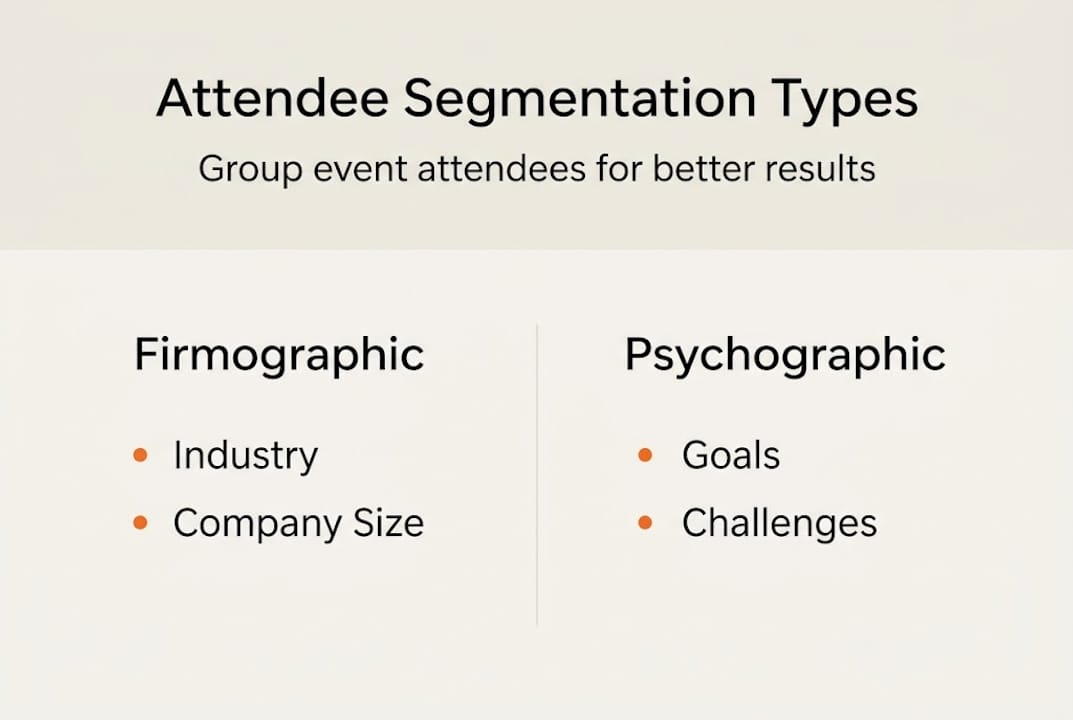
Psychographic segmentation goes deeper, grouping people by their goals, challenges, and motivations. An attendee who came to your session on cost reduction has different needs than one who attended your product innovation panel. Same event, very different intent.
Behavioral segmentation is the most powerful. It tracks what attendees actually did: which sessions they attended, which content they downloaded, who they met with, and how long they stayed. This is real intent data, and it's what separates high-performing follow-up from noise.
One of the clearest indicators of segmentation impact comes from registration strategy. Dynamic registration converts at 24.4% vs 11.6% static, meaning adaptive registration flows that respond to user input more than double conversion rates.
| Registration type | Conversion rate | Key advantage |
|---|---|---|
| Static registration | 11.6% | Simple to set up |
| Dynamic registration | 24.4% | Adapts to attendee input, captures richer data |
Here's a practical process for building data-driven segments:
- Define your segment criteria before the event. Decide which firmographic, psychographic, and behavioral signals matter most for your follow-up goals.
- Build your registration form to capture the data you need. Ask about role, company size, and primary challenge.
- Layer in behavioral data during the event. Track session attendance, booth visits, and content interactions.
- Score and rank attendees post-event based on engagement depth and fit.
- Map each segment to a follow-up track with tailored messaging and timing.
Pro Tip: Don't stop at job title and company size. Behavioral signals like which sessions an attendee chose or which demo they requested tell you far more about purchase intent than demographics alone. Pair event marketing automation benefits with your segmentation strategy to keep data flowing into the right workflows automatically. A solid event conversion optimization guide can help you connect these signals to measurable outcomes.
Proving ROI and maximizing post-event engagement
Segmentation doesn't just improve messaging. It directly improves the numbers that matter most to leadership: attendance rates, conversion rates, and pipeline contribution.

High-performing programs run 25 events a year with 52% attendance. That attendance rate isn't accidental. It reflects consistent, relevant communication with the right audiences before and after each event.
| Metric | Unsegmented approach | Segmented approach |
|---|---|---|
| Email open rate | ~18% | ~47% |
| Click-through rate | ~2.5% | ~3.5% to 4.5% |
| Post-event attendance | Below 30% | Above 50% |
| Lead-to-opportunity rate | Low | Significantly higher |
The gap between these two columns represents real revenue. When you follow up with the right message at the right time for the right audience, conversion rates climb and sales cycles shorten.
Here are the best practices for post-event follow-up that actually converts:
- ✅ Follow up within 24 hours for high-intent attendees who attended key sessions or requested demos
- 🎯 Customize subject lines by segment. A VP of Sales and a Marketing Manager need different hooks
- 📋 Reference specific interactions from the event. Mention the session they attended or the question they asked
- 🔄 Use marketing automation for events to trigger segment-specific sequences without manual effort
- 📈 Track engagement by segment so you can see which groups convert and refine your approach over time
Pro Tip: Automate your segmentation logic inside your CRM before the event ends. Set up rules that assign attendees to follow-up tracks based on their registration data and behavioral signals. This removes the manual bottleneck and ensures no high-intent attendee falls through the cracks. A strong follow-up process for max ROI and a focus on post-event engagement for conversions make the difference between events that generate pipeline and events that generate spreadsheets.
Practical steps to implement attendee segmentation
Knowing segmentation matters is one thing. Building the system to do it consistently is another. Here's how to move from theory to execution.
- Audit your current data collection. Look at what your registration form actually captures. If it's just name, email, and company, you're starting with almost nothing useful for segmentation.
- Add intent-revealing questions. Ask registrants about their primary challenge, their role in the buying process, or what outcome they're hoping to get from attending.
- Connect your event platform to your CRM. Data that lives only in your event tool is data you can't act on. Integration is non-negotiable.
- Assign segment tags during the event. Use check-in data, session scans, and interaction logs to update attendee records in real time.
- Build follow-up tracks before the event. Don't wait until it's over to figure out what you'll say. Map your segments to messaging in advance so execution is fast.
- Review and refine after each event. Which segments converted? Which messages got the best response? Use that data to sharpen your approach for the next program.
Common pitfalls to avoid:
- Over-segmenting too early. If you create 12 micro-segments for a 200-person event, you'll spend more time managing lists than closing deals. Start with 3 to 5 meaningful groups.
- Ignoring data quality. Segments are only as good as the data behind them. Dirty data leads to misrouted follow-up and missed opportunities.
- Treating segmentation as a one-time task. Attendee behavior evolves. Someone who was cold at the event might become warm two weeks later. Your segments should update accordingly.
Pro Tip: Use automation to maintain segment accuracy over time. Set up triggers in your CRM that move contacts between segments based on new behaviors, like opening a follow-up email or visiting your pricing page after the event. Pair this with segmentation tips for marketing ROI and a repeatable event follow-up process to build a system that compounds results across every event you run.
Segmentation improves event follow-up effectiveness and engagement at every stage of the post-event journey. The teams that treat it as a core workflow, not an afterthought, are the ones consistently proving event ROI to leadership.
Why segmenting event attendees is the hidden growth lever most marketers ignore
Here's something most event marketing guides won't tell you: the majority of teams treat segmentation as a nice-to-have. They plan the event, execute the logistics, and then send a single follow-up email to everyone on the list. The results are predictably average.
We've seen what happens when segmentation is skipped. High-intent attendees get the same generic message as someone who barely engaged. Sales follows up with no context. The event generates activity but not pipeline. And leadership questions whether events are worth the budget.
The uncomfortable truth is that segmentation isn't a marketing tactic. It's a revenue decision. When you know who attended, what they cared about, and how they engaged, you have everything you need to make follow-up feel personal and timely. That's what drives conversion.
Tracking event metrics for smarter marketing is how you build the case internally. But segmentation is how you actually deliver the results that make those metrics worth reporting. The teams winning at events in 2026 aren't running more events. They're running smarter ones.
Unlock event ROI with smarter segmentation workflows
Segmentation is only as powerful as the system behind it. Knowing your segments matters. Acting on them at scale is what drives results. 🚀
Sandbox is built for exactly this. Our platform captures real intent signals across meetings, content, and live event interactions, then connects those signals to event marketing workflows that help your team follow up faster and smarter. We help you move from a list of attendees to a prioritized pipeline of opportunities, with the context your sales team needs to convert. If you're ready to make every event accountable, explore what the Sandbox-GTM platform can do for your next program.
Frequently asked questions
What is event attendee segmentation?
Event attendee segmentation is dividing your audience into meaningful groups based on data to deliver tailored follow-up and drive higher engagement. Segmented email campaigns yield more engagement than generic outreach at every stage of the event journey.
How does segmentation impact event ROI?
Segmentation increases open rates, click-through rates, and converts more attendees, leading directly to improved event ROI. Segmented campaigns yield 100% more clicks, 29% higher opens, and 41% higher CTRs compared to non-segmented outreach.
What types of data help segment attendees?
Firmographics, psychographics, behavioral data, and responses from event registration or surveys all strengthen attendee segmentation. Dynamic registration converts at much higher rates because it captures richer intent data from the start.
Can CRM tools automate segmentation?
Yes, modern CRM and marketing platforms can automate segment creation and targeted follow-up for more effective event campaigns. Explore the key benefits of event marketing automation to see how automation supports scalable segmentation.
What's the biggest mistake in attendee segmentation?
The most common mistake is relying only on basic demographics and missing behavioral or intent signals. Going beyond job title to track session attendance and content interactions gives you a far more accurate picture of who is ready to buy.