

Most event marketers walk away from conferences and webinars with a gut feeling about success, but intuition rarely translates into budget approvals or strategic pivots. The difference between guessing and knowing lies in event metrics. These data points reveal not just who showed up, but who engaged, converted, and delivered real pipeline value. Understanding why tracking event engagement matters transforms events from expensive experiments into accountable growth channels. This guide breaks down which metrics to track, how to use them strategically, and why they are essential for proving ROI and refining your marketing approach.
Table of Contents
- Key Takeaways
- The role of event metrics in marketing strategy
- Core event metrics every marketer should track
- Using event metrics to enhance ROI and campaign effectiveness
- Best practices and tools for tracking event metrics efficiently
- Explore Sandbox to elevate your event metrics strategy
- Frequently asked questions about event metrics
Key Takeaways
| Point | Details |
|---|---|
| Metrics link ROI | Tracking metrics connects event activity to revenue outcomes and justifies budget decisions. |
| Engagement signals intent | Higher engagement and conversion metrics indicate stronger attendee intent and guide follow up. |
| Prioritize three to five metrics | Start with a handful of core metrics aligned to your goal to reduce noise and focus actions. |
| Optimize campaigns with data | Use insights to refine messaging, allocate budget, and improve follow up workflows. |
The role of event metrics in marketing strategy
Event metrics are the key data points you collect to evaluate how well your events perform against defined goals. They go far beyond headcount. Think registration rates, session engagement, booth interactions, content downloads, meeting bookings, and post-event conversions. Each metric tells part of the story about attendee behavior and intent.
These metrics fall into several categories. Attendance metrics measure who registered and who actually showed up. Engagement metrics track interactions like questions asked, polls answered, or booth visits. Conversion metrics capture lead quality, demo requests, or sales meetings booked. Intent data reveals which sessions attendees prioritized, signaling buying interest. Together, these categories paint a complete picture of event impact.
Why does this matter for your overall marketing strategy? Metrics help you identify what resonates with your audience and what falls flat. If a webinar topic drives high registration but low attendance, you know the promise did not match expectations. If booth traffic spikes but follow-up meetings stay flat, your messaging or qualification process needs work. Event conversion optimization depends on this clarity.
The benefits extend across your entire marketing operation:
- Better decisions rooted in evidence rather than assumptions
- Smarter budget allocation toward high-performing event types and channels
- Campaign refinement based on what actually drives pipeline, not what sounds good in planning meetings
- Clear accountability that links event spend to revenue outcomes
Pro Tip: Start with three to five core metrics aligned to your event goals. Tracking everything creates noise. Focus on the data that directly informs your next action, whether that is adjusting messaging, reallocating budget, or changing follow-up workflows.
Core event metrics every marketer should track
Not all metrics carry equal weight. The ones you prioritize depend on your event objectives, but certain metrics prove universally valuable for understanding performance and guiding improvements.
Registration rate measures how many people sign up compared to how many were invited or exposed to your promotion. A low rate signals weak messaging or poor targeting. Attendance rate compares registrants to actual participants. A significant drop-off indicates friction in the experience or competing priorities. Engagement rate tracks active participation during the event, such as chat messages, poll responses, or session attendance. High engagement correlates with stronger intent and better conversion potential.

Lead quality assesses how well attendees match your ideal customer profile. Are you attracting decision makers or tire kickers? Conversion rate captures how many attendees take a desired next step, like booking a demo, requesting a proposal, or entering your sales pipeline. This metric ties event activity directly to business outcomes.
| Metric | How to measure | Why it matters |
|---|---|---|
| Registration rate | Registrations divided by invitations sent or ad impressions | Reveals campaign appeal and targeting accuracy |
| Attendance rate | Attendees divided by registrations | Identifies friction or disengagement before the event |
| Engagement rate | Active interactions divided by total attendees | Signals content relevance and audience intent |
| Lead quality score | Percentage of attendees matching ICP criteria | Ensures you attract the right prospects, not just volume |
| Conversion rate | Post-event actions divided by attendees | Connects event effort to pipeline and revenue impact |
Prioritizing metrics requires a structured approach. Follow this process:
- Define your event goal clearly, such as generating qualified leads, accelerating existing opportunities, or building brand awareness.
- Identify which metrics directly measure progress toward that goal.
- Establish baseline performance from past events or industry benchmarks.
- Track those priority metrics consistently across all events to enable comparison.
- Review results within 48 hours post-event to capture insights while context is fresh.
Marketing teams using event marketing automation benefits can track these metrics automatically, reducing manual work and improving data accuracy. Automation also enables real-time dashboards that surface trends as events unfold, allowing you to adjust on the fly.
Pro Tip: Balance quantitative metrics with qualitative feedback. Post-event surveys asking what attendees valued most or found confusing add context that numbers alone cannot provide. Combine both for a fuller picture of event performance.
Using event metrics to enhance ROI and campaign effectiveness
Tracking metrics means nothing if you do not act on what the data reveals. The real power emerges when you use event metrics to refine targeting, sharpen messaging, and optimize follow-up workflows. Continuous tracking creates a feedback loop that compounds improvements over time.
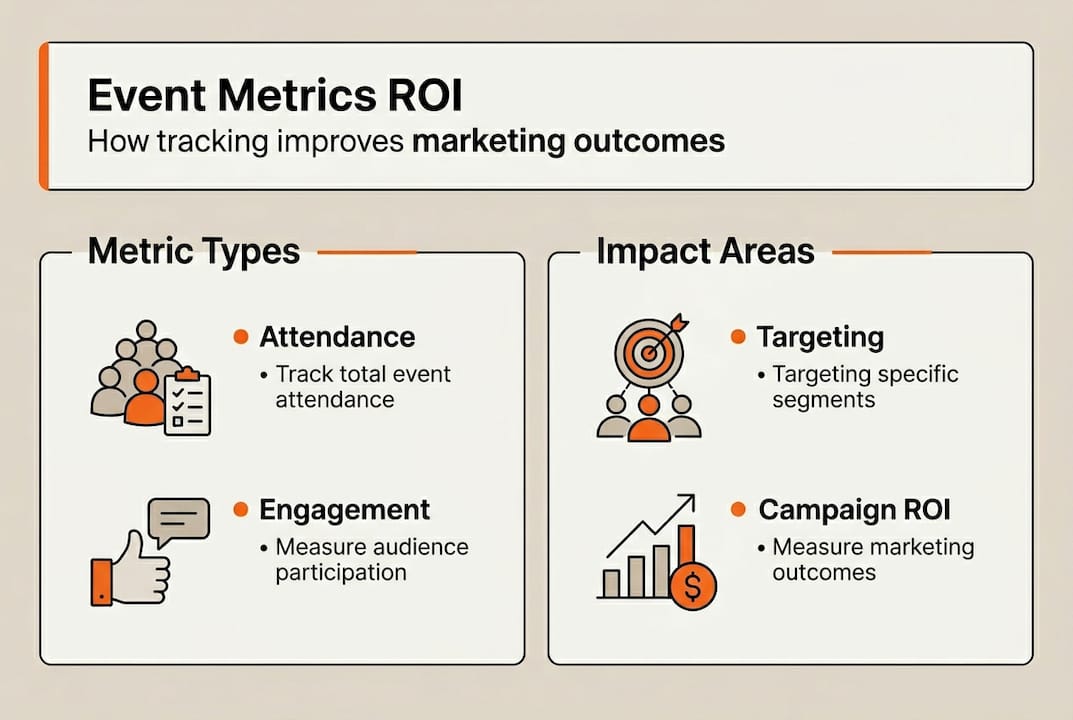
Consider how metrics improve targeting. If data shows that mid-market companies convert at three times the rate of enterprise accounts, you can shift promotion budgets toward that segment. If certain job titles engage deeply but rarely convert, you might adjust content to address their specific pain points or route them to nurturing campaigns instead of immediate sales outreach.
Messaging also sharpens with metric-driven insights. Session attendance data reveals which topics resonate most. If a session on ROI measurement draws twice the audience of a product demo, you know where interest lies. Post-event surveys combined with engagement metrics show whether your value proposition landed or confused attendees. Use this intelligence to refine pitch decks, booth messaging, and follow-up emails.
Integrating metrics into your workflows ensures insights translate into action:
- Automate lead scoring based on engagement levels, prioritizing high-intent attendees for immediate sales follow-up
- Trigger personalized email sequences based on which sessions attendees joined or content they downloaded
- Update CRM records with event participation data to give sales teams context before outreach calls
- Create retargeting audiences from attendees who engaged but did not convert, keeping your brand top of mind
Events marketing automation and ROI go hand in hand because automation ensures metrics flow into systems that trigger the right next actions without manual effort.
"Organizations that consistently analyze event metrics and adjust strategies accordingly see 40% higher conversion rates compared to those relying on intuition alone. The difference is not smarter people, it is better systems."
ROI growth examples tied to metric-driven strategies include a SaaS company that increased demo bookings by 35% after segmenting follow-up based on session attendance, and a professional services firm that reduced cost per lead by 28% by reallocating budget from low-engagement webinar topics to high-engagement roundtable formats. Both wins came from letting data guide decisions rather than assumptions.
The key is closing the loop. Metrics identify opportunities, but execution determines whether those opportunities become results. Build processes that turn insights into actions within days, not weeks.
Best practices and tools for tracking event metrics efficiently
Effective metric tracking starts with clear goals and ends with regular analysis. The middle requires smart systems and disciplined processes. Follow these best practices to avoid common pitfalls and maximize the value of your data.
Define goals before the event, not after. Vague objectives like "increase awareness" make it impossible to measure success. Specific goals like "generate 200 qualified leads" or "book 50 sales meetings" create clear targets. Automate data capture wherever possible to reduce manual entry errors and save time. Use event platforms that integrate with your CRM and marketing automation tools so data flows automatically. Segment data by attributes like company size, industry, or job title to uncover patterns that aggregate numbers hide. Analyze regularly, ideally within 48 hours post-event while context is fresh and follow-up is timely.
| Tool | Key features | Best for | Integration ease | Pricing |
|---|---|---|---|---|
| Sandbox | Intent capture, GTM workflows, pipeline tracking | Teams treating events as growth channels | Native CRM and MAP integrations | Custom |
| HubSpot | Event registration, email automation, basic analytics | Small to mid-market companies with existing HubSpot stack | Excellent within HubSpot ecosystem | Tiered |
| Bizzabo | Event management, engagement tracking, reporting | Large-scale conferences and multi-day events | Good via APIs | Premium |
| Goldcast | Webinar platform with engagement analytics | Virtual and hybrid event programs | Moderate | Mid-range |
| Splash | Event marketing, registration, basic metrics | Marketing teams focused on brand experiences | Good | Mid-range |
Overcoming common challenges requires intentional design. Data overload happens when you track too many metrics without prioritization. Combat this by limiting dashboards to five to seven key metrics aligned to goals. Inconsistent tracking across events makes comparison impossible. Standardize data collection methods and metric definitions from the start. Lack of integration between event platforms and CRM systems creates data silos. Invest in event marketing workflows and tools that connect seamlessly.
Other pitfalls to avoid:
- Measuring vanity metrics like total registrations without considering quality or conversion
- Waiting weeks to analyze data, losing the window for timely follow-up
- Failing to benchmark performance against past events or industry standards
- Ignoring qualitative feedback that adds context to quantitative trends
Pro Tip: Treat metric tracking as a skill that improves with practice. Run post-event retrospectives with your team to discuss what data proved most useful, what you wish you had tracked, and how to refine processes for next time. Continuous education and iteration keep your measurement approach sharp and relevant as your event program evolves.
Explore Sandbox to elevate your event metrics strategy
Turning event moments into measurable growth requires more than spreadsheets and good intentions. You need systems that capture intent, connect activity to pipeline, and make follow-up seamless. Sandbox helps marketing teams treat events as accountable growth channels by combining opinionated GTM workflows with hands-on execution. The platform captures real intent across meetings, content, and live interactions, then surfaces the signal that tells you who to follow up with, why they matter, and what to do next.

Whether you are running your first event program or scaling a flagship conference, Sandbox provides the systems and support to make events repeatable and ROI-positive. Explore event marketing workflows and ROI insights to see how leading teams connect event activity directly to revenue outcomes.
Frequently asked questions about event metrics
What are the most important event metrics for B2B marketing?
The most critical metrics are lead quality, conversion rate, and engagement rate. Lead quality ensures you attract the right prospects, conversion rate ties events to pipeline, and engagement rate signals buying intent. Track registration and attendance rates as leading indicators, but prioritize metrics that connect to revenue outcomes.
How often should event metrics be analyzed?
Analyze metrics within 48 hours post-event for immediate follow-up decisions, then again at 30 and 90 days to measure longer-term conversion impact. Real-time dashboards during events help you adjust on the fly. Monthly rollups across all events reveal trends that inform strategic planning and budget allocation.
Can event metrics predict long-term customer value?
Yes, when combined with CRM data. Attendees who engage deeply across multiple events, download specific content types, or attend advanced topic sessions often signal higher lifetime value. Tracking engagement patterns over time helps identify prospects likely to become high-value customers, enabling prioritized nurturing and sales attention.
What are key challenges when tracking event data?
Common challenges include data silos between event platforms and CRM systems, inconsistent metric definitions across events, and overwhelming volume of data points. Lack of integration creates manual work and errors. Solve this by standardizing processes, using event segmentation tips, and investing in tools that automate data flow and reporting.
How does segmentation improve metric insights?
Segmentation reveals patterns hidden in aggregate data. Breaking metrics down by company size, industry, job title, or engagement level shows which segments convert best, respond to specific messaging, or require different follow-up approaches. This granularity enables precise targeting and personalized outreach that drives higher conversion rates and better ROI.