

Ninety percent of major live events now use AI for real-time attendee behavior analytics, fundamentally changing how we understand engagement. Yet many event marketers still equate engagement with attendance or emotional reactions rather than measurable actions. This guide explains what live event engagement truly means, how to measure it accurately through behavioral metrics, and why correcting common misconceptions directly impacts your event ROI and revenue pipeline.
Table of Contents
- Understanding Live Event Engagement: Definition And Dimensions
- Why Engagement Matters: Attendee Motivation And Business Impact
- How To Measure Engagement In Live Events: Behavioral Metrics And Tools
- Technology's Role In Engagement: Enhancing Experience And Measurement
- Common Misconceptions About Live Event Engagement
- Conceptual Framework For Understanding Engagement: Behavioral, Emotional, Cognitive
- Practical Applications Of Engagement Data: From Measurement To Revenue Impact
- Discover Event Solutions To Maximize Your Engagement Results
Key takeaways
| Point | Details |
|---|---|
| Engagement definition | Live event engagement measures active attendee behaviors like polling, Q&A participation, and chat activity rather than passive presence. |
| Networking priority | Networking drives 55% of attendee motivation, but requires intentional facilitation to maximize engagement effectiveness. |
| Behavioral metrics focus | Track actions per minute using polls, Q&A submissions, and session transitions to measure true engagement levels. |
| Technology advantage | AI and AR/VR tools enhance both attendee experience and real-time measurement accuracy for engagement tracking. |
| ROI impact | Correcting engagement misconceptions and measuring behavioral signals connects event activity directly to pipeline growth. |
Understanding live event engagement: definition and dimensions
In 2026, live event engagement is primarily measured through observed attendee behaviors such as poll participation, Q&A submissions, chat activity, and session transitions rather than passive presence alone. This shift from attendance counting to behavior tracking represents a fundamental change in how event marketers evaluate success.
True engagement reveals itself through specific actions. When attendees raise questions during sessions, respond to polls, engage in chat discussions, or actively transition between sessions, they demonstrate measurable interest and intent. These behaviors provide concrete data points that correlate with business outcomes far more reliably than head counts or time spent in a venue.
Networking stands out as the most powerful engagement form, motivating 55% of attendees to participate in live events. This finding underscores why measuring connections made, conversations initiated, and relationship-building activities matters more than simply tracking who showed up. The quality of interactions drives value, not the quantity of bodies in seats.
Measuring actions per minute offers superior insight compared to total attendance duration. An attendee who participates in three polls, asks two questions, and initiates four networking conversations in 30 minutes demonstrates higher engagement than someone who sits passively for three hours. This granular, time-based measurement approach helps identify truly engaged participants who are more likely to convert into qualified leads.
Key behavioral indicators include:
- Poll responses and survey completions during sessions
- Q&A submissions and live discussion participation
- Chat activity and peer-to-peer messaging volume
- Session-to-session transition patterns and content consumption
- Networking connections initiated and meetings scheduled
Why engagement matters: attendee motivation and business impact
Networking is the top motivation for event attendance, with 55% of attendees citing connecting with peers and industry professionals as their primary reason to engage in live events. This statistic reveals why passive content delivery fails to maximize event value. Attendees come seeking active participation, not lecture-style presentations.

Speaker time discipline directly impacts engagement levels. Sessions started and ended on time show higher participant interaction and sustained engagement throughout. When speakers respect scheduled times, attendees can plan their experience, attend multiple sessions, and maximize networking opportunities between talks. Conversely, sessions that run over create frustration and reduce overall event satisfaction.
Effective networking requires facilitation, not just opportunity. Simply placing people in a room together generates minimal connection value. Structured networking activities, curated introductions based on interests or roles, and dedicated spaces for specific conversation topics dramatically increase the quality and quantity of meaningful interactions.
High engagement translates directly into positive event sentiment and stronger sales pipeline. When attendees actively participate, they develop stronger associations with your brand and solutions. These behavioral signals help sales teams prioritize follow-up conversations with attendees who demonstrated genuine interest through their actions rather than relying on generic post-event outreach.
Pro Tip: Create engagement loops by sharing real-time poll results or popular Q&A questions during sessions. This feedback mechanism encourages more participation by showing attendees their input creates visible impact and shapes the event experience.
How to measure engagement in live events: behavioral metrics and tools
Engagement metrics measured per minute provide more actionable insights than total duration tracking. Polling, Q&A, chats, and session attendance serve as key metrics, with AI and analytics tools enabling real-time tracking. This granular approach reveals engagement patterns that aggregate data obscures.
Real-time AI tools collect and analyze engagement data as events unfold. These systems track individual attendee behaviors, identify participation trends, and flag high-intent signals that indicate strong purchase consideration or partnership interest. The technology operates unobtrusively, capturing digital interactions without disrupting the attendee experience.
Follow this process for tracking and interpreting metrics during live events:
- Establish baseline metrics before the event starts by defining target engagement rates for each session type and audience segment.
- Deploy tracking tools across all interaction points including mobile apps, session platforms, and networking spaces to capture comprehensive behavioral data.
- Monitor real-time dashboards during sessions to identify engagement spikes or drops that require immediate response or adjustment.
- Analyze patterns across sessions to understand which formats, topics, or speakers drive highest participation and interest levels.
- Score attendees based on cumulative engagement signals to prioritize post-event follow-up and sales outreach efforts.
Email engagement metrics demonstrate similar principles, showing user interaction intensity boosts ROI. The same logic applies to live events: measuring how attendees interact reveals their true interest level and conversion potential.
| Technology Type | Engagement Benefit | Measurement Capability | Implementation Complexity |
|---|---|---|---|
| AI Analytics | Real-time behavior tracking | High accuracy per-minute metrics | Medium |
| Event Apps | Direct attendee interaction | Poll, Q&A, chat volume tracking | Low |
| Session Platforms | Content engagement tracking | Viewing patterns, participation rates | Medium |
| Networking Tools | Connection facilitation | Meeting bookings, conversations initiated | Low |
Pro Tip: Set engagement thresholds that trigger automated workflows. When an attendee crosses a certain participation level, automatically route their profile to sales teams for priority follow-up while interest remains high.
Technology's role in engagement: enhancing experience and measurement
Ninety percent of major events use AI for real-time attendee behavior analytics, while AR/VR adoption increases immersive experience and engagement by about 20%. This widespread technology adoption reflects how critical accurate measurement has become for proving event ROI and optimizing attendee experiences.
AI analyzes attendee behavior in real time, identifying patterns that human observers miss. Machine learning algorithms detect engagement signals across multiple touchpoints simultaneously, correlating session attendance with networking activity, content downloads, and booth visits. These insights help event teams understand what drives participation and adjust programming on the fly.
AR and VR create immersive engagement experiences that generate measurable interaction data. Virtual product demonstrations, augmented networking experiences, and mixed-reality presentations provide novel ways for attendees to engage while producing rich behavioral datasets. These technologies transform passive viewing into active participation that can be tracked and analyzed.
Technology supports seamless, unobtrusive attendee interactions and better engagement measurement. Modern event platforms capture participation without requiring attendees to complete forms or take extra steps. Background systems log behaviors automatically, creating comprehensive engagement profiles without adding friction to the attendee experience.
Future trends point toward even more sophisticated technology integration:
- Predictive analytics that forecast attendee interests based on early engagement patterns
- Biometric feedback systems that measure attention and emotional response during sessions
- AI-powered matchmaking that connects attendees with similar interests or complementary needs
- Voice analytics that evaluate discussion quality and conversation depth during networking
- Integrated CRM systems that update lead scores automatically based on live event behaviors
Common misconceptions about live event engagement
Engagement is not merely emotional or duration-based, and over 66% of attendees share content, showing active engagement. This content sharing behavior represents a concrete action that indicates genuine interest, yet many event marketers still focus primarily on how attendees feel rather than what they do.
Attendance numbers alone provide minimal insight into engagement quality. An event with 500 passive attendees generates less business value than one with 200 highly engaged participants who ask questions, schedule meetings, and share insights with their networks. Raw attendance figures mask the engagement distribution and interaction intensity that actually drive outcomes.
Networking effectiveness drops significantly without intentional facilitation. The misconception that simply providing networking time creates valuable connections leads to wasted opportunities. Attendees need structure, prompts, and systems that help them identify relevant connections and initiate meaningful conversations rather than awkward small talk.
Common myths that undermine engagement success:
- Assuming longer event duration automatically increases engagement value
- Believing emotional reactions translate directly to business outcomes without behavioral follow-through
- Thinking attendee satisfaction scores accurately reflect genuine interest or purchase intent
- Expecting networking to happen organically without strategic design or facilitation tools
- Confusing social media mentions with deep engagement or qualified lead generation
Conceptual framework for understanding engagement: behavioral, emotional, cognitive
Behavioral engagement includes active participation actions and is the most measurable and impactful for business results. Understanding the three engagement types helps event marketers design better measurement strategies and focus resources where they generate the strongest ROI.
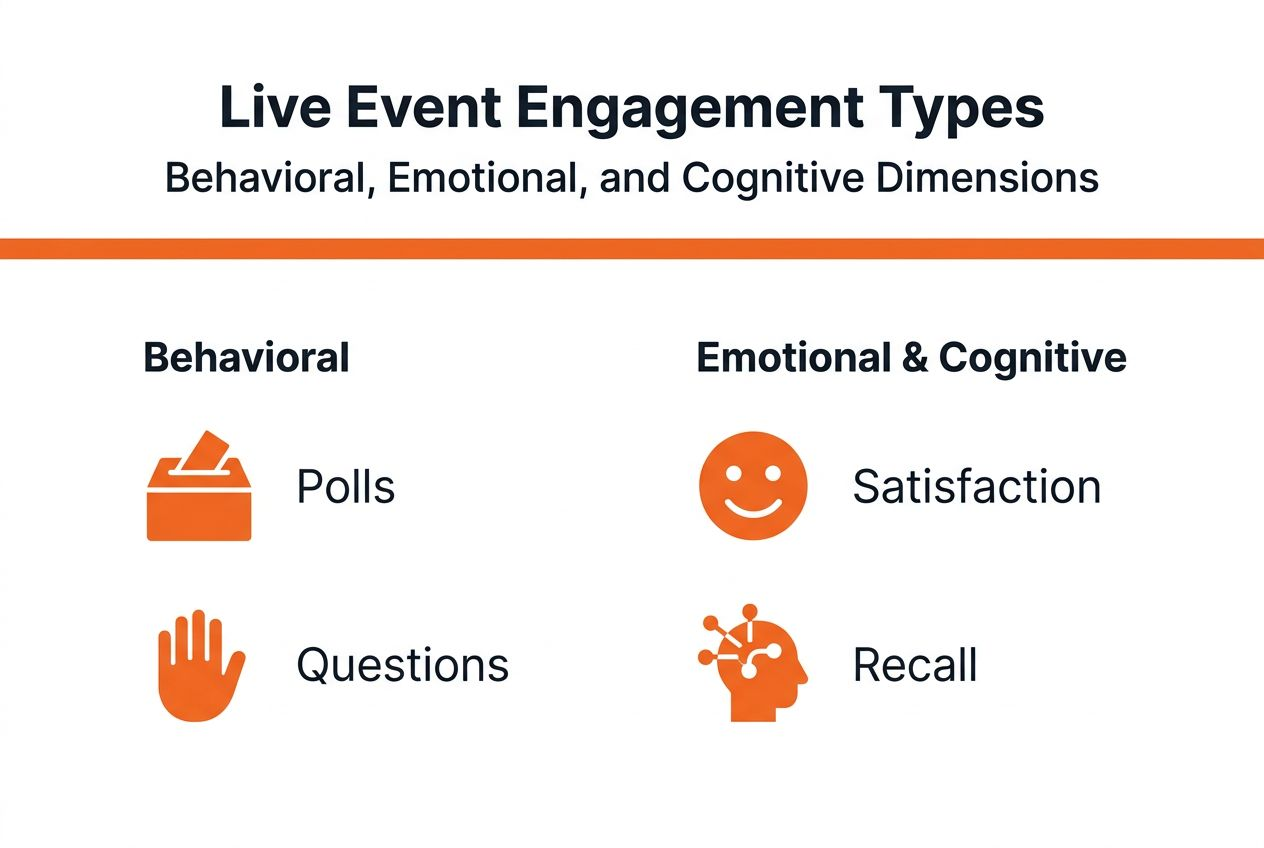
Behavioral engagement encompasses observable actions like poll responses, question submissions, booth visits, and networking connections. These actions produce quantifiable data that connects directly to business metrics. Emotional engagement involves feelings and attitudes toward the event, brand, or content. Cognitive engagement reflects mental investment and learning depth during sessions.
The three types differ significantly in measurability and business impact. Behavioral signals can be tracked automatically and correlated with revenue outcomes. Emotional responses require surveys or qualitative assessment and show weaker correlation with conversion rates. Cognitive engagement proves difficult to measure in real time and may not translate into immediate business action.
| Engagement Type | Key Characteristics | Measurement Examples | Business Relevance |
|---|---|---|---|
| Behavioral | Observable actions and interactions | Poll responses, Q&A submissions, booth scans, meetings booked | Direct correlation with pipeline and revenue |
| Emotional | Feelings and attitudes toward event/brand | Satisfaction surveys, sentiment analysis, Net Promoter Score | Influences long-term brand perception |
| Cognitive | Mental investment and learning depth | Knowledge assessments, content recall, application intent | Impacts product adoption and usage |
Event marketers should prioritize behavioral engagement measurement because it provides actionable data for sales follow-up and demonstrates clear ROI. While emotional and cognitive engagement matter for overall event quality, behavioral signals offer the most reliable foundation for revenue impact attribution and program optimization.
Practical applications of engagement data: from measurement to revenue impact
Integrate engagement data across meetings, content, and interactions to identify high-value leads and prioritize follow-ups. This integration transforms raw behavioral metrics into strategic business intelligence that drives revenue growth and justifies event investment.
Translating engagement metrics into actionable strategies requires systematic workflows:
- Consolidate data from all event touchpoints into a unified attendee profile that shows complete participation history across sessions, networking, and content engagement.
- Score attendees using weighted behavioral signals where high-intent actions like demo requests or pricing conversations receive higher scores than passive behaviors.
- Segment attendees into priority tiers based on engagement intensity and strategic fit, enabling sales teams to focus efforts on qualified prospects.
- Create personalized follow-up sequences that reference specific sessions attended, questions asked, or topics discussed to demonstrate genuine connection.
- Track post-event conversion rates by engagement level to refine scoring models and prove event contribution to pipeline growth.
High-intent attendees reveal themselves through specific behavioral patterns. Multiple session attendances in a single product area, detailed technical questions during Q&A, and requesting one-on-one meetings with product specialists all signal serious consideration. These behaviors provide stronger purchase intent indicators than job title or company size alone.
Prioritization techniques for follow-up should combine engagement scores with firmographic data. An attendee with high engagement from an ideal customer profile company deserves immediate outreach. Lower engagement from strategic accounts may warrant nurture campaigns. High engagement from poor-fit companies might indicate partnership opportunities rather than direct sales prospects.
Turning data into measurable revenue impact requires closed-loop reporting. Track which engaged attendees progress through your sales funnel, close deals, and generate revenue. Calculate average deal size and close rates by engagement tier to quantify the relationship between event participation intensity and business outcomes. This analysis builds the business case for treating events as a first-class growth channel.
Discover event solutions to maximize your engagement results
You have learned how behavioral measurement transforms live events from logistics exercises into revenue-driving growth channels. Now you need systems that capture high-intent moments and convert them into measurable pipeline.
Sandbox turns event engagement into actionable GTM signal by connecting attendee behaviors directly to your sales workflows. Our platform helps you identify who to follow up with, why they matter, and what to do next based on real participation data. Whether you are launching your first event program or scaling a flagship conference, we provide the tools and support to make every event accountable and repeatable.
Frequently asked questions
What is live event engagement?
Live event engagement measures active attendee behaviors during events rather than passive presence or attendance. It includes observable actions like poll participation, Q&A submissions, chat activity, networking connections, and session transitions. These behaviors indicate genuine interest and intent, providing concrete data that correlates with business outcomes better than attendance counts.
How can event marketers measure live event engagement accurately?
Use behavioral metrics like polls, Q&A submissions, and chat activity measured per minute rather than total duration. Leverage AI and analytics tools to collect real-time data across all event touchpoints automatically. Deploy event apps and session platforms that track participation without adding friction to the attendee experience.
What common misconceptions should I avoid about engagement at live events?
Engagement is not just emotional reaction or time spent at the event. Attendance numbers alone do not reflect true engagement quality or business impact. Networking needs active facilitation through structured activities and curated introductions rather than expecting valuable connections to form organically.
How does technology enhance live event engagement and its measurement?
AI analyzes real-time attendee behavior across multiple touchpoints, identifying high-intent signals and participation patterns that human observers miss. AR and VR increase immersion and interaction quality while generating rich behavioral datasets. These technologies enable unobtrusive tracking that creates comprehensive engagement profiles without disrupting the attendee experience.