

Most event marketers believe attendance numbers tell the whole story. Nearly 40% of organizers struggle to prove ROI because they rely on simplistic attendance metrics alone. This misconception limits your ability to optimize events and demonstrate real business impact. Mastering event success measurement means tracking tailored KPIs that capture engagement, sentiment, and revenue, not just headcount. This guide shows you how to measure what truly matters for growth.
Table of Contents
- Understanding Event Success Measurement
- Tailoring Event Success Metrics To Event Type And Goals
- Critical Metrics And KPIs For Event Success
- Common Misconceptions In Event Success Measurement
- Frameworks For Phased Event Measurement
- Leveraging Technology For Event Success Measurement
- Applying Event Success Measurement To Drive Growth And ROI
- Boost Your Event Success Measurement Today
- Frequently Asked Questions About Event Success Measurement
Key Takeaways
| Point | Details |
|---|---|
| Align metrics with goals | Event success measurement must be tailored to event type and objectives, as different events prioritize seat filling, engagement, or conversion. |
| Go beyond attendance | Track engagement, sentiment, NPS, and financial ROI to capture true event value. |
| Measure in phases | Pre-event, during-event, and post-event tracking enables real-time adjustments and deeper learning. |
| Leverage technology | Automated platforms unify hybrid event data and accelerate ROI insights. |
| Drive continuous growth | Measurement insights refine strategies, improve experiences, and prove stakeholder value. |
Understanding Event Success Measurement
Event metrics are raw data points you collect before, during, and after your event. These include registrations, check-ins, session attendance, app downloads, and social media mentions. KPIs are the specific metrics you choose to align with your business objectives, like lead conversion rate or net promoter score.
You need to start with clear, measurable event objectives. Are you building brand awareness, generating qualified leads, driving revenue, or strengthening customer relationships? Each goal requires different measurement priorities. An awareness event focuses on reach and impressions. A sales-driven conference tracks pipeline and closed deals.
Relying on attendance alone misses the strategic picture. A sold-out event with disengaged attendees who never convert fails to deliver business value. You need layered metrics that capture attention, interaction, and outcomes.
Pro Tip: Write down three specific business outcomes you want from your event before selecting any KPIs. This forces clarity and prevents vanity metric traps.
Common event goals include:
- Increasing brand visibility and market awareness
- Generating qualified sales leads and opportunities
- Accelerating existing pipeline and closing deals
- Strengthening customer retention and loyalty
- Launching products or services with measurable adoption
- Building community and fostering long-term advocacy
Each goal demands its own measurement framework. Your KPI dashboard should reflect what success actually means for your organization, not generic benchmarks.
Tailoring Event Success Metrics to Event Type and Goals
Event format dramatically changes which metrics matter most. Small workshops prioritize per-attendee engagement depth. Large conferences focus on aggregate reach and pipeline impact. Virtual events enable granular digital behavior tracking impossible at in-person gatherings.
76% of US event organizers plan to host more events, reflecting diverse strategic priorities. Your measurement approach must adapt to each event's scale, audience, and purpose. A networking mixer needs connection quality metrics. A product launch demands adoption and trial signup rates.
For engagement-focused events, track session participation rates, Q&A activity, poll responses, and networking meeting counts. Lead generation events require form completions, demo requests, and marketing qualified lead scores. Revenue events measure influenced pipeline, deal velocity, and closed won attribution.
Hybrid events demand unified tracking across physical and digital touchpoints. You need platforms that capture in-person badge scans and virtual session views in one system. Audience intent also shapes measurement. High-intent buyers deserve deeper qualification tracking than early-stage prospects.

Pro Tip: Set different success thresholds for pilot events versus established programs. First-time events need learning-focused metrics, while mature programs should hit revenue and efficiency targets.
Consider tailoring event KPIs to objectives by mapping:
- Event scale to measurement granularity
- Audience profile to engagement indicators
- Business stage to outcome priorities
- Resource investment to ROI expectations
Customization prevents wasted effort on irrelevant metrics and ensures your data drives decisions. Generic dashboards create noise. Tailored KPIs create clarity.
Critical Metrics and KPIs for Event Success
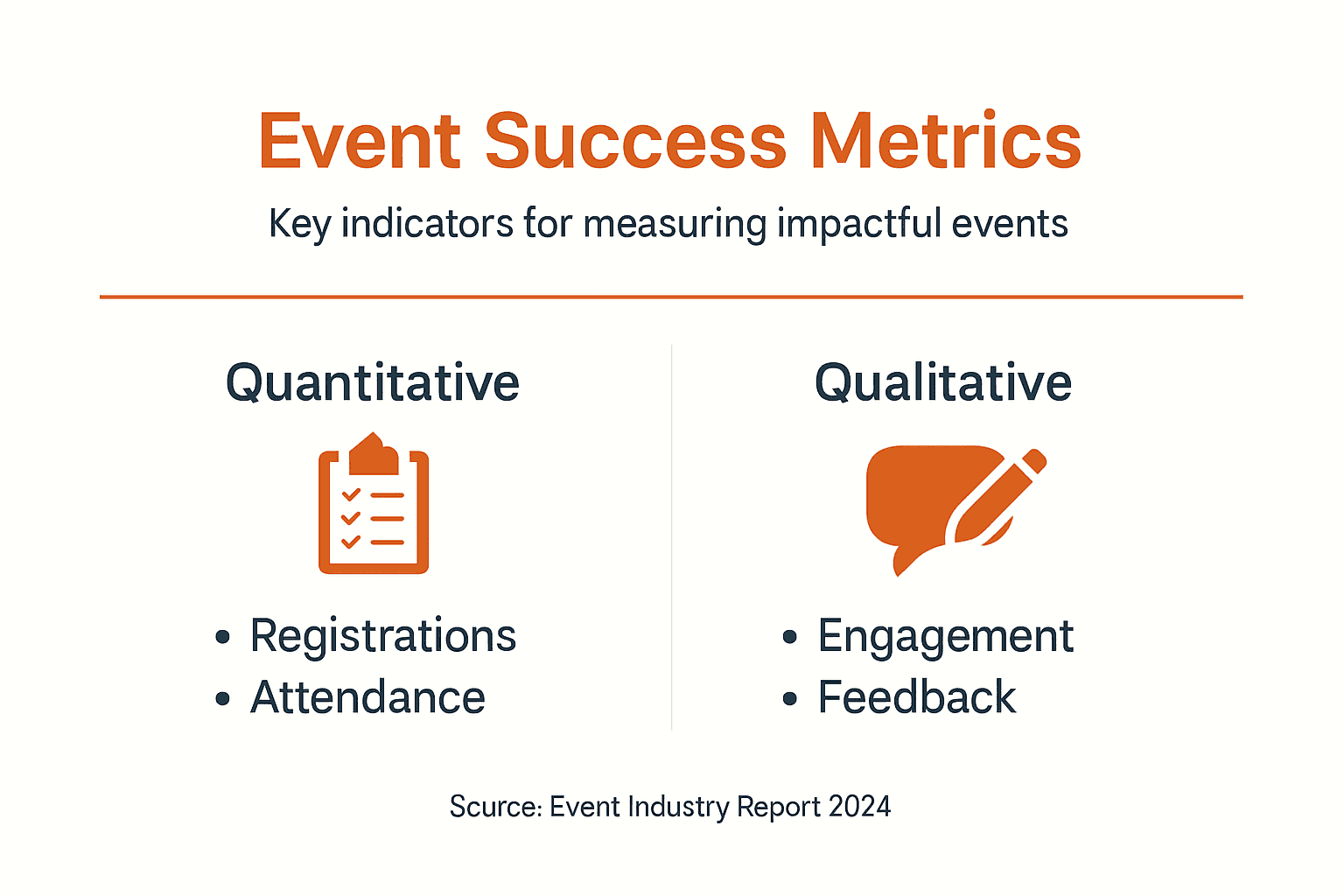
Quantitative metrics provide the numbers that prove performance. Registration conversion rate shows marketing effectiveness. Attendance rate reveals actual show-up versus signups. Session participation indicates content relevance. Networking meeting volume measures connection success.
Engagement metrics go deeper. Track mobile app usage frequency, session rating scores, live poll participation, and social media mentions with event hashtags. These indicators reveal attention quality, not just presence.
Qualitative tools capture sentiment and loyalty. Post-event surveys and Net Promoter Score (NPS) are essential qualitative metrics to capture attendee sentiment and predict advocacy. Open-ended feedback surfaces improvement opportunities numbers miss. Exit interviews with key accounts reveal strategic relationship insights.
Financial KPIs connect events to business outcomes. Calculate cost per lead by dividing total event spend by qualified leads generated. Measure influenced pipeline by tracking deals where event touchpoints played a role. Compute ROI by comparing revenue attributed to the event against total costs.
| Metric Type | Examples | Primary Use |
|---|---|---|
| Quantitative | Registration rate, attendance, session views | Measure scale and reach |
| Engagement | App usage, poll responses, networking meetings | Assess interaction depth |
| Qualitative | NPS, satisfaction scores, feedback themes | Capture sentiment and loyalty |
| Financial | Cost per lead, influenced pipeline, ROI | Prove business impact |
Pro Tip: Combine leading indicators like engagement with lagging indicators like revenue to balance immediate feedback with long-term impact visibility.
The importance of NPS and post-event feedback cannot be overstated. Promoters become advocates who extend your event's value through word of mouth and repeat attendance.
Common Misconceptions in Event Success Measurement
Many marketers treat attendance as the ultimate success signal. A packed room feels good but proves nothing about business outcomes. High attendance with low engagement wastes resources and misses opportunities.
A sold-out event can fail strategically if attendees leave confused, unconvinced, or unconnected to next steps. Tickets sold measures interest, not impact. You need conversion and retention metrics to understand true value.
Generic KPIs copied from industry reports mislead because every organization has unique goals and contexts. What works for a SaaS company's user conference differs from a services firm's client summit. Benchmarks provide reference points, not mandates.
Ignoring qualitative data creates blind spots. Numbers show what happened, but feedback explains why and how to improve. Attendee stories reveal emotional connections and barriers that spreadsheets cannot capture.
Top misconceptions to avoid:
- Attendance equals success when engagement and outcomes matter more
- One-size-fits-all KPIs work when customization drives relevance
- Immediate metrics tell the full story when long-term impact takes months
- Quantitative data suffices when qualitative insights reveal root causes
Engagement, lead quality, and conversion velocity reveal event success far more accurately than headcount alone. Focus on what drives your business forward.
Short-term thinking also limits measurement value. Some event benefits emerge weeks or months later as relationships mature and deals progress. Build multi-touch attribution to capture delayed impact.
Frameworks for Phased Event Measurement
Pre-event measurement tracks marketing effectiveness and interest signals. Monitor registration velocity, source attribution, and early engagement with promotional content. These indicators predict attendance and help optimize last-minute outreach.
During-event measurement enables real-time adjustments. Track live attendance against expectations, session popularity, app adoption, and participation rates. Immediate feedback lets you pivot content, extend popular sessions, or address technical issues before they cascade.
Post-event measurement captures outcomes and learning. Survey attendees within 48 hours while experiences remain fresh. Analyze follow-up meeting booking rates, content downloads, and lead progression through your funnel over 30 to 90 days.
| Event Phase | Key KPIs | Data Sources |
|---|---|---|
| Pre-Event | Registration rate, source attribution, early engagement | Marketing automation, registration platform |
| During Event | Live attendance, session participation, app usage, networking volume | Event platform, mobile app, badge scanners |
| Post-Event | NPS, survey responses, follow-up meetings, lead progression, influenced pipeline | Survey tools, CRM, sales data |
Phased tracking delivers multiple benefits:
- Real-time course correction during the event itself
- Immediate post-event debriefs with fresh insights
- Long-term ROI analysis as deals close and relationships deepen
- Comparative learning across multiple events over time
This lifecycle approach prevents tunnel vision. You see what worked, what failed, and why at each stage. Continuous measurement builds institutional knowledge that compounds with every event.
Leveraging Technology for Event Success Measurement
Modern event platforms automate data collection across registration, attendance, engagement, and outcomes. Integration with your CRM and marketing automation system unifies event data with broader customer journeys. This connection enables multi-touch attribution and pipeline tracking.
Virtual and hybrid formats unlock new measurement capabilities. You can track exact session viewing duration, content download timing, and chat participation in ways impossible at purely physical events. Digital interactions generate granular behavioral data.
Leading tools include:
- Event management platforms with built-in analytics dashboards
- Mobile event apps that capture networking and engagement
- Survey and feedback tools for qualitative data collection
- CRM integrations that sync attendee data with sales pipelines
- Marketing automation platforms that track pre and post-event nurture
Omnichannel data consolidation matters because attendees interact across multiple touchpoints. Someone might register via email, engage on social media, attend in person, and book a follow-up meeting through your website. Unified tracking connects these dots.
Pro Tip: Choose platforms with flexible APIs and integration options so your measurement stack evolves as your event program grows and new channels emerge.
Automation accelerates insights. Real-time dashboards show live engagement trends. Automated reports deliver post-event summaries within hours instead of weeks. Speed enables faster learning cycles and better resource allocation decisions.
Applying Event Success Measurement to Drive Growth and ROI
Measurement insights should directly inform your next event's strategy. Low session attendance signals content misalignment. High NPS from specific attendee segments reveals expansion opportunities. Lead quality analysis shows which promotion channels attract your ideal customers.
Use data to personalize follow-up. Attendees who engaged deeply with product demos deserve different outreach than those who only attended keynotes. Behavioral data enables targeted nurture campaigns that accelerate conversion.
Demonstrating ROI to stakeholders requires clear data storytelling. Show how applying event measurement data for growth connects event activity to pipeline influence and closed revenue. Visualize the customer journey from registration to closed deal.
Scale what works by identifying high-performing event elements. If roundtable discussions generate more qualified leads than panel sessions, expand roundtables in future programs. Data removes guesswork from event design decisions.
Practical steps to leverage measurement:
- Review metrics within one week of event close while context remains fresh
- Share insights across marketing, sales, and product teams
- Build quarterly trend reports comparing events over time
- Test measurement-driven hypotheses in your next event iteration
- Align event investment decisions with demonstrated ROI patterns
Measurement transforms events from cost centers into accountable growth channels. Data-driven optimization compounds returns with every program cycle.
Consistent measurement also builds organizational confidence in events as a strategic channel. When you prove impact, you earn budget, resources, and executive attention for future programs.
Boost Your Event Success Measurement Today
You now understand how tailored metrics drive better event outcomes and demonstrable ROI. But implementing comprehensive measurement requires the right systems and expertise.

Sandbox turns high-intent event moments into measurable pipeline signal. We help you capture real intent across meetings, content, and interactions, then connect that activity directly to revenue. Our platform combines opinionated workflows with hands-on execution so you understand who to follow up with, why they matter, and what to do next. Explore our event marketing solutions to build accountable programs. Leverage our event analytics tools for unified tracking across hybrid formats. Partner with our ROI optimization services to prove and improve event performance systematically.
Frequently Asked Questions About Event Success Measurement
What's the difference between event metrics and KPIs?
Metrics are all the data points you can collect, like registrations, check-ins, and social mentions. KPIs are the specific metrics you select because they align with your business goals and indicate success. Every KPI is a metric, but not every metric deserves KPI status.
How often should I measure event success during the event lifecycle?
Measure continuously across three phases: pre-event for marketing effectiveness, during-event for real-time engagement, and post-event for outcomes and ROI. Each phase provides unique insights that inform different decisions. Pre-event data guides promotion tactics, live data enables course correction, and post-event analysis drives future strategy.
Which technology tools best support hybrid event measurement?
Platforms that integrate registration, mobile apps, virtual event features, and CRM systems work best. Look for tools offering unified dashboards across physical and digital touchpoints, automated reporting, and flexible API connections. Your tech stack should consolidate data from multiple sources into one coherent view.
How can I use attendee feedback to improve future events?
Collect NPS scores and open-ended feedback immediately after your event while experiences remain fresh. Analyze response themes to identify content gaps, logistical pain points, and engagement opportunities. Share insights with your team and implement specific improvements in your next program. Close the loop by telling attendees how their feedback shaped changes.
Why is it important to customize KPIs for each event?
Generic KPIs miss your unique business context, audience profile, and strategic priorities. A networking event and a sales conference require completely different success indicators. Customization ensures your measurement effort focuses on what actually matters for your organization's goals, not irrelevant benchmarks.
What ROI calculation method works best for events?
Calculate influenced pipeline by tracking deals where event touchpoints played a role, then divide attributed revenue by total event costs. Use multi-touch attribution models that credit events appropriately within longer sales cycles. Include both direct conversions and accelerated deal velocity in your ROI analysis for a complete picture.