

Cross-channel event marketing coordinates your messaging and data across email, social media, SMS, and in-person touchpoints to create cohesive attendee journeys. Many B2B event marketers confuse it with omnichannel or assume it's too complex to implement. This guide clarifies what cross-channel marketing actually is, why it dramatically improves event ROI, and how to deploy it effectively for your programs in 2026.
Table of Contents
- Understanding Cross-Channel Event Marketing
- Why Cross-Channel Marketing Is Critical For B2B Event Success
- Implementing Cross-Channel Strategies For Effective Event Marketing
- Cross-Channel Vs. Omnichannel: What Event Marketers Need To Know
- Explore Sandbox To Supercharge Your Event Marketing
- Frequently Asked Questions
Key takeaways
| Point | Details |
|---|---|
| Cross-channel marketing synchronizes data across event channels | Unifying email, social, SMS, and in-person data creates consistent attendee experiences and eliminates messaging conflicts. |
| Reduces silos and boosts ROI measurably | Only 15% of businesses achieve unified customer views, but those that do see higher engagement and conversion rates. |
| Differs from omnichannel in scope and complexity | Cross-channel focuses on coordinated campaigns while omnichannel delivers seamless experiences requiring extensive infrastructure. |
| Platforms automate personalized campaigns at scale | Technology orchestrates messaging triggers across channels based on attendee behavior and real-time interactions. |
| Essential for competitive B2B event programs | Coordinated cross-channel strategies drive measurable pipeline and revenue outcomes modern stakeholders demand. |
Understanding cross-channel event marketing
Cross-channel marketing connects your event promotion channels through shared data and coordinated campaigns. Instead of running isolated email blasts, social ads, and SMS reminders, you synchronize these touchpoints to deliver consistent messaging based on unified attendee data.
When someone downloads your event guide, cross-channel marketing connects channels so your email nurture sequence, retargeting ads, and SMS confirmations all reflect that action. This coordination eliminates the friction of duplicate messages or contradictory calls to action.
"Cross-channel marketing connects channels through shared data and coordinated campaigns, enabling marketing channels to work together toward unified goals rather than operating in isolation." — Amplitude
The alternative creates silos where each channel operates independently. Your social team promotes one registration deadline while email announces another. Attendees receive conflicting messages and drop off.
Typical channels in cross-channel event marketing include:
- Email campaigns and automated sequences
- Social media organic and paid content
- SMS and push notifications
- Web personalization and chatbots
- Display and retargeting ads
- In-person booth interactions and badge scans
- Direct mail and physical event materials
Cross-channel differs from omnichannel marketing in a critical way. Cross-channel coordinates messaging and shares data between channels. Omnichannel creates seamless experiences where customers move fluidly between touchpoints without noticing transitions. Think of cross-channel as the practical foundation that makes omnichannel possible.
For B2B event programs, event marketing workflows that connect channels transform scattered tactics into strategic systems. You gain visibility into which touchpoints drive registrations, attendance, and post-event engagement.
Why cross-channel marketing is critical for B2B event success
Unified customer data is the foundation of effective event marketing, yet 88% of businesses believe it's essential while only 15% have actually achieved it. This gap explains why many event programs struggle with inconsistent messaging and wasted ad spend.
When you unify attendee data across channels, you can personalize experiences based on actual behavior rather than assumptions. Someone who engaged with your product demo content receives different pre-event messaging than someone who only viewed pricing pages.
| Metric | Before Cross-Channel | After Cross-Channel | Improvement |
|---|---|---|---|
| Email engagement rate | 18% | 31% | +72% |
| Registration conversion | 4.2% | 7.8% | +86% |
| Attendee show rate | 62% | 79% | +27% |
| Cost per registration | $127 | $73 | -43% |
| Event influenced pipeline | $2.1M | $4.3M | +105% |
Cross-channel marketing boosts ROI by eliminating the guesswork of disconnected campaigns. Instead of wondering which channel drove a registration, you see the complete journey from first touch to attendance.
The business impact extends beyond efficiency gains. Customers engaging via multiple channels demonstrate higher loyalty and lifetime value. For events, this means attendees who interact across email, social, and in-person touchpoints are more likely to become qualified opportunities.
Pro Tip: Prioritize data unification before launching sophisticated campaigns. Clean, connected data across your CRM, marketing automation, and event platform prevents duplicate efforts and enables real-time personalization that siloed systems cannot deliver.
The Sandbox platform treats this data challenge as foundational, capturing intent signals across meetings, content consumption, and live interactions to give teams clarity on follow-up priorities.
Implementing cross-channel strategies for effective event marketing
Launching coordinated cross-channel campaigns requires systematic planning and the right orchestration tools. Follow these steps to build campaigns that deliver measurable results:
-
Integrate your data sources first. Connect your CRM, marketing automation platform, event registration system, and ad platforms so attendee actions flow between systems in real time.
-
Segment audiences based on behavior and intent. Group prospects by engagement level, content interests, firmographic fit, and event history rather than generic demographics.
-
Map coordinated messaging across the attendee journey. Design pre-event nurture, event day activation, and post-event follow-up sequences that reference previous interactions across channels.
-
Set up behavioral triggers for timely outreach. Automate responses when attendees download content, visit pricing pages, or scan badges at your booth.
-
Launch campaigns across synchronized channels. Deploy email, social, SMS, and ads that share consistent messaging and creative while respecting channel-specific best practices.
-
Measure performance with unified reporting. Track how each channel contributes to registrations, attendance, and pipeline rather than evaluating channels in isolation.
-
Optimize based on cross-channel insights. Identify which channel combinations drive the highest conversion and double down on winning patterns.
Cross-channel marketing platforms give you a single control center to plan, launch, and optimize journeys across multiple touchpoints. These tools handle the complexity of coordinating messages, timing, and audience syncing that manual processes cannot scale.

A global technology firm used Marketo cross-channel orchestration to boost event conversion rates by 25%. They triggered personalized email sequences when prospects engaged with event landing pages, then coordinated retargeting ads and SMS reminders based on registration status.
Behavioral triggers create momentum by delivering the right message at the right moment. When an attendee books a meeting at your event, immediate confirmation via their preferred channel reinforces commitment and reduces no-shows.
Pro Tip: Sync your event audience segments to ad platforms daily during registration periods. This minimizes wasted spend on prospects who already registered and enables you to shift budget toward lookalike audiences or post-event nurture campaigns.
The event marketing workflows that Sandbox provides eliminate manual handoffs between channels. Teams capture intent signals and orchestrate follow-up without waiting for data exports or batch updates.
Unified reporting reveals blind spots that single-channel analytics miss. You might discover that LinkedIn ads drive high-quality registrations but email nurture actually converts them to attendees. Without cross-channel visibility, you'd optimize the wrong metrics.
Cross-channel vs. omnichannel: What event marketers need to know
Event marketers often use cross-channel and omnichannel interchangeably, but the distinction matters for strategy and execution. Understanding both approaches helps you build the right foundation for your program maturity.
| Criteria | Cross-Channel Marketing | Omnichannel Marketing |
|---|---|---|
| Primary focus | Coordinated messaging across channels | Seamless customer experience across all touchpoints |
| Data integration | Channels share data and insights | Complete real-time data unification |
| Implementation complexity | Moderate, achievable with existing tools | High, requires significant infrastructure investment |
| Attendee experience | Consistent messaging, some channel transitions visible | Fluid transitions, channel-agnostic journey |
| Strategic goal | Eliminate silos and improve campaign ROI | Create frictionless end-to-end experiences |
| Technology requirements | Marketing automation, CRM integration, ad platform syncing | Advanced CDP, unified commerce, AI orchestration |
Omnichannel approaches manage the entire attendee journey from save-the-date through post-event engagement without visible handoffs between digital and physical experiences. An attendee starts registration on mobile, continues on desktop, and completes check-in via event app without re-entering information.
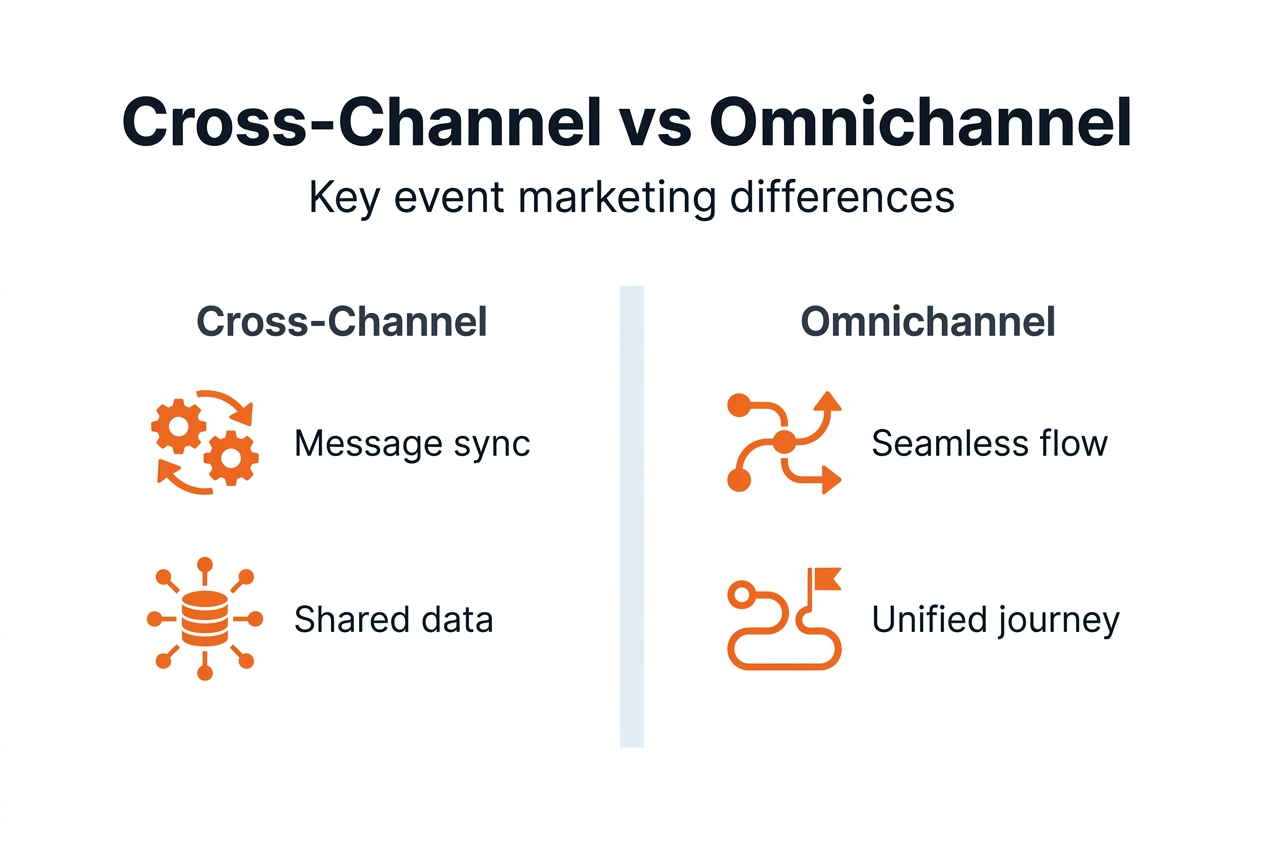
Cross-channel marketing delivers coordinated messaging and better ROI without requiring the extensive infrastructure of true omnichannel systems. For most B2B event programs, cross-channel represents an achievable step toward omnichannel maturity.
The experience gap represents the biggest pain point in event marketing today. When channels don't communicate, attendees face friction like receiving registration reminders after they've already registered or missing personalized session recommendations based on their content downloads.
Cross-channel marketing advantages:
- Faster implementation with existing marketing stack
- Lower technology and integration costs
- Measurable ROI improvements from eliminating silos
- Clearer attribution across campaign touchpoints
- Practical stepping stone toward full omnichannel capabilities
Omnichannel marketing advantages:
- Superior attendee experience with invisible channel transitions
- Deeper personalization based on complete behavioral history
- Competitive differentiation in crowded event markets
- Higher attendee satisfaction and loyalty metrics
- Future-proof infrastructure as expectations evolve
Most B2B event marketers should master cross-channel coordination before attempting full omnichannel transformation. Build reliable data flows between your core channels, prove ROI from coordinated campaigns, then invest in advanced infrastructure as your program scales.
The Sandbox event marketing solutions recognize this progression, helping teams capture high-intent signals and coordinate follow-up across channels without requiring enterprise-grade omnichannel platforms.
Explore Sandbox to supercharge your event marketing
Now that you understand how cross-channel marketing transforms event programs, consider how the right platform accelerates your results. Sandbox unifies data across meetings, content interactions, and live event touchpoints to give you clear follow-up priorities.
Our opinionated GTM workflows eliminate the silos that plague event marketing. You'll know exactly who to engage, why they matter, and what action to take next based on real intent signals rather than guesswork. Teams using Sandbox connect event activity directly to pipeline and revenue, making programs accountable and repeatable.
Whether you're launching your first integrated campaign or scaling a flagship event series in 2026, explore how Sandbox provides the systems and signal to make cross-channel event marketing practical. Our platform combines automation with hands-on execution support, helping you generate demand and accelerate conversions without the complexity of enterprise marketing clouds.
Learn how event marketing workflows that connect channels can boost your ROI and eliminate the frustration of disconnected systems.
Frequently asked questions
How does cross-channel marketing improve event ROI?
Cross-channel marketing eliminates wasted spend from duplicate messaging and poor targeting while increasing conversion through coordinated touchpoints. You allocate budget based on which channel combinations actually drive registrations and attendance rather than siloed performance metrics.
What channels should B2B event marketers prioritize?
Email, LinkedIn ads, and event registration platforms form the foundation for most B2B programs. Add SMS for high-value attendees, retargeting ads for engaged prospects, and in-person touchpoints like booth interactions as your sophistication grows.
Do I need expensive technology to implement cross-channel event marketing?
No, you can start with existing tools like your CRM and marketing automation platform. Focus on connecting data flows between systems and coordinating messaging before investing in specialized orchestration platforms.
How is cross-channel different from multi-channel marketing?
Multi-channel uses several platforms independently without data sharing or coordinated strategy. Cross-channel connects those platforms so they work together with unified goals and shared attendee insights.
What metrics prove cross-channel event marketing success?
Track registration conversion rates, cost per attendee, show-up rates, post-event engagement, and pipeline influenced by events. Compare these before and after implementing coordinated campaigns to quantify impact.