

TL;DR:
- Event signal tracking captures attendee behaviors to better understand engagement and buying intent.
- Advanced attribution models rely on granular signals to attribute revenue accurately across the customer journey.
- Overcoming challenges like signal decay and data silos requires a unified data hub and quick follow-up within 48 hours.
Most B2B event marketers walk away from a conference with a badge scan list and a gut feeling. They credit the last touchpoint before a deal closes and call it measurement. But that approach misses the majority of what actually drives pipeline. Attendees who downloaded your whitepaper, lingered at your booth, or asked pointed questions during a session are sending clear buying signals. Without a system to capture those moments, you're flying blind on which events truly move revenue. Event signal tracking changes that. It gives you a structured way to see who engaged, how deeply, and what that engagement means for your pipeline.
Table of Contents
- Defining event signal tracking: why signals matter
- Traditional vs. advanced attribution: shifting the paradigm
- Signal decay and data silos: overcoming core challenges
- Application: turning signals into high-quality leads and ROI
- Why signal tracking is the missing link for event marketing ROI
- Optimize your event strategy with Sandbox-GTM
- Frequently asked questions
Key Takeaways
| Point | Details |
|---|---|
| Signals reveal real value | Event signal tracking uncovers hidden attendee behaviors leading to higher-quality leads. |
| Act fast to avoid decay | Signals lose relevance quickly; timely follow-up is critical for effective outcomes. |
| Unified hubs combat silos | Centralizing event data prevents information gaps and enables advanced attribution models. |
| Multi-touch beats last-click | Modern attribution models deliver more accurate ROI and smarter event strategies. |
Defining event signal tracking: why signals matter
Event signal tracking is the practice of monitoring granular attendee behaviors across both digital and in-person touchpoints throughout your event program. It goes far beyond counting registrations or tracking session attendance. You're capturing the full picture of how people interact with your content, your team, and your brand.
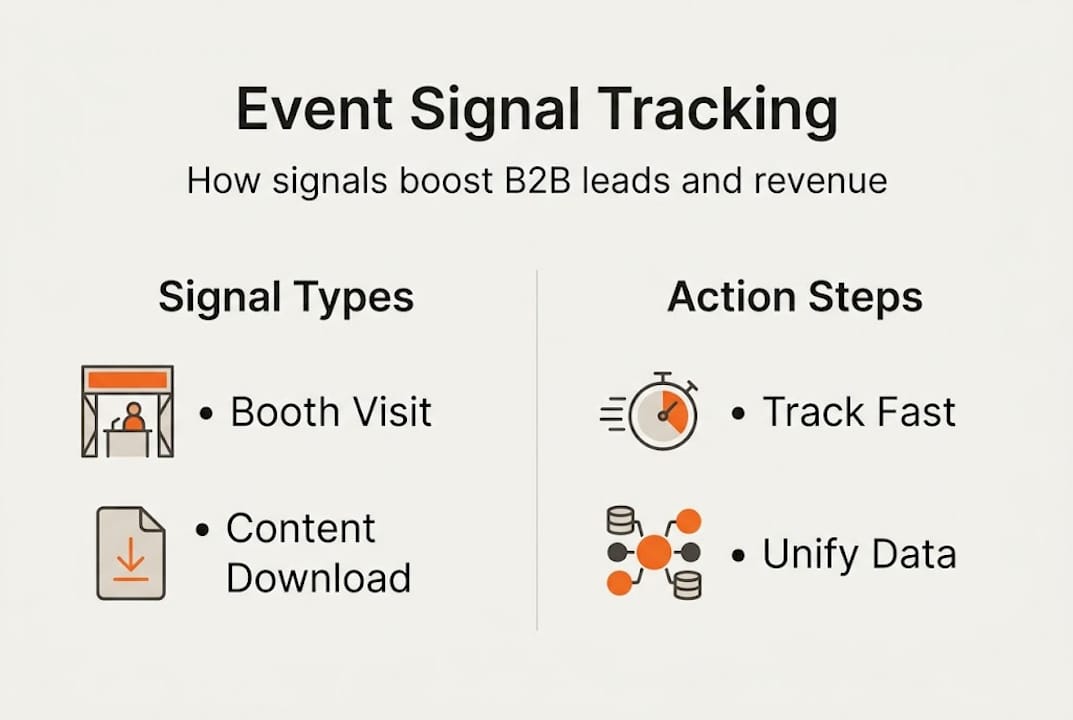
Signals come in many forms. Here are the most valuable ones to track:
- 📋 Session check-ins and dwell time — which topics held attention longest
- 🙋 Q&A participation and live poll responses — indicators of active interest
- 📥 Content downloads and resource requests — intent to learn more
- 🗺️ Booth visits and meeting requests — direct sales-readiness signals
- 💬 Chat interactions and networking connections — relationship-building intent
- 🖥️ Virtual platform clicks and replays — post-event engagement depth
Each of these actions tells a story about where a prospect is in their buying journey. Taken together, they create a roadmap that your sales and marketing teams can actually use. Your event metrics guide can help you decide which signals to prioritize based on your goals.
One critical reality: signal decay can undermine event data relevance within 48 hours. That means the clock starts the moment your event ends. If you wait a week to analyze and act, the signals you captured have already lost much of their predictive power.
B2B buying journeys are complex. Multiple stakeholders attend the same event. One person visits your booth while another downloads your case study. A third watches your keynote replay three days later. Without tracking all of these signals, you're only seeing fragments of a much larger picture. Applying event segmentation tips to your signal data helps you group attendees by behavior, making follow-up far more targeted and effective.
Signal tracking transforms your event from a one-time interaction into an ongoing intelligence feed. It's the difference between knowing someone attended and knowing why they were there and what they want next.
Traditional vs. advanced attribution: shifting the paradigm
Understanding signals sets the stage for evaluating how marketers attribute value. Let's examine the shift from last-click models to sophisticated attribution systems.
Last-click attribution is simple: whatever touchpoint came right before a conversion gets full credit. It's easy to measure, easy to report, and almost entirely misleading for event marketing. A prospect might have attended your roundtable six months ago, engaged with your follow-up content twice, and then clicked a retargeting ad before signing. Last-click gives the ad all the credit and makes your event look worthless.
Advanced attribution models fix this by distributing credit across the entire journey. Here's how the main models compare:
| Attribution model | How it works | Best for |
|---|---|---|
| Last-click | Credits the final touchpoint only | Simple, short sales cycles |
| First-touch | Credits the first interaction | Awareness campaign measurement |
| Linear | Splits credit equally across all touches | Balanced journey visibility |
| W-shaped | Weights first touch, lead creation, and opportunity creation | B2B multi-stakeholder journeys |
| Multi-touch | Distributes credit based on influence at each stage | Complex, long sales cycles |
Multi-touch and W-shaped attribution is preferred by 58% of B2B event marketers, and for good reason. These models reflect how B2B buying actually works.
Signal tracking is what makes advanced attribution possible. Without granular behavioral data, you can't weight interactions accurately. With it, you can see that a session attendance early in the funnel deserves credit for warming a lead, even if the deal closed months later.
The practical benefits of shifting to advanced attribution include:
- ✅ Smarter budget allocation — invest more in event formats that generate early-stage signals
- ✅ Better targeting — identify which attendee behaviors predict conversion
- ✅ Stronger reporting — show leadership the full revenue contribution of events
- ✅ Improved follow-up timing — know when to reach out based on signal strength
Start tracking event engagement at every stage of your program, and your attribution model will have the data it needs to tell the real story.
Signal decay and data silos: overcoming core challenges
To fully harness the potential of signal tracking, you need to tackle its practical challenges. Here's how to move from confusion to clarity.
The two biggest obstacles are signal decay and data silos. Signal decay is straightforward: behavioral data loses predictive value fast. Acting on event signals within 48 hours is essential, and unified hubs help solve data silos that slow you down. That 48-hour window is your activation zone.

Data silos are trickier. Your event platform captures session data. Your CRM holds account history. Your marketing automation tool tracks email opens. Your sales team logs meeting notes separately. None of these systems talk to each other by default, so you end up with isolated snapshots instead of a complete picture.
Here's a practical approach to overcoming both challenges:
- Set up a unified data hub — centralize signals from all event touchpoints into one platform before your event ends
- Use IP-to-account mapping — resolve anonymous web traffic and booth visits back to known accounts
- Automate your 48-hour follow-up — trigger personalized outreach based on specific signals captured during the event
- Sync signals to your CRM in real time — don't wait for manual exports; automate the data flow
- Tag signals by intent level — not all signals are equal; a meeting request outweighs a session check-in
| Challenge | Impact | Solution |
|---|---|---|
| Signal decay | Data loses relevance fast | Activate within 48 hours |
| Data silos | Fragmented attendee view | Unified data hub |
| Anonymous traffic | Can't connect signals to accounts | IP-to-account mapping |
| Manual processes | Slow follow-up, missed opportunities | Marketing automation integration |
Pro Tip: Build your post-event workflow before the event starts. Map out exactly who gets notified when a high-intent signal fires, and what message they send. This removes the lag that kills signal relevance.
Exploring event marketing automation tools can help you build these workflows efficiently. And reviewing post-event engagement tips will sharpen your follow-up strategy once the signals are flowing.
Application: turning signals into high-quality leads and ROI
With challenges addressed, let's turn to practical application. Here's how to leverage signals for measurable business value.
The core insight is this: 79% of volume leads don't convert, which means chasing raw registration numbers is a losing strategy. Signal-qualified leads, those identified through behavioral engagement rather than just attendance, are dramatically higher quality.
Here's a step-by-step process for turning event signals into pipeline:
- Define your signal scoring model — assign point values to each behavior (booth visit = 10 points, content download = 15 points, meeting request = 30 points)
- Set a lead qualification threshold — prospects who hit a score above your threshold get routed to sales immediately
- Segment by signal type — group attendees by the kind of interest they showed (product demos vs. thought leadership content)
- Integrate with your CRM — push signal scores directly into account records so sales has full context
- Measure conversion by signal path — track which combinations of signals most reliably lead to closed deals
This approach connects directly to your event lead generation strategies and makes your measurable customer acquisition reporting far more credible.
Pro Tip: Don't just score individual signals. Look at signal velocity, how quickly someone accumulates engagement points during an event. Fast accumulation often signals active evaluation, not just casual interest.
For ROI measurement, move away from cost-per-registration as your primary metric. Instead, track:
- 💰 Pipeline generated per event — tied to signal-qualified opportunities
- 📈 Revenue influenced — deals where event signals appeared in the journey
- 🔄 Conversion rate by signal type — which behaviors predict closed revenue
- ⏱️ Sales cycle acceleration — do signal-qualified leads close faster?
Using a structured event ROI framework alongside your event intent capture guide gives you the full toolkit to prove event value to leadership.
Why signal tracking is the missing link for event marketing ROI
Here's an uncomfortable truth: most B2B marketing teams still treat events as brand awareness plays because they can't prove anything more specific. That's not a budget problem or a strategy problem. It's a measurement problem.
The teams we see generating the most consistent pipeline from events aren't running bigger booths or hosting more sessions. They're capturing better signals and acting on them faster. They know which accounts sent three attendees to the same session. They know which prospects requested a follow-up call within 24 hours of a product demo. They know which content downloads preceded a deal.
Signal tracking shifts events from a cost center to a revenue driver. It gives you the evidence to defend your budget, optimize your program, and align sales and marketing around shared data. The measurable customer acquisition results speak for themselves when the data infrastructure is in place.
The competitive edge here is real. When your competitors are still counting badge scans, you're routing signal-qualified leads to sales within hours. That gap compounds over every event you run.
Optimize your event strategy with Sandbox-GTM
Ready to level up your event strategy and put signal tracking into practice? Sandbox-GTM is built specifically for B2B teams who want to connect event activity to pipeline and revenue. We capture high-intent signals across every event touchpoint, from booth visits to content engagement, and route them into actionable GTM workflows.
Our platform integrates with your existing CRM and marketing automation tools, so signals flow directly into the systems your sales team already uses. Whether you're optimizing event marketing workflows or building your first signal-based follow-up program, the Sandbox-GTM platform gives you the infrastructure to make every event accountable. Stop guessing which events drive revenue. Start knowing.
Frequently asked questions
How does event signal tracking help identify high-quality leads?
Event signal tracking captures specific attendee behaviors like booth visits, content downloads, and session participation, which qualify leads based on demonstrated intent rather than just attendance. 79% of volume leads don't convert, making signal-based qualification far more reliable.
What is signal decay and why is it important for event marketers?
Signal decay is the rapid loss of relevance in event behavioral data after an event ends. Signal decay can undermine event data relevance within 48 hours, so marketers must activate follow-up quickly to maximize impact.
How can marketers overcome data silos in event tracking?
Implementing a unified data hub consolidates signals from all event platforms into one view, enabling accurate multi-touch attribution. Unified hubs help solve data silos that fragment attendee intelligence and slow down follow-up.
What's the difference between last-click and multi-touch attribution?
Last-click attribution credits only the final action before conversion, while multi-touch models distribute credit across every meaningful interaction in the journey. Multi-touch and W-shaped attribution is preferred by 58% of B2B event marketers for its accuracy in complex buying cycles.