

Event marketing consumes 20 to 30 percent of B2B budgets, yet 89% of B2B marketers struggle to measure event ROI due to manual processes and outdated tracking methods. Traditional revenue divided by cost calculations miss the full picture of how events influence pipeline, accelerate deals, and generate qualified leads. Event analytics transforms this broken measurement landscape by automating data capture, surfacing real time intelligence, and connecting event activity directly to revenue outcomes. This article explores how modern analytics tools fix ROI tracking, improve targeting precision, and help you prove event value to executive stakeholders who demand accountability.
Table of Contents
- Key Takeaways
- Why traditional event ROI measurement falls short
- How event analytics transforms ROI and pipeline generation
- Comparing attribution models and metrics for event success
- Implementing event analytics for improved marketing workflows
- Explore Sandbox GTM solutions to maximize your event ROI
- Frequently asked questions about the role of event analytics
Key Takeaways
| Point | Details |
|---|---|
| Automation clarifies ROI | Automated data capture and real time insights reveal an event's true contribution across the pipeline beyond revenue alone. |
| Probabilistic attribution matters | Shifting from deterministic to probabilistic attribution captures indirect influence such as pipeline velocity and account expansion that traditional ROI calculations miss. |
| Real time pipeline insights | Real time intelligence guides event execution by highlighting target accounts and suggesting next actions to accelerate deals. |
| Better ICP targeting | Automation helps refine ICP targeting and improves efficiency by focusing outreach on the accounts most likely to convert from events. |
Why traditional event ROI measurement falls short
Most event marketers still calculate ROI as revenue divided by cost. You spend $50,000 on a conference, attribute $200,000 in closed deals, and report a 4x return. Simple math, right? This approach ignores critical impact pillars that make events valuable beyond immediate revenue. Pipeline influence, deal acceleration, and relationship building never show up in traditional calculations, leaving you blind to your event's true contribution.
The dark funnel complicates measurement further. Prospects research your brand, consume content, and engage with peers before ever filling out a form or attending your booth. Traditional ROI metrics fail because they ignore impact pillars and rely on deterministic attribution that demands direct, trackable touchpoints. When someone attends your keynote, discusses your solution with colleagues, then converts three weeks later through a different channel, deterministic models miss the event's influence entirely.
Consider what traditional ROI measurement overlooks:
- Pipeline velocity changes when prospects move faster after event interactions
- Account expansion opportunities surfaced through executive conversations
- Competitive displacement insights gathered from booth discussions
- Brand perception shifts measured through sentiment and engagement
- Cross functional relationships built between buying committee members
These factors drive business outcomes but remain invisible in revenue to cost calculations. A prospect might attend your workshop, share insights with their team, and influence a purchase decision six months later without appearing in your attribution reports. Traditional models treat this as zero event contribution, undervaluing your program and making budget justification nearly impossible.
"The shift from deterministic to probabilistic attribution represents the biggest change in B2B measurement since marketing automation emerged. Events benefit most because indirect influence matters more than direct conversion."
Your executive team sees the event budget line and asks for proof of return. You scramble to connect attendees to closed deals, manually exporting lists and cross referencing CRM records. By the time you compile a report, the data is stale and incomplete. This manual process wastes hours while missing the sophisticated post event engagement conversions that analytics platforms capture automatically. The frustration compounds when stakeholders question event value based on incomplete measurement that never captured the full story.
How event analytics transforms ROI and pipeline generation
Event analytics platforms use AI and automation to capture the complete picture traditional methods miss. Instead of manually tracking spreadsheets and hoping your CRM data stays clean, these systems automatically ingest registration data, booth interactions, session attendance, content downloads, and meeting outcomes. AI and automation enable real-time event intelligence that surfaces which accounts matter most and what actions to take next.

Real time intelligence changes how you execute during events. Your team receives alerts when target accounts enter your booth, sees engagement scores update as prospects attend sessions, and gets recommended next steps based on behavioral signals. This dynamic targeting lets you focus energy on ideal customer profiles showing genuine buying intent rather than chasing every badge scan equally. Analytics platforms score leads instantly, route hot prospects to sales while the conversation is fresh, and trigger personalized follow up sequences based on specific interactions.
Pipeline impact becomes visible when analytics connect event touchpoints to deal progression. You see which accounts accelerated after your event, measure velocity changes across segments, and quantify pipeline addition from new relationships. A prospect attending three sessions and downloading two resources signals stronger intent than someone who registered but never showed. Analytics weight these signals appropriately, helping you prioritize follow up and forecast conversion likelihood with greater accuracy.
Advanced event analytics platforms deliver these essential capabilities:
- Automated data capture from registration, badge scans, and engagement touchpoints
- Real time lead scoring based on behavioral signals and firmographic fit
- Integration with CRM and marketing automation to close the loop on outcomes
- Probabilistic attribution modeling that estimates indirect event influence
- Pipeline dashboards showing velocity, stage movement, and deal acceleration
- Predictive analytics identifying which prospects will convert based on patterns
Pro Tip: Integrate analytics at the planning stage, not post event. Configure tracking, set up dashboards, and train your team before the event starts so you capture complete data and can act on insights in real time rather than discovering gaps after opportunities pass.
| Metric | Traditional Approach | Analytics Enabled Approach |
|---|---|---|
| Data collection | Manual spreadsheets, badge dumps | Automated capture across all touchpoints |
| Lead qualification | Days or weeks post event | Real time scoring during event |
| Attribution | Last touch or first touch only | Multi touch with probabilistic modeling |
| Pipeline visibility | Closed deals only | Full funnel from influence to revenue |
| Follow up timing | Batch emails days later | Personalized outreach within hours |
| ROI calculation | Revenue divided by cost | Impact pillars plus revenue outcomes |
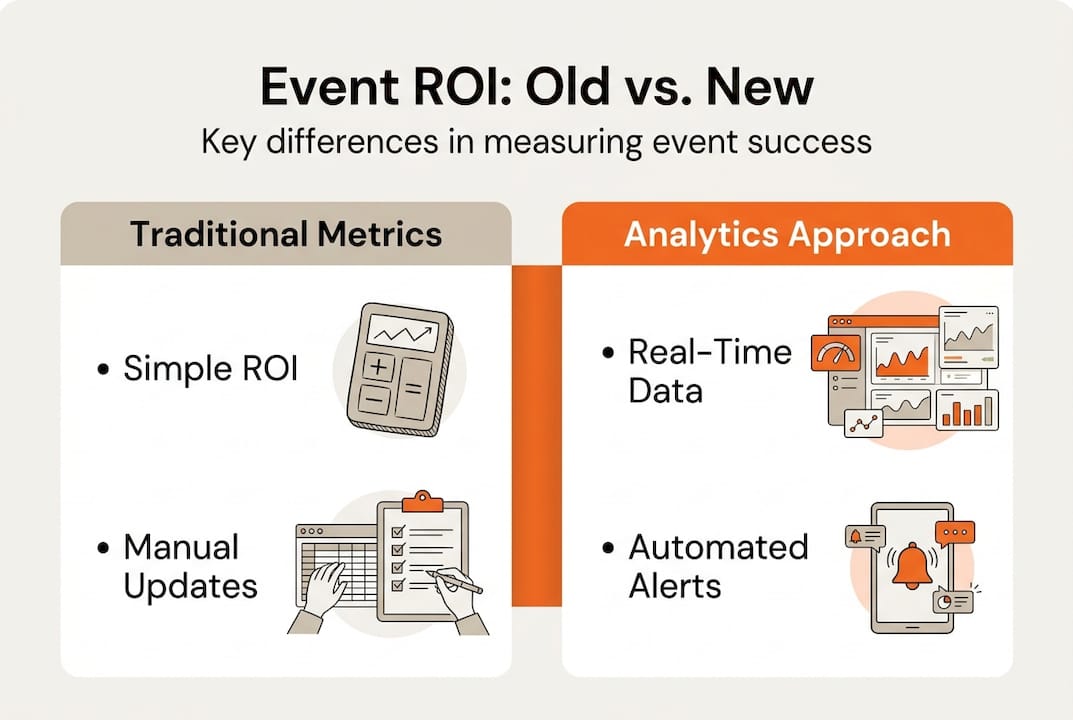
The efficiency gains extend beyond measurement. Marketing automation for events eliminates repetitive tasks like list uploads, email scheduling, and manual lead routing. Your team spends less time on administrative work and more time on strategic activities like relationship building and content development. When analytics handle the busy work, you scale programs without proportionally scaling headcount, improving cost efficiency while maintaining quality.
Targeting precision improves when analytics reveal which segments convert best. You discover that director level attendees from companies with 500 to 2000 employees convert at twice the rate of other segments. Next event, you adjust your promotion strategy to attract more of that profile. These insights compound over time as you refine your events lead generation strategies based on actual performance data rather than assumptions.
Comparing attribution models and metrics for event success
Deterministic attribution demands a direct, trackable line from touchpoint to conversion. Someone clicks your event ad, registers, attends, and converts. The model confidently assigns credit because every step is documented. This works beautifully in controlled digital environments where cookies and tracking pixels capture everything. Events break this model because conversations happen offline, buying committees involve multiple people, and influence spreads through channels you cannot monitor.
Probabilistic attribution uses behavioral signals and statistical modeling to estimate influence when direct tracking fails. Deterministic attribution is dead for events because it cannot account for the complex, multi threaded nature of B2B buying. Probabilistic models analyze patterns across thousands of customer journeys to identify correlations between event engagement and conversion outcomes. When prospects who attend your workshop convert at 3x the rate of those who do not, the model assigns partial credit to that touchpoint even without a direct tracking link.
| Attribution Model | Strengths | Limitations | Best Use Case |
|---|---|---|---|
| First touch | Simple, clear starting point | Ignores nurture and acceleration | Brand awareness campaigns |
| Last touch | Easy to implement and explain | Misses early influence | Direct response programs |
| Linear multi touch | Distributes credit across journey | Treats all touches equally | Long sales cycles with many touchpoints |
| Time decay | Weights recent touches more | May undervalue early education | Short to mid cycle deals |
| Algorithmic/probabilistic | Captures indirect influence | Requires significant data | Complex B2B events with dark funnel |
Traditional revenue remains important, but alternative metrics provide richer insight into event contribution:
- Pipeline addition measures net new opportunities sourced from event interactions
- Velocity improvement tracks how much faster deals close after event touchpoints
- Engagement scores quantify prospect interest based on session attendance and content consumption
- Account penetration shows how many stakeholders from target companies you reached
- Competitive win rate compares deals where event played a role versus those without event influence
Pro Tip: Combine attribution approaches rather than choosing one exclusively. Use deterministic methods for direct conversions you can track confidently, layer in probabilistic modeling for indirect influence, and supplement with engagement metrics that capture relationship depth. This triangulated view gives stakeholders confidence in your measurement while acknowledging the complexity of B2B buying.
The choice of metrics and models should align with your sales cycle and buying committee structure. Enterprise deals with 6 to 12 month cycles and 8 to 12 stakeholders require sophisticated probabilistic attribution because influence spreads across many people and touchpoints. Mid market deals with shorter cycles might rely more on deterministic tracking supplemented by velocity metrics. Adjust your approach based on how your customers actually buy rather than forcing a one size fits all model.
Event segmentation tips help you apply attribution more effectively by grouping similar prospects and analyzing patterns within cohorts. You might discover that enterprise attendees require three post event touches before converting while mid market prospects convert after one. These insights let you tailor follow up cadences and resource allocation by segment, improving efficiency and conversion rates simultaneously.
Implementing event analytics for improved marketing workflows
Adopting event analytics requires more than buying software. You need to redesign workflows, align teams around new processes, and build capabilities that turn data into action. Follow these steps to integrate analytics into your event marketing operations:
-
Audit your current event data landscape to identify gaps, redundancies, and manual processes consuming time without adding value. Document every data source from registration platforms to badge scanners to post event surveys.
-
Select an analytics platform that integrates with your existing marketing automation and CRM systems. Prioritize tools offering real time scoring, automated data capture, and flexible attribution modeling over feature bloat you will never use.
-
Configure tracking and attribution logic before your next event. Define what constitutes meaningful engagement, set scoring thresholds for lead qualification, and establish rules for routing prospects to sales or nurture tracks.
-
Train your event team and sales counterparts on how to interpret analytics dashboards and act on insights. The fanciest platform delivers zero value if your team ignores the data or misunderstands what metrics mean.
-
Implement automated workflows that trigger based on engagement signals. When a target account executive attends your keynote and downloads a case study, automatically alert the account owner and queue a personalized follow up email.
-
Establish feedback loops where sales shares outcome data back to marketing so attribution models improve over time. Close the loop on which event sourced leads actually closed and at what value.
-
Create executive dashboards showing pipeline impact, velocity improvements, and ROI across events. Make the business case visible and update it continuously rather than scrambling for reports when budget season arrives.
Manual event measurement processes limit efficiency by forcing your team to spend hours on data wrangling instead of strategic work. Automation eliminates this waste while improving data quality and timeliness. You get better insights faster with less effort, freeing capacity to run more programs or improve existing ones.
Pro Tip: Align sales and marketing around shared definitions of qualified leads and pipeline contribution before implementing analytics. Disagreement on what counts as event sourced pipeline will undermine your measurement and create friction between teams. Get consensus upfront on attribution windows, qualification criteria, and how to handle multi touch scenarios.
Common pitfalls sabotage analytics implementations when teams skip foundational work:
- Implementing tools without cleaning existing data creates garbage in, garbage out scenarios where insights are unreliable
- Tracking everything generates noise that obscures meaningful signals and overwhelms users with irrelevant metrics
- Ignoring change management means your team reverts to familiar manual processes rather than adopting new workflows
- Setting unrealistic expectations about attribution precision leads to disappointment when probabilistic models show ranges rather than exact numbers
- Failing to iterate based on learnings means you repeat the same mistakes across events instead of improving
Start with a pilot event where you test analytics workflows on a smaller scale before rolling out broadly. Learn what works, identify gaps, and refine your approach. This measured implementation reduces risk while building organizational confidence in new processes. Track specific event conversion optimization metrics during the pilot to quantify improvement and justify broader adoption.
Integration between analytics platforms and existing systems determines success or failure. Your event data must flow seamlessly into CRM records, trigger marketing automation sequences, and update account scoring models. Broken integrations create manual workarounds that negate efficiency gains and introduce errors. Invest time upfront ensuring systems communicate properly rather than discovering integration failures post event when fixing them disrupts operations.
Explore Sandbox GTM solutions to maximize your event ROI
Sandbox GTM treats events as a first class growth channel by turning high intent moments into measurable go to market signal. Our platform captures real intent across meetings, content interactions, and live engagements, helping you understand who to follow up with, why they matter, and what to do next. We combine opinionated workflows with hands on execution support so your team generates demand, accelerates conversions, and connects event activity directly to pipeline and revenue.

Whether you are running your first program or scaling a flagship conference, Sandbox GTM provides the systems, signal, and support to make events accountable and worth repeating. Our approach fixes the broken ROI measurement that frustrates event marketers by automating data capture, enabling real time intelligence, and surfacing the impact pillars traditional metrics ignore. Explore how our event marketing workflows boost ROI efficiency through intelligent automation and precise ICP targeting that transforms event programs from logistics exercises into revenue engines.
Frequently asked questions about the role of event analytics
What key metrics should I track with event analytics?
Track pipeline addition to measure net new opportunities sourced from events, velocity improvement to quantify deal acceleration, and engagement scores that capture prospect interest depth. Supplement these with account penetration showing stakeholder reach and competitive win rates comparing event influenced deals to those without event touchpoints.
How does probabilistic attribution improve event measurement?
Probabilistic attribution uses behavioral signals and statistical patterns to estimate event influence when direct tracking fails due to dark funnel dynamics and multi threaded B2B buying. This approach captures indirect contributions that deterministic models miss entirely, providing a more complete picture of how events drive pipeline and revenue.
What are best practices for integrating event analytics into workflows?
Start by auditing current data sources and manual processes, then select platforms that integrate with existing CRM and marketing automation systems. Configure tracking before events begin, train teams on interpretation and action, and establish automated workflows triggered by engagement signals. Create feedback loops where sales outcome data improves attribution models over time.
How can event analytics accelerate my sales pipeline?
Analytics surface real time intelligence about which accounts show buying intent, enabling dynamic targeting and prioritized follow up while conversations are fresh. Automated lead scoring routes hot prospects immediately while nurture sequences engage others appropriately. This precision and speed reduces time to conversion and improves win rates by ensuring the right message reaches the right prospect at the right moment.
What common pitfalls should I avoid when using event analytics?
Avoid implementing tools without first cleaning existing data, as poor data quality produces unreliable insights. Do not track everything indiscriminately, which creates noise obscuring meaningful signals. Ensure change management so teams adopt new workflows rather than reverting to manual processes. Set realistic expectations about attribution precision since probabilistic models show ranges, and iterate based on learnings rather than repeating mistakes. Discover more strategies in our event marketing automation guide and event conversion optimization guide.