
TL;DR:
- Viewing events as strategic, ongoing lifecycles boosts B2B pipeline and relationship growth.
- Pre-event planning, real-time engagement, and targeted follow-up are essential for maximizing ROI.
- Data and relationships from each event fuel continuous improvement and long-term business impact.
Most B2B event teams are really good at logistics. They book the venue, coordinate speakers, send invites, and make sure the Wi-Fi works. But when the event ends, the momentum fades — and no one can clearly explain what it produced or how to do better next time. That gap isn't a staffing problem or a budget issue. It's a strategic one. Treating events as isolated projects rather than structured, repeatable lifecycles is what keeps so many organizations stuck in a cycle of high effort and low accountability. This guide gives you a practical framework to change that. 🎯
Table of Contents
- Defining the event lifecycle for B2B marketers
- Stage one: Before the event — planning and preparation
- Stage two: During the event — execution and management
- Stage three: After the event — follow-up and analysis 📈
- Why viewing events as lifecycles is the B2B edge
- Scale your event strategy with Sandbox-GTM
- Frequently asked questions
Key Takeaways
| Point | Details |
|---|---|
| Lifecycle drives ROI | Strategic lifecycle thinking maximizes event outcomes and measurable growth. |
| Three-stage model | The event lifecycle includes planning, execution, and analysis for holistic success. |
| Continuous improvement | Iterative follow-up and data analysis make every event stronger than the last. |
| Technology integration | CRM, automation, and analytics tools power each step of the event lifecycle. |
| Compounding returns | Organizations that adopt lifecycle strategies see sustained audience loyalty and increased pipeline impact. |
Defining the event lifecycle for B2B marketers
Let's be direct: event management and the event lifecycle are not the same thing. Event management focuses on the operational tasks required to produce a single event, such as venue logistics, vendor coordination, registration setup, and on-site staffing. The event lifecycle, by contrast, is a strategic model that encompasses everything before, during, and after an event. It treats each event as a connected chapter in an ongoing growth strategy rather than a one-time production.
For B2B marketers, this distinction matters a great deal. B2B buying cycles are long, relationships are complex, and decisions involve multiple stakeholders. A single touchpoint rarely closes a deal. What does move the needle is consistent, strategic engagement over time. The event lifecycle gives you the structure to deliver that.
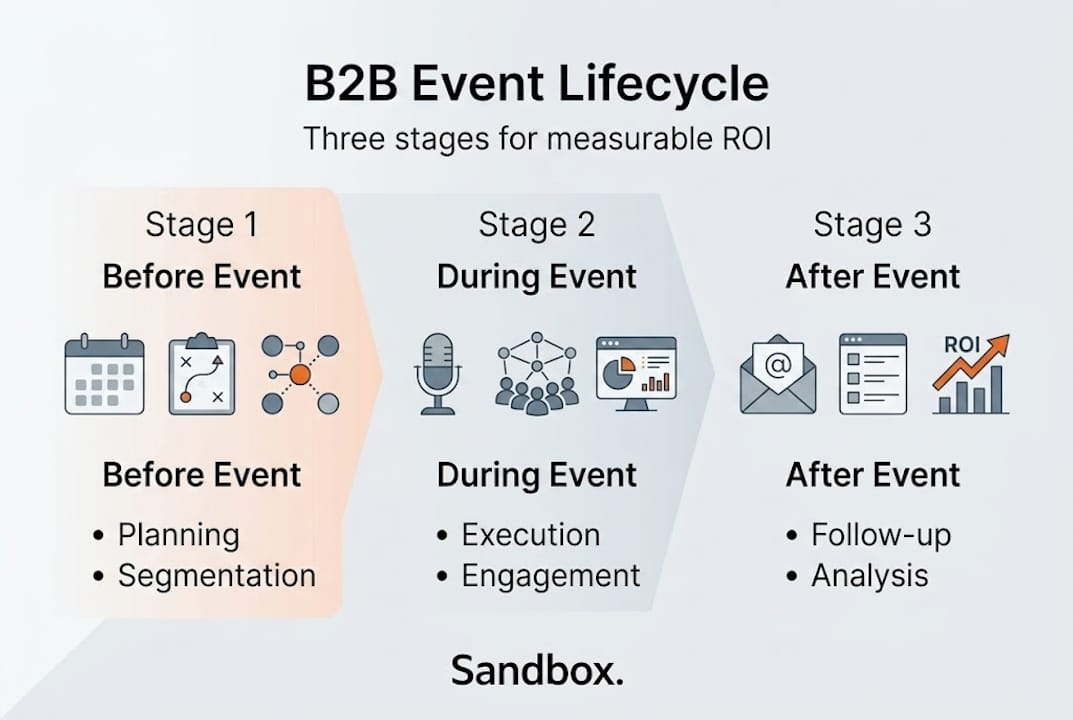
As this practical model explains, event lifecycle work falls into three macro-stages: before the event, during the event, and after the event. Each stage has its own goals, tactics, and success metrics. When all three align with your broader event marketing framework, events stop being expenses and start becoming growth assets.
Here's a quick comparison of the two models:
| Dimension | Event management | Event lifecycle |
|---|---|---|
| Scope | Single event | Ongoing program |
| Focus | Operations and logistics | Strategy, data, and relationships |
| Success metric | Did the event run smoothly? | Did we generate pipeline and improve? |
| Time horizon | Day of the event | Months before and after |
| Ownership | Event team | Cross-functional (marketing, sales, ops) |
Leading B2B organizations treat the lifecycle model as a shared operating system across marketing and sales. Here's what that structure typically includes:
- 🗓️ Before the event: Strategic planning, audience segmentation, messaging development, tech setup, and promotional campaigns
- 🎙️ During the event: Real-time execution, engagement tracking, live data capture, and attendee personalization
- 📊 After the event: Follow-up sequences, pipeline analysis, relationship nurturing, and learnings that feed the next cycle
When you adopt lifecycle thinking, every event generates compounding value. The data you collect at one event improves the next. The relationships you nurture post-event return as advocates and buyers. And your team builds sharper instincts with each iteration.
Stage one: Before the event — planning and preparation
With the event lifecycle framework established, let's dive into the first stage and its strategic importance. The "before" stage is where the real strategic work happens. Most teams spend this time booking vendors and building registration pages. High-performing teams spend it answering a harder question: why are we running this event, and what does success look like?
Start by anchoring your event to clear business objectives. Are you trying to generate new pipeline? Accelerate deals already in progress? Strengthen relationships with existing customers? Your answer shapes everything downstream, from who you invite to how you measure results. Without this clarity, you're optimizing for a smooth event rather than a meaningful outcome.
Audience segmentation is where planning gets precise. Not every prospect or customer deserves the same invitation or the same experience. Reviewing your event segmentation tips helps you map attendance lists to pipeline stages, account tiers, and persona types. A decision-maker at a mid-market account needs a different message than a champion at an enterprise account. Personalization at this stage increases registration rates and, more importantly, ensures the right people show up.
Your messaging and value proposition need to do real work here. Generic "join us for an exclusive experience" language no longer moves B2B buyers. Your pre-event communications should answer: what will I learn, who will I meet, and how will this make my job better? Concrete, specific answers to those questions drive registrations more effectively than polished design alone.
Technology integration is also a before-event priority, not an afterthought. Connecting your registration platform to your CRM and event marketing automation tools before the event means every interaction — a page view, a registration, a session selection — flows into a unified record. That data becomes the foundation for personalized follow-up later.
Key pre-event planning actions include:
- 🎯 Define 2 to 3 specific business objectives tied to pipeline or revenue
- 👥 Segment your invite list by persona, account tier, and pipeline stage
- ✉️ Build a multi-touch promotional sequence across email, social, and paid channels
- 🔗 Integrate your event tech stack with CRM and marketing automation before launch
- 📋 Establish your baseline metrics so you can measure impact post-event
Pro Tip: Build your post-event follow-up plan before the event starts. Knowing exactly what you'll send to each audience segment based on their behavior during the event will save you time and dramatically improve conversion rates afterward.
The three-stage lifecycle model reinforces that pre-event work is not just prep time — it's where strategic decisions get made that determine the entire event's ROI potential.
Stage two: During the event — execution and management
Once your event is strategically planned, seamless execution becomes the focus. But execution in a lifecycle model means more than keeping the agenda on schedule. It means treating every moment as a data point and every interaction as a signal.
Real-time engagement is the currency of the during-event stage. Attendees who are actively engaged — asking questions, participating in polls, visiting sponsor booths, attending roundtables — are showing you exactly what they care about. That behavior data is far more valuable than a badge scan. It tells you who is genuinely interested versus who showed up out of obligation.
Here's a snapshot of how engagement tactics map to data capture opportunities:
| Engagement tactic | Signal captured | GTM use case |
|---|---|---|
| Live polling | Topic interest | Content personalization in follow-up |
| Networking sessions | Relationship depth | Prioritize for sales outreach |
| Session attendance | Pain point mapping | Align follow-up to specific challenges |
| Sponsor booth visits | Vendor intent | Flag for accelerated pipeline |
| Q&A participation | Engagement quality | Lead scoring input |
Your execution checklist should address four priority areas:
- Roles and responsibilities. Every team member should know exactly what they own during the event. Ambiguity leads to gaps, and gaps in a live environment are hard to recover from.
- Tech reliability. Test your tracking event engagement tools before doors open. Engagement data captured in real time is infinitely more accurate than self-reported feedback after the fact.
- Personalization at scale. Use the segmentation work you did in stage one to personalize event outreach and on-site experiences. When attendees feel seen and understood, they engage more deeply.
- Contingency planning. Something will go wrong. Know your fallbacks for A/V issues, speaker cancellations, and low session attendance before they happen.
On-the-fly adaptation is an underrated skill in live event management. If a breakout session is generating exceptional energy, extend it. If a topic is landing flat, pivot. Teams that read the room and adjust in real time consistently deliver more attendee value than teams that rigidly follow the script.
The event lifecycle framework is clear that the during-event stage is not just about flawless production — it's about capturing the intent signals that make post-event follow-up targeted and effective. Think of event conversion optimization as something that starts the moment attendees walk in, not when they walk out.
Pro Tip: Assign a dedicated team member to monitor engagement data in real time during the event. Having someone watch session attendance rates and interaction signals allows you to make smart adjustments on the fly and flag high-intent attendees for immediate post-event prioritization.
Stage three: After the event — follow-up and analysis 📈
Execution is only half the equation; the real ROI comes from thoughtful follow-up and analysis. The "after" stage is where most B2B event teams leave the most value on the table. They send a generic thank-you email, export a lead list to sales, and move on to planning the next event. That approach wastes the data and relationships you worked hard to build.

Immediate follow-up is a conversion driver. The first 48 to 72 hours after an event are when attendee interest is highest and recall is strongest. Personalized outreach during this window, tied to specific sessions they attended or conversations they had, performs dramatically better than generic follow-ups sent days later. Your post-event engagement process should be triggered automatically based on behavior signals captured during the event.
Post-event metrics to track include:
- 📊 Attendance rate vs. registration (measures your promotional effectiveness)
- 💬 Engagement score per attendee (session attendance + interactions + booth visits)
- 🔁 Pipeline influenced (deals where event attendance is a documented touchpoint)
- 💰 Pipeline generated (net-new opportunities created post-event)
- 📅 Meetings booked within 30 days of the event
- 🎯 Content consumption post-event (on-demand views, resource downloads)
Beyond conversion metrics, use your event metrics guide to conduct a structured retrospective. What messaging resonated most? Which sessions drove the highest engagement? Which audience segments showed the strongest pipeline impact? These answers should directly inform your planning for the next event.
"The organizations that treat each event's data as a permanent asset — not a temporary report — are the ones that see compounding improvement in attendance quality, engagement rates, and pipeline contribution over time."
Lead nurturing in the weeks after an event is also critical. Not every attendee is ready to buy right now. But the relationship you build through thoughtful content, relevant follow-up, and consistent presence will determine whether they think of you when they are ready. Map your nurture sequences to the three-stage lifecycle model so that every post-event touchpoint reinforces your brand value and moves attendees forward.
Finally, close the loop. Every learning from the "after" stage feeds back into the "before" stage of your next event. This is how lifecycle thinking compounds. Each cycle makes you smarter, more targeted, and more effective.
Why viewing events as lifecycles is the B2B edge
Here's the uncomfortable truth: most B2B marketing teams run events the way they run campaigns — build it, launch it, measure it once, and move on. That model works reasonably well for digital channels where volume and automation carry the load. It fails for events, because events are fundamentally relational.
The teams that consistently outperform in event-driven pipeline are not running better individual events. They are running a better system. And the system is what the lifecycle model produces. Event marketing workflows that span all three stages create a self-reinforcing engine. The data from your last event improves your targeting for the next one. Your follow-up from last quarter builds the relationships that fill your room this quarter. Your retrospectives sharpen your team's instincts with every iteration.
Loyalty and brand reputation grow from this consistency. Attendees who experience a cohesive, personalized event and then receive thoughtful, timely follow-up become advocates. They refer colleagues. They return. They become the kind of long-term relationships that B2B growth actually depends on. One well-executed event lifecycle can generate more durable pipeline than a dozen disconnected events ever could. That's the real edge. 💡
Scale your event strategy with Sandbox-GTM
Ready to apply lifecycle strategies to your event marketing? Sandbox is built specifically for B2B teams who want to stop treating events as logistics exercises and start treating them as growth engines.
Whether you need frameworks for the pre-event planning stage, workflows to capture real-time signals during your events, or systems to drive post-event conversion, Sandbox has the tools, templates, and expertise to help. Explore our event marketing workflows to build a repeatable, scalable event program. And if you're ready to connect your event activity directly to pipeline and revenue, our resources on CRM-driven event success show you exactly how to make that connection work. Every stage of your event lifecycle can be measurable, and Sandbox helps you prove it. 🚀
Frequently asked questions
Why is a full event lifecycle important for ROI?
A comprehensive event lifecycle model enables ongoing relationship building and iterative improvement across every stage, driving sustained growth and measurable returns rather than one-time outcomes.
What are the three main stages of the event lifecycle?
The event lifecycle comprises three macro-stages: before the event (planning and preparation), during the event (execution and engagement), and after the event (follow-up and analysis).
How can technology support each stage of the event lifecycle?
Tech tools like CRM systems, automation software, and analytics platforms enhance pre-event planning through segmentation, manage real-time engagement and data capture during events, and enable structured post-event analysis and nurture sequences.
Where do post-event follow-ups fit in the lifecycle?
Post-event follow-ups are a critical component of the after-event stage, driving conversions through timely personalized outreach and feeding learnings directly back into the next event's planning cycle.