

TL;DR:
- Most B2B event teams struggle to link activities to actual revenue without a systematic plan.
- Setting clear SMART goals and KPIs aligned with business priorities is essential for event success.
- Effective post-event follow-up and technology integration are crucial to convert event engagement into measurable ROI.
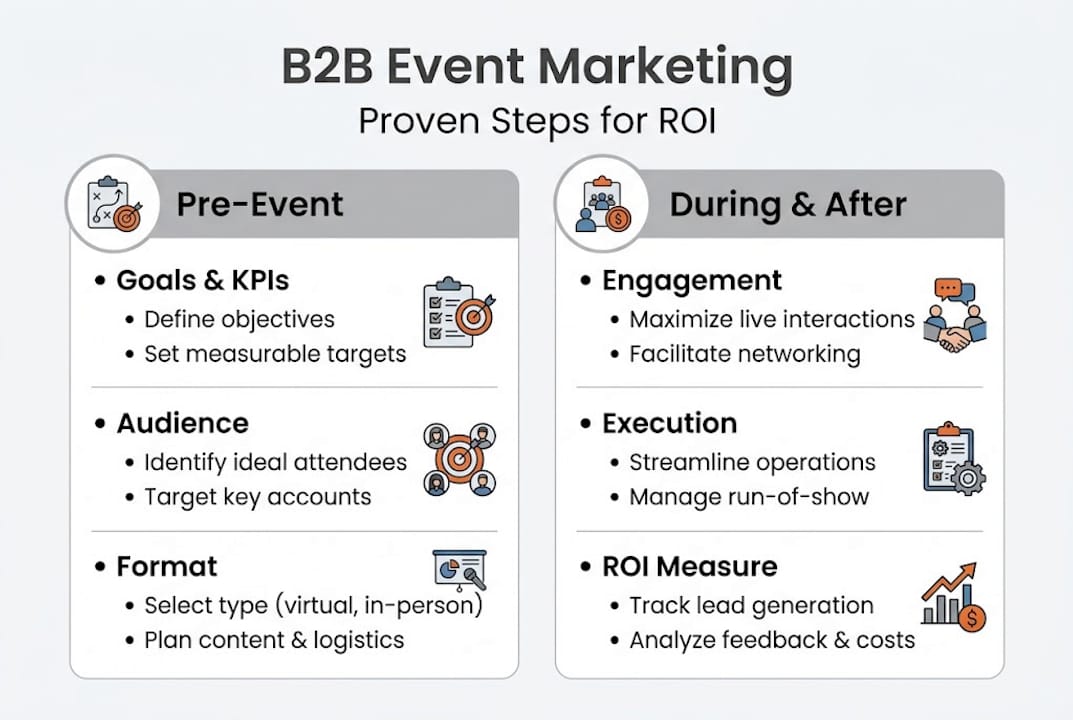
Most B2B event teams work incredibly hard, yet still struggle to show what their events actually produced. Budgets get spent, booths get staffed, and leads get scanned, but without a structured plan, the results rarely connect to revenue. Most B2B organizations struggle to connect event activity to measurable impact without a systematic approach. This guide walks you through every critical step, from setting goals to closing the loop with post-event ROI, so your next event becomes a repeatable growth driver rather than a one-time expense.
Table of Contents
- Set goals and KPIs: The foundation of event success
- Choose your event format and segment your audience
- Build your budget and event plan step by step
- Execute, integrate technology, and drive engagement
- Post-event nurture and measure real ROI
- Our perspective: What most B2B event strategies miss
- Accelerate your event marketing results with Sandbox-GTM
- Frequently asked questions
Key Takeaways
| Point | Details |
|---|---|
| Start with SMART KPIs | Clear, measurable goals are the backbone of every successful B2B event marketing program. |
| Align format and audience | Choosing the right event format and segmenting audiences boosts engagement and pipeline yield. |
| Plan and track comprehensively | A detailed budget and integrated tech stack set up smooth execution and reliable ROI data. |
| Prioritize post-event actions | Timely follow-up and rigorous measurement ensure that event investments drive growth. |
Set goals and KPIs: The foundation of event success
Every successful B2B event starts long before the venue is booked. It starts with a clear answer to one question: what does success look like? Without that answer, every other decision becomes guesswork.
Defining SMART goals and KPIs is the first and most critical step in event marketing. SMART stands for Specific, Measurable, Achievable, Relevant, and Time-bound. A goal like "generate 150 marketing qualified leads (MQLs) within 30 days of the event" is SMART. A goal like "increase brand awareness" is not.
Here are the steps to build a strong goal and KPI framework:
- Identify your business priority. Is this event meant to generate new pipeline, accelerate existing deals, or retain current customers? The answer shapes everything else.
- Choose 2 to 4 primary KPIs. Focus on metrics that connect directly to revenue: MQLs generated, meetings booked on-site, pipeline influenced, or deals closed within 90 days post-event.
- Set numeric targets. Vague goals produce vague results. Assign a specific number to each KPI before the event begins.
- Align with stakeholders early. Share your targets with sales, leadership, and any cross-functional partners. When everyone agrees on what winning looks like, follow-through improves dramatically.
- Document and distribute. Put your goals in writing and make them visible. A shared doc or dashboard keeps the whole team accountable.
Knowing how to measure event KPIs is just as important as choosing them. Many teams track activity metrics like badge scans or session attendance without connecting them to actual business outcomes. That gap is where ROI gets lost.
"The teams that consistently prove event ROI are the ones that agree on success metrics before the event, not after it."
Pro Tip: Build a one-page KPI brief for each event. Include the goal, the target number, the measurement method, and the owner. Review it in your pre-event kickoff and your post-event debrief.
Choose your event format and segment your audience
Once your objectives are set, the next critical choice is the type of event and which audience segments to target. These two decisions directly affect your budget, your content strategy, and your potential ROI.
Selecting the right event format requires matching your goals to the strengths of each format. Here is a quick comparison:
| Format | Best for | Key strength | Key limitation |
|---|---|---|---|
| Trade show | Brand visibility, net-new pipeline | High foot traffic, face-to-face | Expensive, noisy environment |
| Webinar | Education, nurture, top-of-funnel | Low cost, scalable, easy to measure | Lower engagement depth |
| Hybrid event | Broad reach, mixed audience | Combines in-person and digital | Complex to execute well |
| Executive dinner | Deal acceleration, relationship building | Intimate, high-value conversations | Small scale, high cost per head |
Once you have your format, audience segmentation is your next lever. Treating all attendees the same is one of the fastest ways to reduce engagement. Instead, break your audience down by:
- Job title and seniority: A VP of Sales needs a different message than a marketing coordinator.
- Company size and industry: Enterprise buyers have different pain points than mid-market ones.
- Buyer journey stage: Someone who just discovered your brand needs different content than someone already in a sales cycle.
- Past event behavior: Repeat attendees respond well to loyalty recognition and advanced content tracks.
Personalization at the segment level, not just the individual level, is what moves engagement from polite to productive. Reviewing event format best practices and applying audience segmentation tips before you finalize your plan can save significant rework later.
Pro Tip: Map each audience segment to a specific session, offer, or follow-up track before the event. This makes personalization operational, not just aspirational.
Build your budget and event plan step by step
With format and segments in place, focus shifts to building a realistic budget and operational plan. Underestimating costs is one of the most common reasons events underperform, not because the strategy was wrong, but because execution ran out of resources.

A solid event budget should itemize every cost category. Budget planning with a template helps avoid missed expenses. Here is a sample cost breakdown to use as a starting point:
| Cost category | Example budget |
|---|---|
| Venue rental | $8,000 |
| Speakers and talent | $10,000 |
| Technology and tools | $4,500 |
| Staffing and travel | $6,000 |
| Marketing and promotion | $5,000 |
| Contingency (10%) | $3,350 |
| Total | $36,850 |
Beyond the numbers, your event plan needs a clear timeline. Here are the key planning milestones to build around:
- 12 to 16 weeks out: Finalize goals, format, and venue. Lock in speakers and key vendors.
- 8 to 10 weeks out: Launch registration and begin multi-channel promotion. Confirm tech stack integrations.
- 4 to 6 weeks out: Finalize content, run tech rehearsals, and brief your on-site team.
- 1 to 2 weeks out: Send attendee prep communications. Confirm all logistics and escalation contacts.
- Post-event (week 1): Execute follow-up sequences and begin ROI measurement.
When negotiating with vendors, always ask for package pricing and multi-event discounts. Many vendors will reduce rates by 10 to 20 percent if you commit to a recurring relationship.
Pro Tip: Build a 10 percent contingency into every event budget. Unexpected costs are not rare; they are standard. Having a buffer keeps your team calm and your event on track.
Execute, integrate technology, and drive engagement
Once you have mapped the budget and schedule, the next phase is execution. This is where plans meet reality, and where the right technology stack makes a significant difference.
CRM integration and lead capture are essential for data-driven outcomes. Without them, you are collecting business cards instead of building pipeline intelligence. Your core tech requirements should include:
- CRM integration: Every lead and interaction should flow directly into your CRM in real time, not in a spreadsheet upload three days later.
- Registration platform: Choose a tool that captures firmographic data at sign-up so you can segment before the event begins.
- Badge scanners or digital check-in: These capture attendance data and trigger automated workflows.
- Engagement tools: Live polling, Q&A platforms, and networking apps increase session participation and generate behavioral signals.
- Lead scoring setup: Define what a high-intent action looks like (attending a demo session, visiting a specific booth area) and score leads accordingly.
Using event marketing automation allows your team to focus on conversations instead of manual data entry. When your tools are connected, every interaction becomes a data point.
On-site execution also requires a clear escalation plan. Assign a single point of contact for tech issues, a separate one for attendee experience, and a third for vendor coordination. Ambiguity in roles is the most common cause of on-site chaos.
Pro Tip: Run a full tech rehearsal 48 hours before your event. Test every integration, every screen, and every attendee-facing touchpoint. Issues caught in rehearsal take minutes to fix. Issues caught on event day take hours.
Post-event nurture and measure real ROI
To ensure your event is a growth driver, closing the loop with a strong post-event strategy is essential. This phase is where most B2B teams leave the most value on the table.
Post-event nurture and pipeline attribution are what transform event activity into business outcomes. Here is a structured approach:
- Segment your follow-up list. Not every attendee deserves the same message. Prioritize hot leads (high engagement, matched ICP) and tailor your outreach accordingly.
- Launch follow-up within 24 hours. Speed matters. A personalized email the next morning outperforms a generic blast sent five days later.
- Build a multi-touch nurture sequence. Combine email, LinkedIn outreach, and sales follow-up calls over a 3 to 4 week window.
- Attribute pipeline correctly. Tag every opportunity influenced by the event in your CRM. Use first-touch, last-touch, or multi-touch attribution depending on your model.
- Run a post-event debrief. Review what worked, what did not, and what you will change next time. Document it.
Reviewing event follow-up best practices and pairing them with marketing automation for events gives your team the structure to execute consistently.
"The event ends on the last day. The ROI is built in the weeks that follow."
A common reporting mistake is measuring only immediate conversions. Events influence deals that close 60, 90, or even 120 days later. Build your reporting window to capture that full cycle.
Our perspective: What most B2B event strategies miss
Here is something most event marketing guides will not tell you: the process steps are the easy part. The hard part is getting your organization to actually use what the event produced. 📊
We see B2B teams invest heavily in event logistics and then hand a spreadsheet of leads to sales with no context, no prioritization, and no agreed-upon follow-up cadence. The event looked successful on the surface. The pipeline told a different story.
The real differentiator is not a better badge scanner or a more polished booth. It is tracking event engagement in a way that tells your sales team exactly who to call, why they matter, and what to say. That requires tight alignment between marketing and sales before the event, not after.
It also requires ruthless focus on KPIs that connect to revenue. Chasing vanity metrics like total registrations or social impressions feels productive but rarely moves the number that matters: pipeline. The teams that win at event marketing are the ones that treat each event as an experiment, measure honestly, and iterate fast. That mindset is what separates a one-time success from a scalable program. 🎯
Accelerate your event marketing results with Sandbox-GTM
Ready to put this step-by-step plan into action? Sandbox-GTM is built for exactly this kind of work. We help B2B event teams move from scattered activity to structured, measurable growth.
Our platform captures high-intent signals across every event interaction, connects them to your GTM workflows, and tells your team who to prioritize and why. Whether you are planning your first program or scaling a multi-event calendar, we provide the systems and support to make every event accountable. Explore our ROI event marketing workflows to see how structured execution translates to real pipeline. Visit Sandbox-GTM to learn how we help teams turn event moments into measurable revenue. 🚀
Frequently asked questions
What are the most important KPIs for B2B event marketing?
The essential KPIs include MQLs generated, meetings booked, and pipeline influenced that can be directly attributed to the event. Focus on metrics that connect to revenue, not just attendance numbers.
How far in advance should you start promoting a B2B event?
Best practices recommend launching promotions 6 to 8 weeks before your event using email, LinkedIn ads, and paid channels. Starting earlier gives your audience enough time to plan and register.
What is the biggest pitfall in event marketing for B2B companies?
Failure to align event goals with business objectives and not measuring ROI are the most common mistakes B2B teams make. Without clear KPIs set in advance, it is nearly impossible to prove or improve results.
How do you select the right event format for your B2B marketing goals?
Choose based on your target audience, objectives, and available resources. Trade shows, webinars, and hybrid events each serve different goals and audience needs, so match the format to the outcome you are trying to drive.