

TL;DR:
- Integrating sales with event strategies boosts targeting, real-time signals, and revenue attribution.
- Full sales involvement across planning, during, and post-event phases maximizes pipeline and closes deals faster.
- Measuring sourced and influenced pipeline with CRM integration is essential for demonstrating event ROI and continuous improvement.
Most event strategies are built by marketing teams, handed off to logistics, and then evaluated on attendance numbers alone. That's a costly blind spot. When sales is left out of event planning, you lose the targeting intelligence, real-time buyer signals, and follow-up velocity that turn a good event into a revenue engine. Only a quarter of enterprises fully integrate their event platforms, which means the majority of companies are leaving measurable pipeline on the table. This guide breaks down why sales integration is non-negotiable for event-driven growth and exactly how to make it work across every stage of your event program.
Table of Contents
- Why sales matters in event strategy
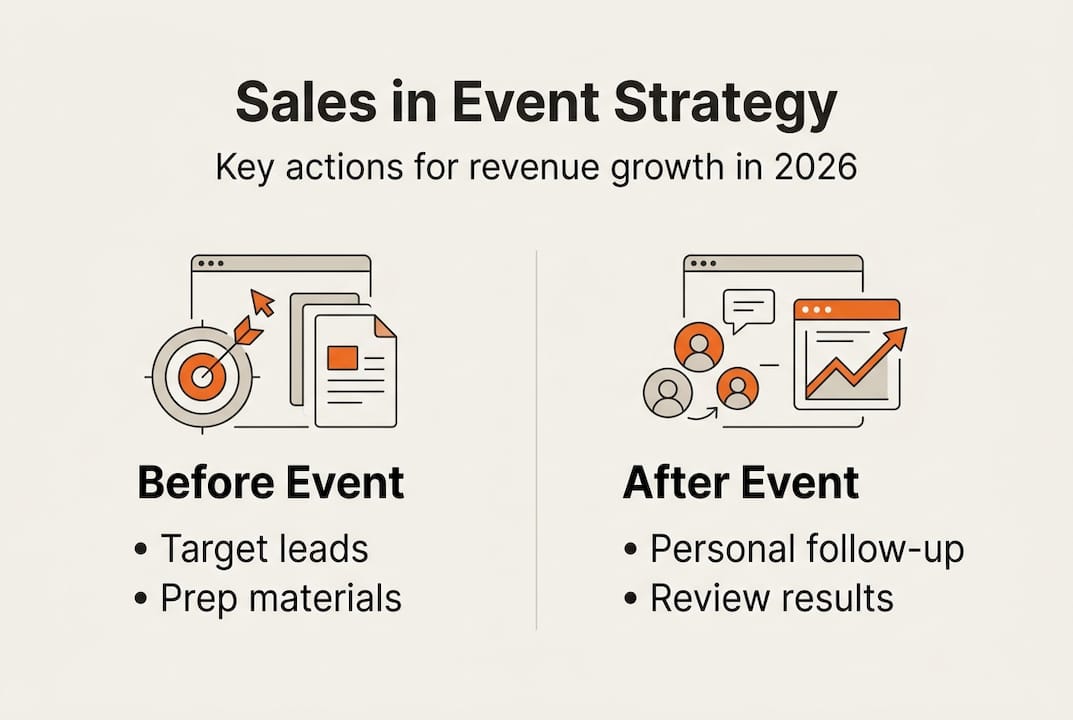
- Key sales roles and actions before, during, and after events
- How to integrate sales and marketing for event ROI
- Measuring and optimizing sales-driven event success
- Why the real win comes from sales-driven event learnings
- Unlock event-driven growth with Sandbox-GTM
- Frequently asked questions
Key Takeaways
| Point | Details |
|---|---|
| Sales integration multiplies event ROI | Bringing sales into event strategy drives deeper engagement, better targeting, and measurable revenue growth. |
| Strategic roles at every stage | Sales adds value in pre-event planning, live execution, and fast, personalized post-event follow-up. |
| Tech alignment is essential | Integrating event platforms with CRM enables accurate tracking and optimization of event-driven opportunities. |
| Learnings matter most | Sales insights from events help improve future strategies and maximize long-term growth. |
Why sales matters in event strategy
Events are one of the highest-intent touchpoints in your entire GTM (go-to-market) motion. Prospects show up, raise their hands, and signal what they care about in real time. But if sales isn't part of the strategy, that signal goes nowhere. It gets logged in a spreadsheet, passed along in a batch email three weeks later, or worse, ignored entirely.
Strong sales-event alignment consistently improves business outcomes across the board. Teams that bring sales into the process earlier see more targeted outreach before the event, sharper buyer insights during it, and higher quality follow-up after. The result is a shorter sales cycle and a clearer line between event activity and closed revenue.
"Siloed planning between marketing and sales is one of the primary reasons event ROI stays low. When teams operate in separate lanes, the data stays fragmented and the opportunity disappears." — Forrester B2B Events Research
Here's why sales involvement makes a measurable difference:
- Alignment on targeting: Sales knows which accounts are in active buying cycles. That intelligence shapes who gets invited, who gets prioritized on the floor, and who gets a same-day follow-up.
- Rapid feedback loops: Sales reps hear objections, questions, and competitive mentions in real time. That feedback is gold for refining messaging and content.
- Closing the loop on influenced opportunities: Without sales in the picture, event-influenced pipeline never gets attributed correctly. Deals close and nobody connects them back to the event that moved the needle.
As Forrester B2B events research confirms, integrating event tech with CRM and breaking down team silos leads directly to improved event ROI. The companies unlocking event-driven ROI are the ones treating sales as a core event function, not an afterthought.
Only 25% of enterprises fully integrate their event platforms. That means 75% of companies are running events without the infrastructure to connect activity to revenue. If you're in that majority, the opportunity to differentiate is significant.
Key sales roles and actions before, during, and after events
Sales involvement isn't a single moment. It spans the entire event lifecycle, and each stage has distinct responsibilities that directly affect outcomes. Tailoring events to buyer lifecycle stages maximizes both engagement and post-event follow-up effectiveness.
Here's how that breaks down:
| Stage | Sales responsibilities | Key goals |
|---|---|---|
| Before | Account prioritization, outreach to target attendees, briefing on messaging | Fill pipeline with high-fit prospects, set meetings |
| During | Attend sessions, host 1:1 meetings, capture notes and signals in CRM | Qualify interest, deepen relationships, log intent |
| After | Personalized follow-up within 24-48 hours, route leads to right reps, update CRM | Convert interest to pipeline, close the loop |
Pre-event sales preparation: a step-by-step approach
- Pull a list of registered attendees and cross-reference with your CRM and target account list.
- Identify which accounts are in active buying stages and flag them for priority outreach.
- Brief the sales team on event messaging, key sessions, and competitive context.
- Schedule meetings in advance using a shared calendar or event app.
- Align on what a qualified lead looks like for this specific event, not just a generic MQL definition.
Review your event marketing framework to make sure pre-event prep is built into your standard operating process, not improvised each time.
Post-event follow-up is where most teams lose momentum. Generic "great to meet you" emails don't move deals. Personalized outreach that references a specific conversation, session attended, or challenge mentioned does. Explore event follow-up best practices and post-event engagement strategies to build a repeatable system.
Make sure your team also has effective event materials on hand so every touchpoint reinforces your message.
Pro Tip: Personalization based on event interactions boosts conversion rates significantly. Train reps to capture one specific detail from each conversation and lead with it in follow-up. It takes 60 seconds and changes the entire tone of the outreach. 🎯
How to integrate sales and marketing for event ROI
Defining sales roles is one thing. Getting sales and marketing to actually operate as one team around events is another. The gap between those two realities is where most event ROI gets lost.
Here's a side-by-side look at what siloed versus integrated teams actually look like in practice:
| Area | Siloed teams | Integrated teams |
|---|---|---|
| Process | Marketing plans, sales shows up | Joint planning from day one |
| Data | Separate spreadsheets and tools | Shared CRM with event data synced |
| Outcomes | Leads handed off, rarely tracked | Pipeline attributed, feedback loops closed |
| Follow-up | Batch email days later | Personalized outreach within 24 hours |
The enablers that make integration real:
- Shared goals: Both teams own the same pipeline and revenue targets tied to the event, not separate vanity metrics.
- Event tech-CRM integration: Integrating event tech with CRM is the foundation for tracking and boosting event-driven revenue. Without it, attribution is guesswork.
- Regular feedback loops: Weekly syncs during event season, a debrief within 48 hours of the event, and a shared Slack channel for real-time updates during the event itself.
Pitfalls to avoid: Don't let sales get looped in only for the follow-up. Don't let marketing own lead scoring without sales input. And don't skip the post-event debrief. That's where the most valuable learning happens.
Pro Tip: Establish clear mutual SLAs (service-level agreements) for event leads. For example: marketing delivers qualified leads within 24 hours of the event, sales follows up within 48 hours. Written agreements eliminate the blame game and create accountability on both sides. 📋
For more on optimizing event conversions and event signal tracking, explore the frameworks that help teams turn integration into measurable results.
Measuring and optimizing sales-driven event success
Once integration is in place, ongoing measurement and refinement will unlock real revenue impact. The metrics you track determine the behavior you reinforce. If you only measure attendance and badge scans, that's what your team will optimize for.
Here are the sales-driven metrics that actually matter:
- Sourced pipeline: New opportunities created directly from event interactions.
- Influenced pipeline: Existing opportunities that accelerated because of event engagement.
- Closed-won revenue: Deals that closed where an event was a touchpoint in the journey.
- Lead-to-opportunity conversion rate: How many event leads became qualified sales opportunities.
"Failure to measure event-linked revenue isn't just a reporting gap. It's a strategic gap. If you can't show that events move pipeline, you can't justify the investment or improve the program."
Best practices for tracking these metrics:
- Use automated lead capture tools at the event so data enters your CRM in real time, not after a manual import.
- Match event attendee data with CRM records within 24 hours to preserve context and timing.
- Build a closed-loop feedback process where sales reports back on which event leads converted and why.
- Tag every opportunity influenced by an event so you can pull clean attribution reports.
CRM and event tech integration enables the deeper ROI measurement and optimization that turns events from a cost center into a growth channel. Review your event activity reporting process and understand why event metrics matter for building a smarter, more accountable program.

For continuous improvement, run a quarterly review of event performance across all metrics. Identify which event types, formats, and audiences generate the highest pipeline conversion. Double down on what works. Cut what doesn't.
Why the real win comes from sales-driven event learnings
Here's a perspective most event playbooks skip: the biggest long-term value of sales-event integration isn't the pipeline you close this quarter. It's the intelligence you collect that shapes your strategy for the next 12 months.
Sales reps at events hear things that no survey or analyst report captures. They hear which competitors prospects are evaluating. They hear what objections are showing up repeatedly. They hear which product features matter most to which buyer types. That's market intelligence in real time.
Most companies don't capture it systematically. Reps come back from events, file a few notes, and move on. The learning evaporates. The next event gets planned with the same assumptions as the last one.
The teams that win over time use event-driven sales feedback to evolve their ICP (ideal customer profile), refine their messaging, and choose better events to invest in. They track objection trends across events and feed them into product and marketing. They treat every event as a research opportunity, not just a lead generation exercise.
Shifting your mindset from MQL and SQL volume to systematic learning is what separates average event programs from exceptional ones. Explore how event ROI automation can help you capture and act on these signals at scale. 💡
Unlock event-driven growth with Sandbox-GTM
Ready to operationalize these approaches? Sandbox-GTM is built for sales and marketing leaders who want events to be a real growth channel, not a line item that's hard to justify.
Our platform and event marketing workflows help you capture high-intent signals, align sales and marketing around shared goals, and connect every event interaction to pipeline and revenue. Whether you're scaling a flagship conference or running targeted field events, Sandbox-GTM gives you the systems and support to make every event accountable and worth repeating. Let's build an event program that your CFO and your sales team both believe in. 🚀
Frequently asked questions
What is the role of sales in event strategy?
Sales teams drive targeted outreach before events, engage high-priority prospects on-site, and follow up quickly to convert event interest into pipeline and revenue. Aligning sales involvement with event tech and CRM unlocks significantly better ROI.
How do you measure the impact of sales on event success?
Track sourced and influenced pipeline, lead-to-opportunity conversion rates, and closed-won revenue tied to event interactions. CRM and event tech integration is the foundation for measuring these sales-driven outcomes accurately.
When should sales get involved in event planning?
Sales should be involved from the earliest planning stages, shaping targeting, messaging, and follow-up strategy before a single invite goes out. Sales involvement at all stages of the buyer lifecycle increases both engagement and follow-up effectiveness.
Why do some companies see low ROI from events?
Low event ROI typically comes from siloed planning, weak sales integration, and no system for tracking outcomes in CRM. Only 25% of companies fully integrate their event tech, which limits the returns most teams could otherwise achieve.
Recommended
- Events in lead generation: B2B success strategies 2026
- Events in marketing automation: Unlock ROI in 2026
- Unlock key benefits of event marketing automation in 2026
- Why track event engagement: boost B2B growth in 2026
- How to Make Conferences Profitable | Proven Strategies for Event Revenue | King Sixteen — King Sixteen