

Seventy-two percent of event marketers confirm that content marketing significantly increases engagement and drives higher attendance. Yet many organizations still treat content as an afterthought rather than a strategic driver of ROI. This guide reveals how to deploy content across pre-event, live, and post-event phases to maximize engagement, capture intent, and convert attendees into pipeline.
Table of Contents
- Why Content Is Central To Successful Event Marketing
- Strategic Content Planning: Persona Development And Audience Understanding
- Content's Role Before And During Events: Building Buzz And Sustaining Engagement
- Post-Event Content And Roi Realization: Nurturing Leads And Sustaining Momentum
- Leveraging Technology And Measurement: Data-Driven Personalization And Roi Analytics
- Common Misconceptions About Content's Role In Event Marketing
- Content Formats And Event Technology Integration: Choosing What Works
- Building A Content-Driven Event Marketing Framework For Sustainable Success
- Maximize Your Event Marketing With Strategic Content Solutions
Key takeaways
| Point | Details |
|---|---|
| Content drives measurable outcomes | Strategic content increases event attendance by 72% through targeted engagement. |
| Persona-driven messaging works | Tailoring content to buyer personas improves registration rates and message relevance. |
| Live content amplifies engagement | Real-time social updates and interactive formats boost attendee interaction by 33%. |
| Post-event content extends ROI | Repurposed recordings and follow-up materials increase reach by over 40%. |
| AI personalizes at scale | Technology enables dynamic content customization that deepens engagement and conversion. |
Why content is central to successful event marketing
Content is the engine that powers event marketing from initial awareness through post-event conversion. Without a strategic content plan, events become one-off experiences that fail to generate lasting business value. Organizations that integrate content throughout the event lifecycle capture more qualified leads, create richer attendee experiences, and build measurable pipeline.
The 72% of event marketers who confirm content marketing significantly increases engagement understand this foundational truth. Content serves multiple strategic functions: it educates prospects before they register, sustains attention during live experiences, and nurtures relationships after events conclude. Each phase demands distinct content types and distribution strategies.
Effective event content creates community and positions your brand as a thought leader. It transforms passive attendees into active participants who engage with your message, share experiences, and eventually convert. The key is treating content not as promotional material but as strategic assets that deliver value at every touchpoint.
"Strategic content transforms events from logistics exercises into engagement platforms that generate measurable business outcomes and lasting audience relationships."
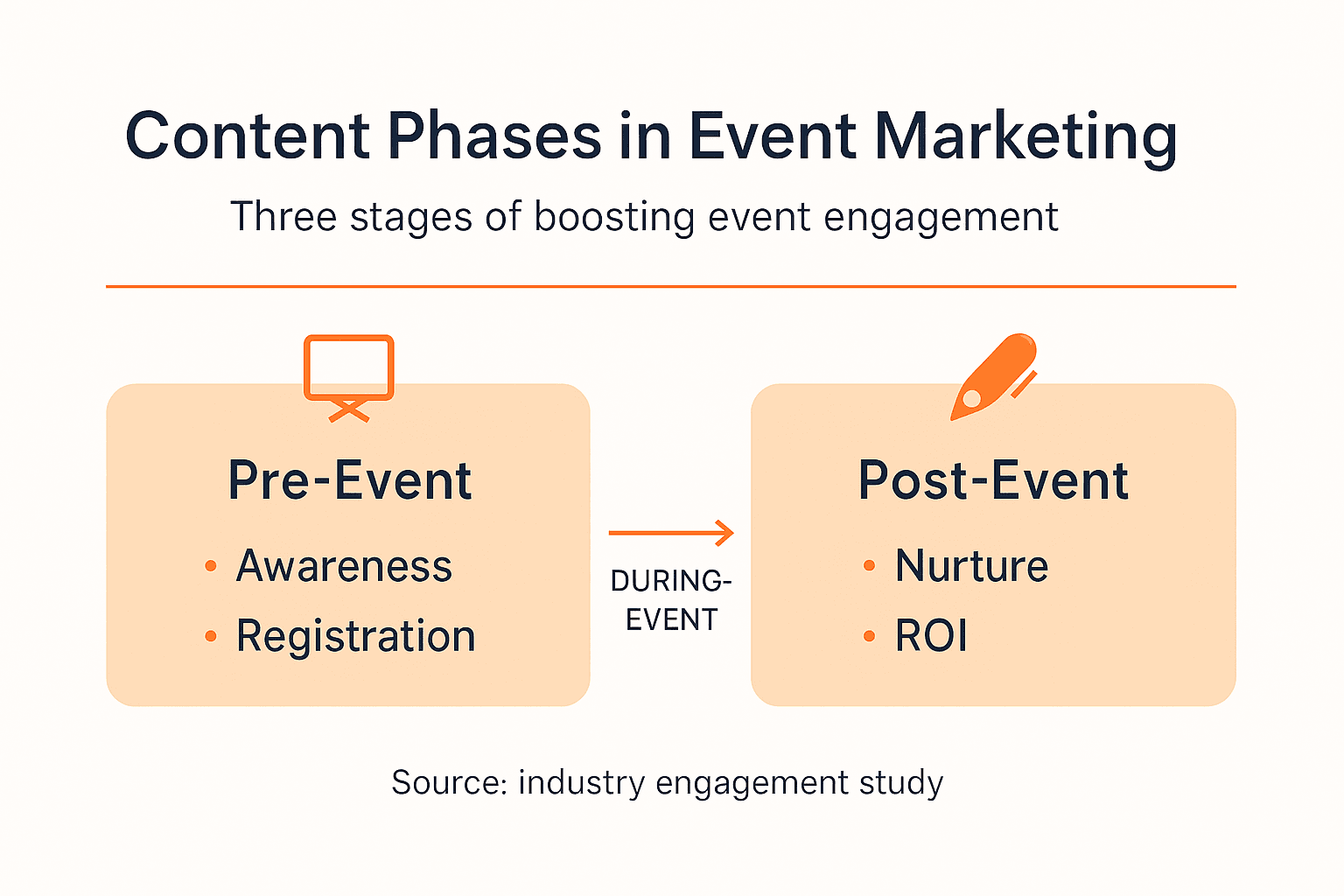
Three phases define content-driven event marketing: pre-event content that builds anticipation and drives registrations, live content that sustains engagement and captures intent signals, and post-event content that nurtures leads toward conversion. Organizations that master all three phases consistently outperform competitors in attendance, engagement metrics, and revenue attribution.
Strategic content planning: persona development and audience understanding
Generic messaging fails because modern buyers expect personalization. Creating detailed buyer personas allows you to segment audiences and craft content that speaks directly to specific pain points, goals, and decision criteria. This targeted approach dramatically improves registration rates and attendee satisfaction.
Start by identifying distinct audience segments within your target market. A typical B2B event might attract executives seeking strategic insights, practitioners looking for tactical guidance, and vendors exploring partnership opportunities. Each group requires different messaging, content formats, and engagement strategies.
Buyer persona-driven strategies improve message relevance by addressing the specific challenges each segment faces. For executives, focus on ROI and competitive advantage. For practitioners, emphasize actionable frameworks and implementation guidance. For vendors, highlight collaboration opportunities and ecosystem benefits.
Pro Tip: Interview 5 to 10 past attendees from each segment to understand their decision-making process, preferred content formats, and information gaps that your event can fill.
Once personas are defined, map content to each stage of the attendee journey:
- Awareness stage content introduces your event value proposition and establishes relevance
- Consideration stage content demonstrates expertise and differentiates your event from alternatives
- Decision stage content provides social proof and removes barriers to registration
- Post-event content reinforces learning and guides next steps
This persona-informed approach ensures every piece of content serves a strategic purpose rather than adding noise to crowded inboxes.
Content's role before and during events: building buzz and sustaining engagement
Pre-event content determines whether prospects register or ignore your event. The most effective organizations deploy a multi-channel content strategy that combines educational material, social proof, and strategic urgency to drive conversions.
Start 8 to 12 weeks before the event with thought leadership content that establishes the event's relevance. Blog posts addressing industry challenges, research reports highlighting emerging trends, and expert interviews previewing session topics all build credibility and awareness. These assets position your event as a must-attend opportunity for professionals seeking competitive advantage.
As the event approaches, shift toward conversion-focused content:
- Speaker highlight videos that showcase expertise and session value
- Testimonials from past attendees demonstrating concrete outcomes
- Agenda deep dives explaining what attendees will learn and how to apply insights
- Early bird deadlines and capacity warnings that create appropriate urgency
- Email sequences tailored to persona segments with customized value propositions
The pre-event content that drives registration focuses on value delivery rather than promotional messaging. Every email, social post, and blog should answer the question: "What specific problem will this event solve for me?"
During the event itself, live content engagement sustains attention and amplifies reach beyond physical attendees. Real-time social media updates, interactive polls, and user-generated content create FOMO for those not present while deepening engagement for those attending.
Live content strategies that work:
- Quote graphics from keynote speakers shared within minutes of delivery
- Behind-the-scenes footage humanizing the event experience
- Attendee interviews capturing real-time reactions and key takeaways
- Interactive Q&A sessions extending participation to virtual audiences
- Live polls and surveys that give attendees voice in content direction
Data confirms that organizations prioritizing live content see a 33% increase in attendee interaction, measured through social engagement, session participation, and booth visits. This real-time content also creates a library of assets for post-event nurture campaigns.
Hybrid events require even more sophisticated content strategies. Physical attendees expect high-touch networking and spontaneous interactions, while virtual participants need structured content delivery and digital engagement tools. Successful hybrid content addresses both audiences without diluting the experience for either group.
Post-event content and ROI realization: nurturing leads and sustaining momentum
Most event ROI happens after the event ends. Post-event content transforms attendee interest into concrete business outcomes by maintaining engagement, reinforcing key messages, and guiding prospects toward conversion.

Recorded sessions are the foundation of post-event content strategy. Make session videos available within 48 hours while the experience remains fresh. Segment recordings by topic and persona to make navigation intuitive. Include timestamps for key moments so busy professionals can quickly find relevant insights.
Beyond recordings, deploy these post-event content assets:
- Highlight reels that capture event energy and showcase key moments
- Blog recaps analyzing major themes and actionable takeaways
- Infographics visualizing data and research shared during sessions
- Follow-up email sequences with persona-specific resources and next steps
- Case studies documenting how past attendees applied learnings to achieve results
The organizations that excel at post-event content repurposing increase reach by over 40% through multi-channel distribution. Share session insights on LinkedIn, create Twitter threads highlighting key quotes, and develop YouTube videos breaking down complex topics presented at the event.
Pro Tip: Create content upgrade paths where attendees can access deeper resources by taking small conversion actions like scheduling a demo, joining a community, or subscribing to a newsletter.
Post-event content serves a critical nurture function for leads not yet ready to buy. Educational follow-up maintains your brand presence while prospects complete internal evaluation processes. When buying intent strengthens, your organization remains top of mind because you consistently delivered value.
Measure post-event content performance through engagement metrics like video completion rates, download statistics, and click-through rates. Track how content consumption correlates with pipeline progression and revenue attribution. These insights inform future content strategies and justify marketing budgets.
Leveraging technology and measurement: data-driven personalization and ROI analytics
Technology transforms content from a manual, labor-intensive process into a scalable, data-driven engine that personalizes experiences and proves ROI. AI personalization for event content enables dynamic customization based on attendee behavior, preferences, and engagement history.
AI tools analyze registration data, session selections, and content interactions to predict what each attendee finds valuable. This intelligence powers personalized email recommendations, customized agenda suggestions, and targeted post-event follow-up. The result is higher conversion rates and deeper engagement across the entire event lifecycle.
Key AI applications in event content include:
- Dynamic email personalization that adjusts messaging based on engagement patterns
- Chatbots delivering instant, personalized responses to attendee questions
- Content recommendation engines suggesting sessions and resources aligned with interests
- Sentiment analysis identifying which messages resonate with specific segments
Data analytics provide the measurement layer essential for optimizing content strategy. Data analytics in event marketing track engagement heatmaps showing which content captures attention, content interest tracking revealing topic preferences, and conversion attribution connecting content consumption to business outcomes.
Modern event platforms capture granular data on attendee behavior: which sessions they attend, how long they engage with content, what resources they download, and which calls to action they respond to. This behavioral data informs real-time content adjustments during events and strategic planning for future programs.
| Approach | Personalization | Scalability | ROI Measurement |
|---|---|---|---|
| Manual Content Creation | Limited to broad segments | Requires significant resources | Difficult to attribute |
| AI-Driven Personalized Content | Individual-level customization | Scales automatically | Precise multi-touch attribution |
The measurement framework should track both leading indicators like content engagement and lagging indicators like pipeline and revenue. Connect content consumption to CRM records so sales teams understand which prospects engaged deeply with event content. This intelligence enables more informed, personalized follow-up conversations.
Justifying event marketing budgets requires demonstrating concrete ROI. Analytics dashboards that connect content performance to business outcomes make this case compellingly. When leadership sees how specific content assets drive registrations, engagement, and conversions, continued investment becomes an easy decision.
Common misconceptions about content's role in event marketing
Several persistent myths limit how organizations leverage content in event marketing. Dispelling these misconceptions enables more strategic, effective approaches.
Misconception 1: Content is primarily promotional. Many teams treat content as advertising rather than education. Effective event content delivers genuine value by solving problems, answering questions, and providing actionable insights. Promotional messaging should represent less than 20% of your content mix.
Misconception 2: Content only matters before events. Pre-event promotion is important, but live and post-event content often deliver greater engagement and conversion impact. Organizations that deploy content across all three phases see significantly higher ROI than those focusing exclusively on pre-event promotion.
Misconception 3: More content is always better. Volume without strategy creates noise. Five high-quality, strategically timed assets outperform 50 generic pieces. Focus on content that addresses specific audience needs at critical decision points rather than flooding channels with mediocre material.
Misconception 4: Content creation can be spontaneous. Effective event content requires intentional planning, clear objectives, and systematic execution. Successful organizations build content calendars 12 weeks before events, assign clear ownership, and establish quality standards that ensure consistency.
Recognizing these misconceptions helps you avoid common pitfalls and build content strategies grounded in what actually drives results.
Content formats and event technology integration: choosing what works
Different event formats demand different content approaches. Understanding how content strategy varies across in-person, virtual, and hybrid events ensures you maximize engagement regardless of format.
In-person events offer rich opportunities for sensory, experiential content. Attendees value spontaneous networking, hands-on demonstrations, and immersive brand experiences. Content here emphasizes capturing moments for post-event distribution while enabling real-time sharing that extends reach beyond the venue.
Virtual events democratize access and reduce costs but require more structured content delivery. Without physical presence, you must work harder to maintain attention and create engagement. Interactive formats like live polls, Q&A sessions, and breakout discussions prevent passive viewing and encourage active participation.
Hybrid event content formats must serve both audiences without compromising either experience. This requires parallel content streams, technology that seamlessly integrates physical and digital interactions, and facilitators skilled at managing multi-channel engagement.
| Event Format | Content Strengths | Technology Requirements | Engagement Strategy |
|---|---|---|---|
| In-Person | Experiential, networking-focused, spontaneous | Mobile apps, social sharing tools | Capture and amplify moments |
| Virtual | Accessible, cost-effective, globally scalable | Streaming platforms, engagement tools | Structured interaction, frequent breaks |
| Hybrid | Combines benefits of both formats | Advanced integration technology | Parallel content streams, unified experience |
Content formats that drive participation across all event types include:
- Interactive presentations with live audience input shaping content direction
- Engaging photo booths and visual content stations that create shareable moments
- Gamification elements like scavenger hunts and challenges rewarding engagement
- Expert panels with moderated discussions addressing real attendee questions
The most successful organizations test multiple content formats, measure performance, and continuously optimize based on engagement data. What works for one audience might not resonate with another, so experimentation informed by measurement is essential.
Building a content-driven event marketing framework for sustainable success
Transforming event marketing into a predictable revenue channel requires a systematic framework that integrates content throughout the attendee lifecycle. The following approach synthesizes insights from this guide into actionable steps you can implement immediately.
-
Develop detailed buyer personas grounded in research, interviews, and behavioral data. Map content needs to each persona and lifecycle stage.
-
Create a content calendar spanning 12 weeks pre-event through 8 weeks post-event. Assign clear ownership, deadlines, and quality standards for each asset.
-
Deploy multi-channel distribution that meets audiences where they spend time. Coordinate email, social media, blog content, and paid promotion for maximum reach.
-
Integrate AI and analytics to personalize content delivery and measure performance. Connect content engagement to pipeline and revenue outcomes.
-
Establish feedback loops where post-event analysis informs future content strategy. Document what worked, what didn't, and why.
-
Build a content library of reusable assets that can be adapted for future events. Session recordings, presentation templates, and promotional materials save time and ensure consistency.
Pro Tip: Start small if resources are limited. Mastering one or two high-impact content types delivers better results than spreading effort across many mediocre initiatives.
Sustainable event marketing success comes from treating content as a strategic asset rather than a tactical necessity. Organizations that invest in content planning, creation, and measurement consistently outperform competitors in attendance, engagement, and revenue attribution. The framework outlined here provides a roadmap for achieving these outcomes.
Continual optimization is essential. What works today might not work next year as audience preferences evolve and new technologies emerge. Commit to regular content audits, performance reviews, and strategic adjustments based on data and feedback.
Maximize your event marketing with strategic content solutions
You now understand how content drives event engagement and measurable ROI across every phase. But knowing the strategy and executing flawlessly are different challenges. Sandbox helps event marketers capture high-intent signals from content interactions and turn them into actionable GTM intelligence.
Our platform connects pre-event content engagement, live event activity, and post-event nurture into a unified system that tells you exactly who to follow up with and why. Whether you're launching your first program or scaling a flagship conference, event marketing solutions from Sandbox provide the systems, signal, and support to make your events accountable and repeatable.
Stop treating events as logistics exercises. Start capturing the intent your content creates and converting it into pipeline and revenue.
FAQ
What types of content work best to drive event registrations?
Pre-event teasers showcasing speaker expertise, educational blogs addressing audience pain points, and testimonials providing social proof are proven registration drivers. Persona-informed messaging that speaks directly to segment-specific goals improves relevance and response rates significantly.
How can live content during events improve attendee engagement?
Real-time social media updates, interactive polls, and user-generated content create excitement and boost engagement by over 30%. These formats sustain attention during sessions and expand event reach to audiences not physically present.
Why is post-event content critical for measurable ROI?
Recorded sessions and follow-up educational materials nurture leads who aren't ready to convert immediately, keeping your brand top of mind. This content reinforces key messages and guides prospects through evaluation processes, directly accelerating conversion rates.
How does technology enhance content personalization in event marketing?
AI-driven tools dynamically customize content based on individual attendee behavior, preferences, and engagement history. Data analytics track content performance across the lifecycle, providing insights that optimize messaging and format choices for maximum impact.
What content formats work best for hybrid events?
Hybrid events require parallel content streams serving both physical and virtual audiences without compromising either experience. Interactive formats like live Q&A, polling, and breakout discussions engage both groups, while recording technology ensures virtual participants access the same quality content as in-person attendees.