

Generic event invitations are quietly costing you pipeline. When every attendee receives the same message, you're leaving real revenue on the table. Personalization drives 10-15% revenue lift, and that number applies directly to how you invite, nurture, and follow up with event prospects. The event marketing professionals who are winning right now aren't sending more emails. They're sending smarter ones. This guide breaks down the psychology, the data, the frameworks, and the practical steps you need to make personalized event outreach your strongest growth lever.
Table of Contents
- What makes personalized event outreach so powerful?
- The data: How personalization drives event success
- Real-world frameworks: Tiers of event personalization
- Best practices and common pitfalls in personalized outreach
- Applying these strategies to your next event
- Supercharge your event ROI with advanced personalization
- Frequently asked questions
Key Takeaways
| Point | Details |
|---|---|
| Personalized outreach boosts results | Personalization in event marketing drives higher engagement, ticket sales, and ROI. |
| Tiered strategies outperform generic | Using company, role, or behavioral segments is more effective than one-size-fits-all messaging. |
| Avoid over-personalization | Balance personalization with privacy to maintain trust and prevent recipient fatigue. |
| Start simple and scale up | Begin with segment-based personalization and iterate based on data and outcomes. |
| Leverage tools and workflows | Automation and platforms help make personalization manageable and impactful even for lean teams. |
What makes personalized event outreach so powerful?
Personalized event outreach is more than swapping in a first name. It means crafting every touchpoint, from the initial invitation to the post-event follow-up, around what a specific person or segment actually cares about. Think: their role, their industry challenges, their past behavior with your brand, and their likely intent.
The psychology here is straightforward. People pay attention to messages that feel relevant to them. When your outreach answers "why you, why now," it earns trust faster than any generic campaign ever could. Contextual relevance in outreach builds credibility, shortens sales cycles, and drives higher conversion rates because recipients feel understood rather than targeted.
"The best event outreach doesn't feel like marketing. It feels like a well-timed, relevant conversation."
Here's what personalized event outreach actually delivers:
- 🎯 Higher open and click rates because the message matches the reader's context
- 🤝 Stronger trust signals that accelerate relationship-building before the event
- ⚡ Shorter conversion cycles as prospects move from awareness to registration faster
- 📈 Better ROI through improved engagement at every stage of the funnel
If you're exploring automation in event outreach, personalization is the strategy that makes automation actually work. Without it, you're just automating noise.
The data: How personalization drives event success
The numbers behind personalization aren't subtle. They're hard to ignore. Ticketek saw a 49% increase in sales per email opened and a 250% conversion uplift after implementing AI-driven personalization in their event outreach. That's not a marginal improvement. That's a fundamental shift in what's possible.
Here's a summary of what the data shows across key performance areas:
| Metric | Typical generic campaign | With personalization |
|---|---|---|
| Revenue lift | Baseline | Up to 15% increase |
| Email sales uplift | Baseline | Up to 49% per email opened |
| Conversion rate | Baseline | Up to 250% uplift |
| Customer engagement | Low to moderate | Significantly higher |
These numbers force a mindset shift. If your current event campaigns treat all registrants the same, you're not just underperforming. You're actively leaving conversions behind. Good event segmentation tips can help you start capturing this gap immediately.
Personalization also compounds over time. When you track which segments respond best to which messages, you build a playbook that gets sharper with every campaign. Strong post-event engagement and a structured event follow up process extend the ROI window well beyond the event itself.

Pro Tip: Before you scale personalization, benchmark your current campaign performance. Track open rates, conversion rates, and pipeline generated by campaign type. Then measure the delta as you introduce personalization tiers. This gives you a clear, defensible ROI story for leadership.
Real-world frameworks: Tiers of event personalization
Not all personalization is created equal. There's a spectrum, and where you start depends on your data maturity, team capacity, and audience size. Here's how the tiers break down:
| Tier | Data used | Example in event campaigns |
|---|---|---|
| Basic | Company name, industry | "We're hosting an event for [industry] leaders" |
| Intermediate | Role, intent signals, past attendance | Segmented tracks, role-specific agendas |
| Advanced | Behavioral data, AI-driven 1:1 recommendations | Dynamic content, personalized session suggestions |
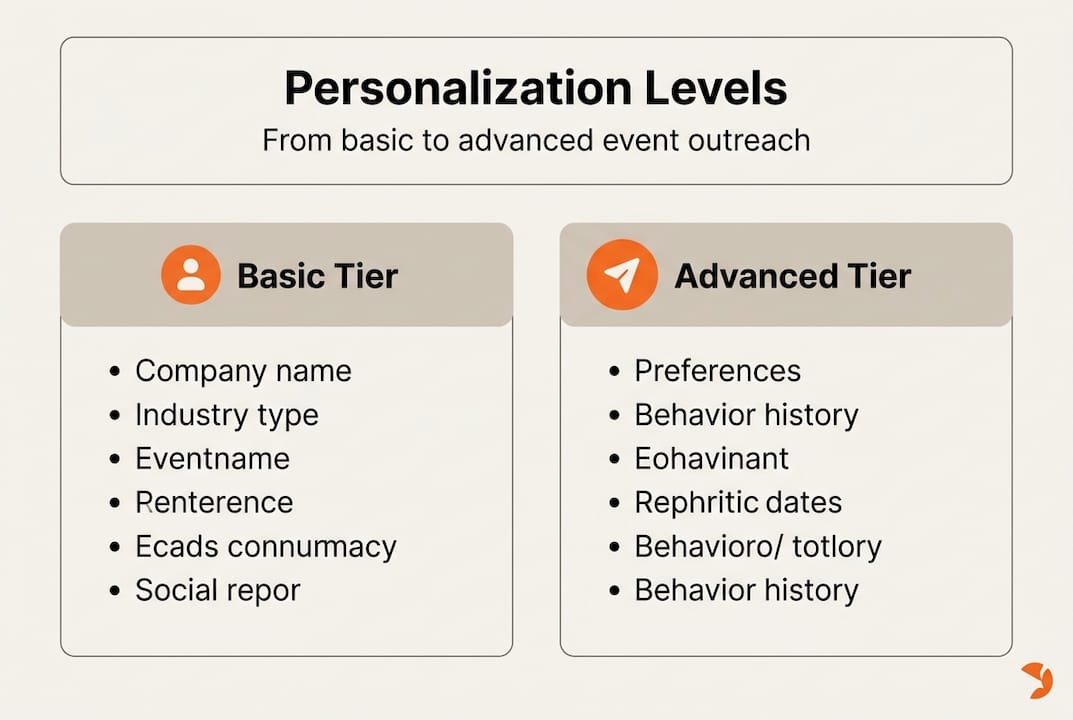
Tiered personalization lets you match your approach to your resources. You don't need a full AI stack to start seeing results. Even basic company-level segmentation outperforms generic blasts.
Here's how to gradually upgrade your personalization approach:
- Audit your data. Identify what you already know about your audience: industry, role, past event attendance, content downloads.
- Segment before you personalize. Group your audience into 3-5 meaningful buckets based on shared characteristics or intent.
- Customize messaging per segment. Adjust subject lines, body copy, and CTAs to reflect each group's priorities.
- Add behavioral triggers. Use registration activity, email clicks, or website visits to send timely, relevant follow-ups.
- Introduce AI-driven recommendations for high-volume programs where 1:1 personalization at scale becomes necessary.
- Review and refine. After each event, assess which tiers drove the most engagement and pipeline.
One important caveat: avoid over-personalization. Using too many personal details can feel intrusive and erode trust. Stick to data that's clearly relevant to the event context, and always respect privacy preferences. Event marketing automation tools can help you manage this balance at scale.
Pro Tip: Use a hybrid approach. Apply manual, high-touch personalization for your top-tier accounts and VIP prospects. Automate personalization for broader segments. This keeps quality high without burning out your team.
Best practices and common pitfalls in personalized outreach
Knowing what works is only half the equation. Knowing what to avoid is equally important. Here's what separates effective personalization from the kind that backfires.
What to do: ✅
- Test and learn continuously. Run A/B tests on subject lines, messaging angles, and send timing across segments.
- Stay privacy-first. Use first-party data collected with clear consent. This builds trust and keeps you compliant.
- Personalize for relevance, not novelty. Every personalized element should serve the reader's needs, not just demonstrate that you know their name.
- Apply manual touches for VIPs. High-value accounts deserve a human voice, not just a dynamic field.
- Track the right metrics. Use event metrics that matter to evaluate whether personalization is actually moving the needle.
What to avoid: ❌
- Token personalization. Inserting a first name into an otherwise generic email isn't personalization. It's a missed opportunity.
- Over-personalization. Referencing too many personal details can feel surveillance-like and damage your brand.
- Ignoring opt-outs. Always make it easy for recipients to update preferences or unsubscribe. Respecting this builds long-term trust.
- Skipping the data audit. Personalizing with outdated or inaccurate data is worse than not personalizing at all.
Capturing the right signals before and during your event is foundational. Strong event intent capture practices give you the data you need to personalize meaningfully without guessing.
Pro Tip: Always include a clear, easy opt-out in every outreach. And briefly explain how you're using their data. Transparency isn't just a legal requirement. It's a trust-building move that improves long-term engagement.
Applying these strategies to your next event
Ready to put this into practice? Here's a step-by-step approach you can apply before, during, and after your next event.
Pre-event:
- Define your audience segments based on role, industry, and intent signals.
- Map messaging to each segment. What problem does this event solve for them specifically?
- Set up triggered emails based on registration behavior (registered but not confirmed, confirmed but not engaged).
- Personalize landing pages where possible to reflect the segment's priorities.
During the event:
- Use real-time engagement data (session attendance, booth visits, content downloads) to flag high-intent attendees.
- Brief your sales team on who showed the strongest signals so they can prioritize conversations.
Post-event:
- Segment your follow-up by engagement level. High-intent attendees get a different message than passive ones.
- Reference specific sessions or interactions in your follow-up to make it feel personal and timely.
- Feed engagement data back into your CRM to inform future campaigns.
Starting with segments rather than trying to personalize at the individual level from day one is the smartest move for most teams. It's scalable, testable, and delivers results fast. Strong event lead generation strategies pair naturally with this segmented approach to maximize pipeline from every program.
Pro Tip: After each event, document what worked and what didn't by segment. Build this into a living playbook. Over time, you'll have a repeatable system that gets sharper with every campaign cycle.
Supercharge your event ROI with advanced personalization
Personalized event outreach isn't a nice-to-have. It's the difference between events that generate pipeline and events that generate spreadsheets. If you're ready to move from generic campaigns to intent-driven outreach, the right workflows and technology make all the difference.
Sandbox is built for exactly this. Our platform captures real intent signals across meetings, content, and live interactions, then turns those signals into actionable GTM workflows. Whether you're refining your event marketing workflows or building a full personalization engine from scratch, we help you connect event activity directly to pipeline. Explore what's possible with the Sandbox-GTM platform and see how leading teams are making every event count. 🚀
Frequently asked questions
What is event outreach personalization?
It's tailoring invitations, messages, and follow-up for each event prospect or segment using relevant data to increase engagement and impact. Contextual relevance is what separates true personalization from simply adding a first name.
Does personalization really improve event ROI?
Yes. Data shows event personalization significantly increases ticket sales and conversions. Ticketek saw 250% conversion uplift using AI-driven personalization, making the ROI case impossible to ignore.
What are some risks of over-personalizing?
Too much or overly intrusive personalization can reduce trust and feel surveillance-like. Test personalization tiers and use only data that's clearly relevant to the event context to stay on the right side of this line.
Is advanced personalization only for big events?
Not at all. Even small teams can implement segment-based outreach for meaningful ROI gains. Start with segments, test what works, then scale your approach as results build confidence.