

TL;DR:
- Measuring event success requires analyzing the full conversion funnel from registration to revenue.
- Effective optimization involves auditing, setting goals, testing improvements, and enhancing post-event follow-up.
- Connecting online and offline touchpoints with behavioral signals and timely follow-up maximizes pipeline impact.
Most event teams measure success by how many people showed up. But attendance alone doesn't close deals or fill pipelines. The real gap sits between the moment someone walks into your event and the moment that interaction becomes measurable revenue. Event conversion funnels quantify effectiveness at every stage, from registration all the way to closed revenue. This guide walks you through a structured, repeatable process to optimize event conversions, covering funnel mapping, pre-event prep, execution tactics, and post-event follow-up so you can finally connect your event activity to pipeline results.
Table of Contents
- Understand the event conversion funnel
- Prep for optimization: audit, goals, and tools
- Implement the CRO process: optimize key touchpoints
- Follow up, attribute, and iterate: post-event to pipeline
- Why most event conversion advice falls short
- Want hands-on help optimizing your next event? 🚀
- Frequently asked questions
Key Takeaways
| Point | Details |
|---|---|
| Map the conversion funnel | Understanding every event stage pinpoints where prospects drop off and what to fix. |
| Prep with data and tools | Effective optimization depends on clear goals, strong data collection, and the right platforms. |
| Optimize key touchpoints | Registration, CTAs, and mobile-ready experiences yield the fastest conversion wins. |
| Follow up fast | Personalized, timely follow-ups—especially within 24 hours—drive the greatest pipeline value. |
| Measure pipeline, not just attendance | Attribution to real opportunities proves event ROI more than top-line attendance figures. |
Understand the event conversion funnel
Let's start by mapping out what success looks like and where most companies lose conversions.
Every event has a conversion funnel, whether you've defined it or not. The funnel stages move from registrants through attendees, leads, marketing-qualified leads (MQLs), sales-qualified leads (SQLs), opportunities, and finally revenue. Each stage has a drop-off rate, and each drop-off is a signal worth investigating.
Here's a quick look at how those stages typically perform:
| Funnel stage | Definition | Example benchmark |
|---|---|---|
| Registrants | People who signed up | 100% baseline |
| Attendees | People who actually showed | 50-70% of registrants |
| Leads | Attendees who engaged | 30-50% of attendees |
| MQLs | Leads meeting ICP criteria | 20-35% of leads |
| SQLs | MQLs accepted by sales | 30-50% of MQLs |
| Opportunities | Active deals created | 40-60% of SQLs |
| Revenue | Closed won deals | 20-40% of opportunities |
Key metrics to track at each stage include:
- Lead conversion rate: Percentage of attendees who become leads
- MQL rate: Percentage of leads who qualify for marketing nurture
- SQL rate: Percentage of MQLs passed to and accepted by sales
- Cost per lead (CPL): Total event spend divided by leads generated
For a deeper breakdown, the event conversion optimization guide covers how to calculate and benchmark each of these metrics for your specific program.
📊 Stat to know: 40% of organizers struggle to prove event ROI. If you're in that group, you're not alone, and it's fixable.
Common funnel bottlenecks include weak lead capture at the event itself, no segmentation after the event, and poor handoff between marketing and sales. You can also use event segmentation tips to identify which audience segments convert best, so you can prioritize your follow-up efforts. The point is this: measuring pipeline impact, not just attendance, is what separates teams that grow from teams that guess.
Prep for optimization: audit, goals, and tools
With the funnel mapped, it's time to check your foundation and toolkit.
Before you optimize anything, you need to know where you currently stand. Jumping straight into tactics without a baseline is one of the most common mistakes event teams make. A solid 9-step CRO process starts with defining goals, establishing a baseline, and gathering data before you ever run a single test.
Here's how to prepare in four steps:
- Audit your current funnel. Pull data from your last 2-3 events. Map where leads dropped off and where conversions happened.
- Gather baseline data. Document your current lead conversion rate, CPL, MQL rate, and SQL rate. These are your starting benchmarks.
- Set clear conversion goals. Define what a win looks like. Is it a 15% lift in MQL rate? A 20% drop in CPL? Be specific.
- Identify and collect the right tools. You'll need a CRM, an event platform, analytics software, and a survey tool at minimum.
Here's a quick comparison of tools and what each brings to the table:
| Tool type | What it provides |
|---|---|
| CRM (e.g., Salesforce, HubSpot) | Lead tracking, pipeline attribution |
| Event platform (e.g., Hopin, Cvent) | Registration data, session engagement |
| Analytics (e.g., Google Analytics) | Traffic, drop-off, and behavior data |
| Survey tools (e.g., Typeform) | Qualitative feedback and intent signals |
To build a complete picture, also review your event lead nurturing workflow to see if your post-event sequences are aligned with what you learn during the audit. And consider adding event marketing automation tools to reduce manual work and speed up follow-up.
Pro Tip: Always define your ideal customer profile (ICP) before you start optimizing. Optimizing for the wrong audience will inflate your lead numbers while your pipeline stays flat.
Spot funnel leaks by looking for patterns: low lead conversion after high attendance, strong MQL rates but weak SQL acceptance, or zero post-event engagement. Each symptom points to a specific fix.
Implement the CRO process: optimize key touchpoints
Armed with goals and tools, here's how to execute the CRO process at every stage.
Conversion rate optimization (CRO) for events follows a clear sequence. Skip steps and you'll get inconsistent results. Follow them and you build a repeatable system.
Here are nine steps to work through:
- Set goals. Define the conversion you're optimizing (e.g., registration to attendee rate).
- Establish a baseline. Document current performance before any changes.
- Collect data. Use heatmaps, session recordings, and CRM data to understand behavior.
- Hypothesize. Form a clear, testable idea: "If we shorten the registration form, more people will complete it."
- Prioritize. Focus on the highest-impact, lowest-effort changes first.
- Test. Run A/B tests or phased rollouts to validate your hypothesis.
- Analyze. Review results against your baseline with enough data to be statistically meaningful.
- Iterate. Adjust based on what you learned and run the next test.
- Implement. Roll out winning changes and document them for future events.
For event-specific touchpoints, simplifying forms and creating urgency are proven high-impact moves. Use progressive profiling so you're not asking for 12 fields upfront. Add countdown timers to registration pages. Make your CTAs specific and action-oriented, not generic like "Learn More."
💡 Dynamic registration optimization can boost conversions by 24.4%. That's a meaningful lift from a single touchpoint change.
Mobile optimization matters more than most teams realize. Over half of event registrations happen on mobile devices, so a clunky mobile form is a direct revenue leak. Review your post-event engagement tips to make sure your optimization work doesn't stop when the event ends. You should also set up event signal tracking to capture behavioral intent data during the event itself.
Pro Tip: Use heatmap tools on your event registration and landing pages to see exactly where attendees drop off. Even small friction points, like a confusing field label, can cost you 10-15% of completions.
Follow up, attribute, and iterate: post-event to pipeline
After the event ends, real conversion work begins.
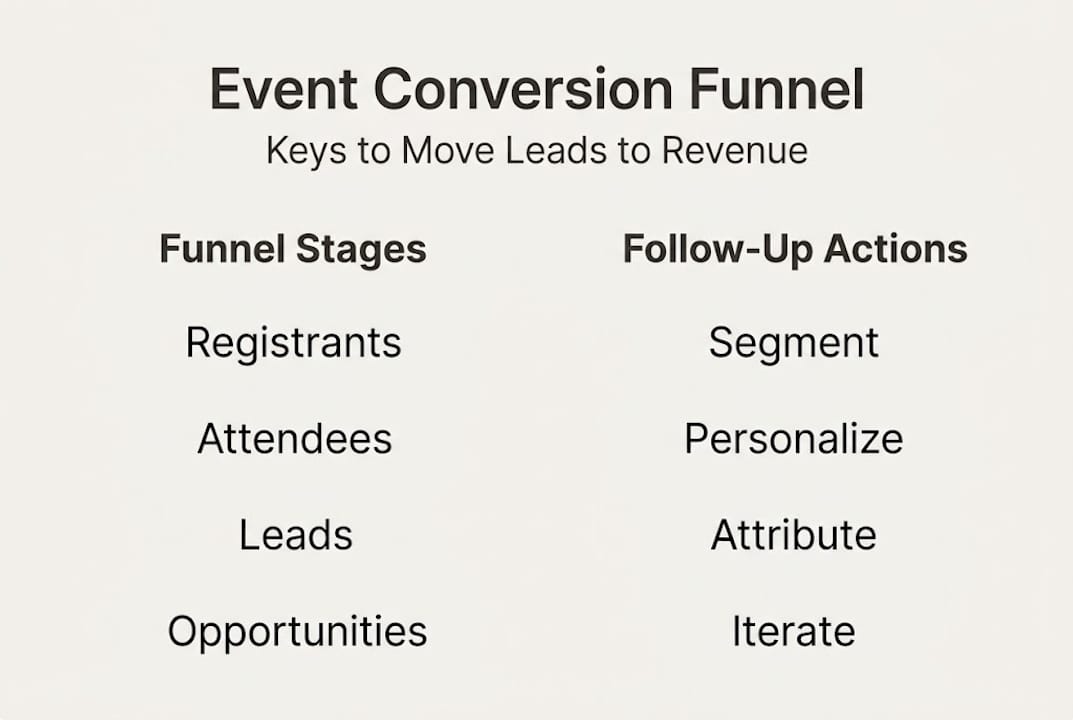
This is where most event teams leave money on the table. The energy goes into planning and execution, and follow-up becomes an afterthought. That's a costly mistake. Post-event follow-up within 24 hours with personalized, session-specific messaging converts at the highest rate. Speed and relevance are both non-negotiable.
Common post-event mistakes to avoid:
- Slow follow-up: Waiting 3-5 days after an event dramatically reduces response rates
- Generic outreach: Sending the same email to every attendee ignores intent signals
- Weak attribution: Not tagging leads to specific sessions or interactions breaks your pipeline reporting
- No segmentation: Treating a keynote attendee the same as a booth visitor wastes personalization potential
- Skipping the debrief: Not reviewing what worked means you repeat the same mistakes next time
For attribution, use your CRM to tag every lead with the event, the sessions they attended, and any interactions they had. This creates a clear line from attendee behavior to pipeline opportunity. Events measure pipeline and ROI beyond attendance, and your reporting should reflect that.
Your post-event follow-up process should include tiered outreach based on engagement level. High-intent attendees (those who visited multiple sessions or requested demos) get a direct sales touchpoint. Mid-intent attendees enter a nurture sequence. Low-engagement attendees get a content-led follow-up to re-engage. You can use personalized event outreach frameworks to build these tiers quickly.
Finally, gather feedback from attendees and your internal team after every event. Combine that qualitative input with your quantitative funnel data to build a learning log. Over time, this becomes your most valuable asset for improving event lead generation strategies across your entire program.
Why most event conversion advice falls short
Here's an uncomfortable truth: most CRO advice is written for websites, not events. It focuses on button colors, headline tests, and page load speeds. Those things matter for e-commerce. They don't move the needle for a B2B event with 500 attendees and a six-figure budget.
The real opportunity in event conversion isn't more A/B testing. It's faster, smarter post-event action. Teams that obsess over attendance numbers while ignoring speed-to-lead and session-based segmentation are optimizing the wrong variable. The B2B event lead gen strategies that actually work are built on behavioral signals, not registration counts.
Conventional web CRO also misses the offline and onsite dimensions of events: badge scans, hallway conversations, demo requests, and in-person follow-ups. These are high-intent moments that never show up in a heatmap. The teams winning at event conversion are the ones connecting every touchpoint, online and off, to a single pipeline view. That's the mindset shift that changes everything.
Want hands-on help optimizing your next event? 🚀
If you're ready to apply these strategies and scale ROI, expert support is just a click away.
Sandbox is built specifically for teams that want to turn event activity into measurable pipeline. We bring proprietary GTM workflows, intent signal capture, and hands-on execution support to every engagement. Whether you need a proven system for follow-up sequencing or a full-stack approach to attribution, we've got the frameworks to make it work.

Explore our event marketing workflows to see how leading teams structure their programs for maximum conversion. Or connect with our team directly at Sandbox to get expert event CRO help tailored to your next event. Your pipeline will thank you. 📈
Frequently asked questions
What are the most important metrics in event conversion optimization?
Lead conversion rate, MQL rate, SQL rate, and CPL are the four essential metrics that give you a complete view of funnel performance from registration to revenue.
How soon should you follow up with attendees after an event?
Follow up within 24 hours for the highest conversion chances, and make sure your messaging is personalized to the sessions each attendee participated in.
How can you quickly increase event attendee-to-lead conversion?
Simplify registration forms, add clear CTAs, create urgency with countdowns, and use heatmap data to identify and fix drop-off points fast.
How do I prove event ROI to my organization?
Attribute each attendee to pipeline opportunities and revenue using CRM tags, because events measure pipeline and ROI beyond simple attendance numbers and that's what leadership needs to see.