

TL;DR:
- Effective multi-channel event strategies require coordinated messaging and integrated touchpoints.
- Starting with a few high-value channels and analyzing their performance ensures better results.
- Clear attribution and consistent messaging across channels drive higher conversion rates and ROI.
Many marketing and sales teams assume that adding more promotional channels automatically means better event results. It's a reasonable assumption, but it's also one of the most common reasons event strategies fall flat. A true multi-channel event strategy is a coordinated approach that integrates live events with digital channels like social media ads, email, programmatic advertising, and event websites to maximize attendance, engagement, and demand generation. The difference between success and noise isn't the number of channels you use. It's how well those channels work together. This guide breaks down the core principles, step-by-step mechanics, and measurement tips you need to make it work.
Table of Contents
- What is a multi-channel event strategy?
- How does a multi-channel event strategy work?
- Best practices: Messaging, orchestration, and attendee experience
- Measurement, attribution, and scaling your strategy
- Real-world examples: Demand generation and revenue impact
- Why more channels aren't always better: Our take
- Accelerate your event performance with Sandbox-GTM
- Frequently asked questions
Key Takeaways
| Point | Details |
|---|---|
| Orchestration over quantity | Effective multi-channel event strategies rely on coordinated messaging, not simply more channels. |
| Measurement drives ROI | Tying every channel to KPIs and revenue outcomes gives clarity on what works. |
| Start small, scale smart | Launching with 2-3 high-value channels helps avoid fatigue and enables sustainable growth. |
| Consistent attendee experience | Unified messaging across digital and physical touchpoints boosts engagement and conversions. |
What is a multi-channel event strategy?
A multi-channel event strategy is more than just promoting your event in multiple places. It's about designing a coordinated system where every channel reinforces the others. Think of channels as any touchpoint where your audience encounters your event message. These fall into a few key categories:
- Owned channels: Your event website, email list, and social media profiles
- Paid channels: Social media ads, programmatic advertising, and paid search
- Earned channels: Press mentions, influencer coverage, and organic social sharing
- Physical channels: On-site activations, networking events, and experiential moments
The multi-channel approach succeeds when messaging stays consistent across all touchpoints and transitions between digital promotions and physical events feel seamless. Examples include using photo booths for social sharing or AR activations that bridge online buzz with in-room energy. Each channel plays a specific role. Email nurtures registered attendees. Programmatic ads reach cold audiences. Social builds community. Your event website converts.
Where teams go wrong is treating each channel as its own campaign. When email says one thing, ads say another, and your website tells a third story, you erode trust and dilute impact. Orchestration, not volume, is what drives results. Before you add a sixth or seventh channel, ask whether your current three are working together. Understanding strong event conversion principles will help you evaluate which channels are actually moving the needle.
| Channel type | Example | Primary role |
|---|---|---|
| Owned | Email newsletter | Nurture and convert |
| Paid | Programmatic ads | Reach and awareness |
| Earned | Influencer posts | Trust and amplification |
| Physical | On-site activation | Experience and retention |
Pro Tip: Start with two or three high-value channels before expanding. Master the handoff between them, then add more once you have a repeatable system.
How does a multi-channel event strategy work?
Building a multi-channel strategy requires deliberate planning, not just execution speed. Here's a step-by-step approach your team can follow:
-
Set objectives and define KPIs. What does success look like? Registration numbers, MQLs generated, pipeline influenced? Define clear KPIs per channel so you know what each one is accountable for, such as traffic sources, registration completions, or post-event engagement rates.
-
Audit your channels and select the right mix. Not every channel fits every audience. A B2B tech audience responds differently than a retail consumer base. Audit where your target attendees spend time and which channels your team can realistically manage well.
-
Coordinate messaging and creative. Every asset, whether an ad banner, email subject line, or event page headline, should share a unified theme. Inconsistency at this stage is where most strategies break down.
-
Map channels to the attendee journey. Different channels serve different stages. Awareness channels like programmatic ads bring people in. Consideration channels like email sequences nurture intent. Decision channels like retargeting ads or personal outreach close registrations. Leveraging event marketing automation benefits can help you map and trigger these touchpoints at the right moment.
-
Use real-time optimization. Don't set it and forget it. Monitor performance weekly, or even daily during peak promotion windows. Shift budget toward what's working and pause what isn't.
Common pitfalls to watch for:
- Launching too many channels simultaneously before you have data
- Inconsistent creative that confuses your audience
- No clear owner for each channel's performance
- Skipping post-event channel activation (events don't end when the lights go off)
Teams that unlock ROI with automation typically see faster optimization cycles and cleaner attribution data.
Pro Tip: Document every channel touchpoint and handoff in a shared workspace. Visibility across your team prevents gaps where prospects fall through.
Best practices: Messaging, orchestration, and attendee experience
Executing a plan is only half the challenge. Quality messaging and experience orchestration are what separate good strategies from great ones.
Messaging consistency means your audience should feel like they're hearing one coherent story across every channel they encounter. A common failure mode is when your paid ads use urgency-driven copy while your email sequences are still in awareness mode. These mixed signals slow conversions. Align your messaging by mapping copy themes to funnel stages, then check every asset against that map before launch.
Creative alignment bridges your digital and physical touchpoints. If your ads feature a specific visual identity or event theme, that same identity should appear in your registration page, your event signage, and your post-event follow-up emails. Consistent messaging reinforced by data-driven targeting and smooth transitions between digital and physical moments, including tools like AR activations or social sharing stations, creates a more memorable experience.
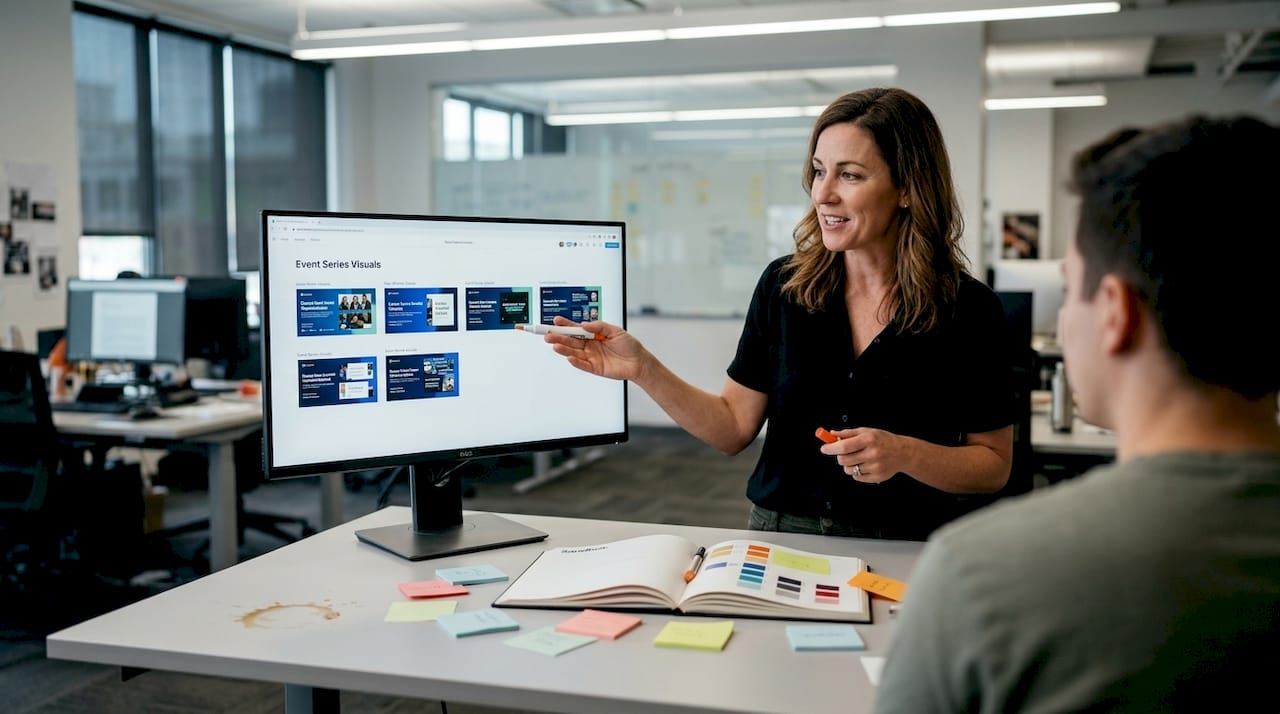
Enhancing the attendee experience with interactive tech is a high-leverage move. Social media walls at the venue, live polling, and triggered content (like automated thank-you sequences or follow-up resource drops) all extend the digital experience into the room and back out again.
Using smart event segmentation strategies lets you tailor messaging to specific audience segments, so a first-time attendee gets different content than a returning customer. And signal tracking for engagement tells you which touchpoints are actually driving behavior, not just impressions.
| Factor | Single-channel approach | Multi-channel approach |
|---|---|---|
| Audience reach | Limited | Broad and layered |
| Message reinforcement | Weak | Strong and consistent |
| Conversion opportunity | One touchpoint | Multiple touchpoints |
| Attribution clarity | Simple | Requires planning |
| Conversion uplift | Baseline | Up to 25% higher |
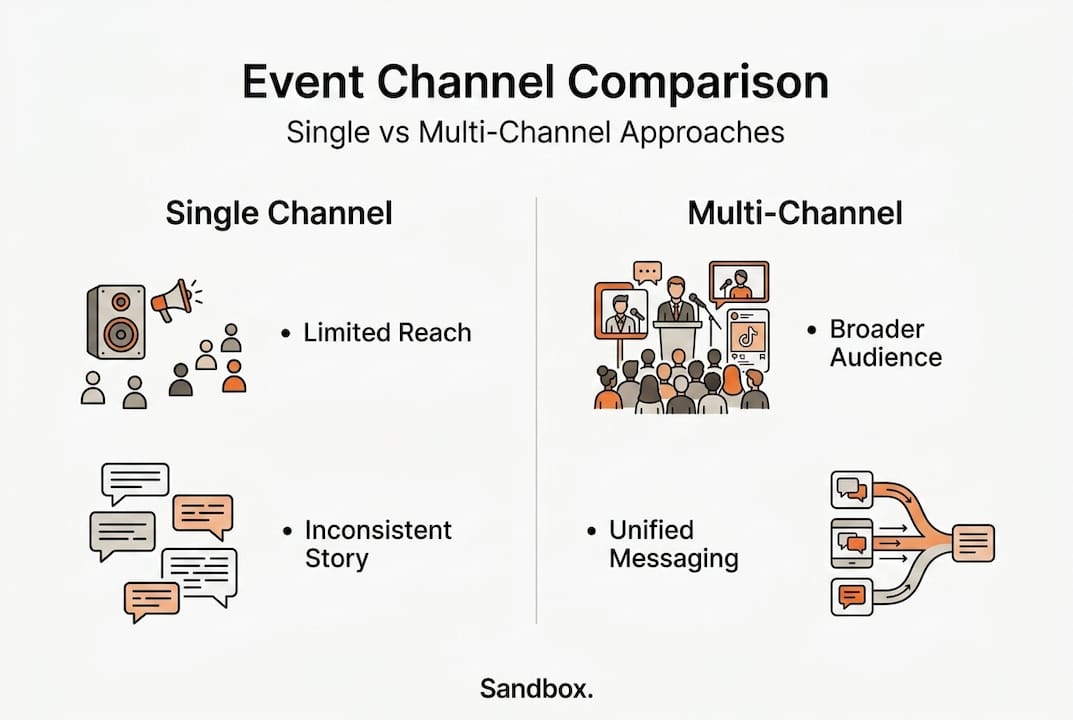
📊 Stat spotlight: Organizations that coordinate messaging across digital and in-person channels consistently outperform single-channel campaigns, with some reporting conversion uplifts of up to 25% when orchestration is deliberate and data-driven.
Measurement, attribution, and scaling your strategy
With execution covered, let's make sure your efforts translate into real numbers and long-term impact.
Attribution is the most underrated part of a multi-channel event strategy. Without it, you can't prove which channels drove pipeline and which ones just burned budget. Start with a simple model: track how each channel contributes to MQL creation, opportunity generation, and average order value. Measuring event success accurately is what separates teams that get budget increases from those that don't.
The KPIs that matter most:
- Marketing qualified leads (MQLs): How many event-sourced leads met your scoring threshold?
- Pipeline opportunities: How many MQLs converted to active sales conversations?
- Average order value (AOV): Are event-sourced deals larger than average?
- Channel-specific cost per registration: Which channels are most efficient at driving sign-ups?
A tech firm using Marketo orchestrated email, ads, and events together and achieved 25% higher conversions. Multi-channel demand generation, when measured correctly, ties directly to revenue via MQLs, opportunities, and AOV.
"Overloading channels leads to fatigue, and poor attribution consistently undervalues top-funnel events. Start with two or three channels before scaling."
Here's how to scale responsibly:
- Pilot with 2-3 channels and establish baseline performance metrics
- Add one channel at a time, measuring its incremental impact before the next addition
- Build a B2B ROI measurement framework that connects event activity to revenue outcomes before you scale further
Real-world examples: Demand generation and revenue impact
Let's make these ideas tangible with real organizations that saw impact from orchestration.
One technology company ran a demand generation campaign that combined programmatic advertising with a series of regional in-person events. Instead of treating the ads and events as separate initiatives, they used programmatic retargeting to nurture event registrants before they showed up, and followed up with personalized email sequences within 24 hours post-event. The result was a sharper attendee-to-opportunity conversion rate and a measurable reduction in sales cycle length.
The revenue impact story that stands out most is from the Marketo cross-channel orchestration case: a tech firm coordinating email, ads, and events together saw 25% higher conversions compared to siloed campaigns. The key wasn't more spend. It was better coordination and unified measurement.
Here are the lessons that B2B teams consistently take away:
- Programmatic ads work best when audience segments mirror event personas
- In-person event content should be designed for digital repurposing from day one
- Follow-up speed matters: contacts reached within 24 hours post-event convert at significantly higher rates
- Attribution must be set up before the campaign launches, not after
One pitfall worth calling out: a mid-market software company added five channels simultaneously to promote a user conference. Messaging became inconsistent, the team was stretched too thin, and post-event attribution was nearly impossible. They scaled back to three core channels the following year, tightened their creative guidelines, and saw better B2B event lead generation outcomes with less effort. The lesson is clear. More channels create more complexity. Complexity without process creates noise.
"When you coordinate your event touchpoints with the same discipline you'd apply to any revenue-generating campaign, events stop being a cost center and start being a measurable acquisition driver."
Why more channels aren't always better: Our take
Here's the honest truth most event strategy content skips: the organizations that get the most from multi-channel programs aren't the ones with the most channels. They're the ones with the most clarity.
We've seen teams pile on LinkedIn ads, retargeting, influencer campaigns, email drips, webinar series, and SMS outreach simultaneously, then wonder why their attribution is murky and their team is burned out. The problem isn't ambition. It's sequence.
The real multiplier comes from integrated measurement and experience mapping, not channel volume. Pilot two or three channels with clear goals. Build the feedback loop. Then scale what's proven. Leaning on automation for orchestration can help you run tighter programs without adding headcount. Simplicity, done well, always outperforms complexity done hastily. Master the handoff between your first channels before you add a fourth. That discipline is what turns events into a repeatable revenue driver. 🎯
Accelerate your event performance with Sandbox-GTM
Ready to move from strategy to measurable outcomes? Sandbox-GTM is built for exactly this moment. Whether you're coordinating your first multi-channel event program or scaling a flagship conference, Sandbox gives your team the workflows, signal capture, and attribution tools to tie every event touchpoint to pipeline and revenue.
Our platform connects intent signals from meetings, content, and live interactions so you always know who to follow up with and why it matters. Explore how teams use event marketing ROI workflows to drive efficiency and accountability at every stage. Visit the Sandbox-GTM platform to see how your team can make events worth repeating. 🚀
Frequently asked questions
What are examples of channels in a multi-channel event strategy?
Examples include email marketing, social media ads, programmatic advertising, influencer outreach, and event websites, all synchronized around your event goals and audience journey.
How do I measure the revenue impact of a multi-channel event strategy?
Track MQLs, pipeline opportunities, and average order value, linking each to specific event touchpoints. This ties demand generation directly to revenue for clear attribution.
What's the biggest pitfall in launching multi-channel event campaigns?
Trying too many channels at once causes fatigue and inconsistent measurement. Start with 2-3 channels and expand only after establishing clear baseline performance.
How can messaging stay consistent across channels and formats?
Centralize your message themes and align creative assets so every touchpoint reinforces the event brand. Consistent messaging across pre-event, during-event, and post-event moments builds recognition and trust.
Recommended
- Streamline your event follow up process for max ROI
- Optimize your post-event engagement process for conversions
- Why personalize event outreach? Boost engagement and ROI fast
- Optimize event conversion: proven process for more leads & revenue
- Boost digital engagement: proven strategies for creators
- Event data: the key to impactful marketing in 2026