

TL;DR:
- Most B2B events fail due to lack of revenue-aligned goals and KPIs.
- Integrating sales and marketing from initial planning boosts pipeline and conversion rates.
- Interactive, personalized experiences create stronger relationships and measurable pipeline impact.
Most B2B companies spend significant budget on events yet struggle to connect that investment to actual pipeline or revenue. The booth gets built, the sessions fill up, and the team flies home with a stack of business cards — only for those contacts to age out in a CRM with no clear next step. ROI-driven planning starts with revenue-aligned KPIs and early sales and marketing integration, yet most organizations skip this step entirely. This guide breaks down the exact frameworks high-performing B2B teams use to turn event activity into measurable business outcomes. 🎯
Table of Contents
- Clarify outcomes: KPIs, goals, and buy-in before you start
- Integrate sales and marketing for maximum engagement 🤝
- Design the attendee experience for lasting impact ✨
- Measure, follow-up, and prove ROI: from event to revenue 📈
- The uncomfortable truth: why most B2B events underperform
- Ready to transform your event ROI? 🚀
- Frequently asked questions
Key Takeaways
| Point | Details |
|---|---|
| Set revenue-based KPIs | Define clear, revenue-aligned KPIs before planning for the best event results. |
| Integrate sales and marketing | Early and ongoing alignment between teams drives attendee engagement and outcomes. |
| Design for interaction | Personalized, interactive experiences lead to longer-term brand and pipeline impact. |
| Measure beyond leads | Track pipeline, revenue, and brand lift—not just registrations or leads. |
| Close the loop | Analyze results 60–90 days post-event and refine your approach for sustained growth. |
Clarify outcomes: KPIs, goals, and buy-in before you start
The most expensive mistake in B2B event marketing isn't overspending on a booth or underestimating logistics. It's starting without a shared definition of success. When your team can't agree on what winning looks like, every post-event debrief turns into a debate — and budget justification becomes nearly impossible.
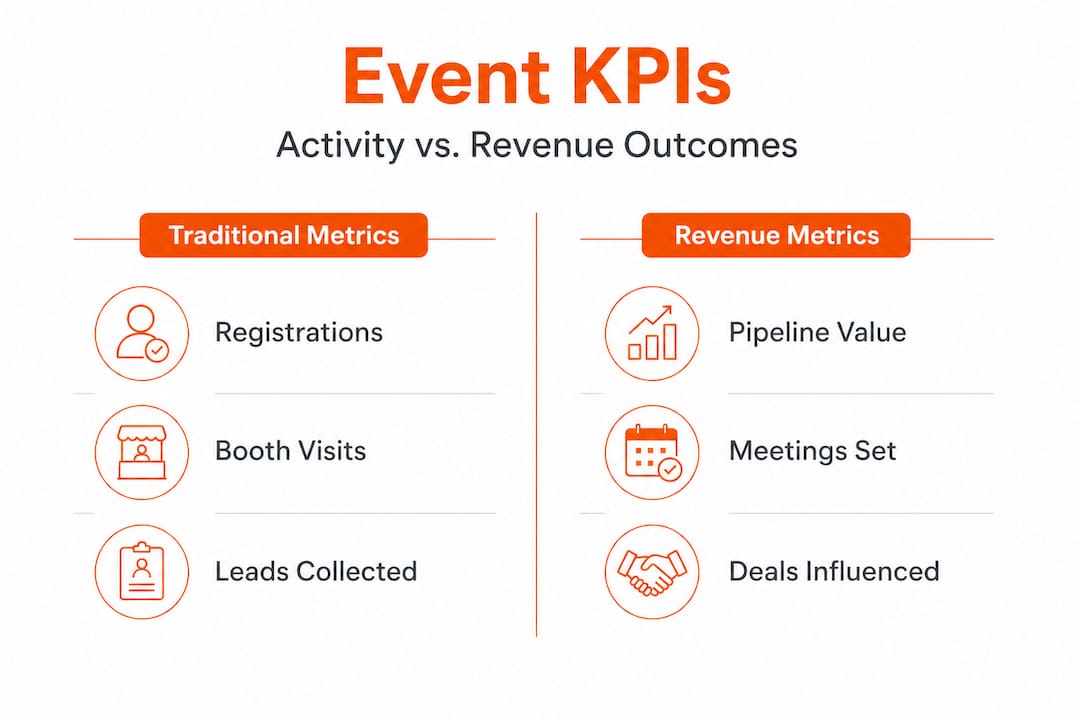
Ambiguous goals create real problems. Without clear KPIs (key performance indicators, meaning the specific metrics your team tracks to measure progress), you end up measuring what's easy instead of what's meaningful. Attendance numbers and badge scans look impressive in a recap deck, but they don't tell leadership whether the event contributed to revenue growth or just burned budget.
Revenue-aligned KPIs worth tracking include:
- 💰 Revenue pipeline created from event-sourced contacts
- 📅 Sales meetings or discovery calls scheduled during or after the event
- 🤝 Deals influenced, meaning active opportunities where an event interaction moved the process forward
- 🔁 Expansion conversations initiated with existing customers
- 📊 Account engagement score changes in the 30 to 60 days following the event
Compare this to what most teams actually measure:
| Traditional event KPIs | Revenue-aligned event KPIs |
|---|---|
| Total registrations | Pipeline value sourced from event |
| Badge scans at booth | Sales meetings scheduled post-event |
| Social impressions | Deals influenced by event touchpoints |
| Session attendance | Expansion opportunities opened |
| Net Promoter Score | Revenue closed within 90 days |
The contrast is stark. Traditional metrics measure activity. Revenue-aligned metrics measure outcomes. When you track event metrics that matter, you give your team a clear standard to plan against and a compelling story to tell stakeholders after.
Getting buy-in is equally critical. Sales, marketing, and leadership each have different definitions of event success, and those definitions often conflict. The fix is simple but underutilized: align before the RFP (request for proposal, the document used to select venues and vendors) goes out. Define shared KPIs in writing, assign ownership, and make sure the people who'll execute follow-up are part of the conversation from day one.
Pro Tip: Embed KPI expectations directly into your event RFP or quarterly business review process. When vendors and internal teams see measurement criteria baked into planning documents, accountability becomes structural rather than aspirational.
Integrate sales and marketing for maximum engagement 🤝
Even the most thoughtfully planned event falls flat when sales and marketing operate in silos. Marketing drives registrations while sales waits to receive leads after the event. That gap is where pipeline gets lost. The fix isn't a better handoff process — it's eliminating the handoff entirely by building collaboration into every stage.
"Events should enable interaction and validation, not just one-way information distribution. The real work happens when both teams show up as one unified function."
Here's how to build that unified function in practice:
-
Pre-event targeting: Sales and marketing jointly build the target account list. Marketing identifies ICP (ideal customer profile) accounts in the region or industry vertical relevant to the event. Sales flags active opportunities and key accounts that need a touchpoint. Together, you prioritize who to invite, who to pursue for meetings, and which accounts need a customized approach.
-
Pre-event outreach: Marketing runs personalized email sequences and LinkedIn touches. Sales reps send direct, personalized notes to their top prospects. Both align on messaging so the experience feels cohesive, not like two different companies reaching out.
-
Live engagement: Sales reps know exactly which accounts are attending and what sessions they've registered for. Marketing equips them with conversation starters, relevant content, and briefing notes. The booth experience, roundtable invites, and executive dinners are all structured around moving specific accounts forward.
-
Real-time signal sharing: When a sales rep has a strong conversation on day one, that signal feeds back into the event strategy in real time. Marketing adjusts session recommendations or dinner invites based on what's happening on the floor.
-
Synchronized follow-up: Within 24 hours of the event, both teams execute a pre-agreed event follow-up strategy rather than scrambling independently. Messaging is tiered by engagement level, not generic.
The numbers reinforce this approach. Teams that align sales and marketing around event activity consistently see higher conversion rates from attendee to pipeline than those that treat events as marketing-owned programs.
Pro Tip: Score and tier your attendees before the event based on account fit, intent signals, and deal stage. Assign each tier a distinct follow-up track so your team isn't improvising post-event when energy and momentum are highest.
Design the attendee experience for lasting impact ✨
Here's a hard truth: generic event experiences don't generate pipeline. A 45-minute product demo with slides, a swag bag, and a booth spin-the-wheel might attract foot traffic, but they rarely create the kind of trust and connection that moves a deal forward.

Static formats fail because they put your team in broadcast mode. You're talking at prospects rather than talking with them. B2B buyers — especially at the senior and executive level — are saturated with vendor messaging. What they actually want is a space to think through their problems, benchmark against peers, and validate that your approach fits their specific situation. As B2B marketing effectiveness research notes, events enable interaction and validation far beyond what simple demand generation content can achieve, and their impact should be measured through long-term brand and pipeline metrics, not just short-term leads.
Interactive formats that consistently drive stronger outcomes:
- 🎤 Executive roundtables where peers debate shared challenges without a sales pitch dominating the room
- 🛠️ Use-case workshops where attendees map your solution to their specific workflow in real time
- 🤝 1:1 advisory consultations with your subject matter experts, booked in advance with a clear agenda
- 🧠 Facilitated peer benchmarking sessions where attendees compare their approaches and metrics
- 🎯 VIP dinners or intimate gatherings for your highest-priority target accounts
The data on personalization is equally compelling:
| Experience type | Avg. engagement rate | Post-event meeting conversion | Pipeline influence |
|---|---|---|---|
| Standard session or panel | Low | 5 to 8% | Minimal |
| Personalized interactive format | High | 22 to 35% | Significant |
| 1:1 consultation or roundtable | Very high | 40 to 60% | Strong and measurable |
Planning personalized event outreach before and during the event is what turns these formats from nice ideas into repeatable systems. You need to know who's attending, what they care about, and how to match them to the right experience before they arrive on-site.
Beyond demand generation, plan deliberately for brand lift and validation. Ask: what do we want attendees to say about us when they return to the office? That story shapes your session content, your dinner conversations, and the materials you put in their hands. When attendees leave feeling seen and understood, your brand sticks.
Measure, follow-up, and prove ROI: from event to revenue 📈
Running a great event and not having a system to capture the outcomes is one of the most common and costly gaps in B2B event programs. You need a closed-loop measurement system that connects event activity to pipeline stages and eventually to revenue. This isn't just about accountability — it's about earning the budget to do it again and better.
Here are the steps to build that system:
-
Tag event-sourced contacts in your CRM (customer relationship management platform) on day one. Every person who attends, meets with a rep, or books a consultation gets tagged with the event name and engagement tier. This makes attribution possible 90 days later.
-
Log all meaningful interactions. Not just leads — conversations, session attendance, dinner participation, and follow-up email opens. These signals tell you who is warm before your CRM can show you pipeline movement.
-
Set pipeline review checkpoints at 30, 60, and 90 days post-event. At each checkpoint, compare event-tagged contacts to your pipeline and identify any new opportunities sourced or influenced.
-
Build a follow-up sequence with measurable triggers. Emails, calls, and LinkedIn touches should all be logged and tracked. Use your event conversion process to score engagement and prioritize outreach.
-
Report in the language of finance and leadership. Replace "we scanned 400 badges" with "we sourced $1.2M in pipeline, influenced 6 active opportunities, and scheduled 34 qualified sales meetings." That framing gets events taken seriously as a growth channel.
-
Optimize your post-event engagement strategy based on what actually moved accounts forward. Which session types generated the most follow-up meetings? Which outreach messages got the best response? Document it and use it to improve the next event.
Pro Tip: Schedule win/loss feedback sessions with sales reps 90 days after each event. Ask directly: which event-sourced contacts progressed, which stalled, and what made the difference? This qualitative data is invaluable for refining your format, targeting, and messaging before the next program.
The goal isn't to prove that events work in general — it's to prove that your specific event worked, and to show exactly which levers drove results. That's the case that earns continued investment.
The uncomfortable truth: why most B2B events underperform
Let's be direct. Most B2B events underperform not because of budget constraints or poor execution but because teams are still running a 2012 playbook in a 2026 environment. The old model — sponsor a booth, collect leads, hand them to sales — was never built for modern B2B buying cycles, and it shows in the numbers.
Chasing vanity metrics is the most persistent problem. When success is defined by registrations or booth traffic, that's what teams optimize for. They invest in games, giveaways, and spectacle rather than in meaningful interactions with the right people. The result is a list of contacts who barely remember the conversation and a sales team that doesn't know where to start.
The real value of a well-run event is harder to quantify but far more powerful: connection, validation, and trust. A senior buyer who spends 45 minutes in your executive roundtable, hears their peers share similar challenges, and sees your team facilitate a genuinely useful conversation is not just a lead. They're a future customer who already trusts you. As B2B marketing research consistently shows, events that enable interaction and validation drive long-term brand and pipeline outcomes that short-term lead counts simply can't capture.
High-performing teams close the learning loop. They run structured debriefs, analyze which accounts moved and which didn't, and use that information to refine their approach. They treat events as a living channel that gets smarter over time, not a one-off campaign that gets evaluated once and forgotten.
A B2B event ROI framework built around integrated teams, revenue-aligned KPIs, and a closed-loop measurement system doesn't just improve your event outcomes. It fundamentally changes how your organization thinks about events — from a cost center to a growth driver. That mindset shift is the real competitive advantage.
Ready to transform your event ROI? 🚀
You now have a clear, actionable roadmap: set revenue-aligned goals before planning starts, integrate sales and marketing from day one, design experiences that create genuine connection, and build the measurement systems that prove impact to leadership. These aren't theoretical concepts — they're the frameworks that the best B2B event teams use to make every program more accountable and more effective.
Sandbox is built to help you put all of this into practice. Our event marketing workflows connect your GTM teams around shared signal and structured follow-up, so nothing falls through the cracks. And our approach to CRM for event ROI means you can finally trace event activity directly to pipeline and revenue. Whether you're planning a single flagship event or scaling a full-year program, Sandbox gives your team the systems, signal, and support to make it count. Let's make your next event worth repeating. 💡
Frequently asked questions
What KPIs give the most accurate read on event impact?
Revenue pipeline generated, sales meetings scheduled, and deals influenced are the most telling KPIs for event impact. These revenue-aligned metrics capture business outcomes rather than activity volume.
How long after an event does pipeline impact usually show up?
Pipeline impact is best measured 60 to 90 days post-event for meaningful revenue attribution. Reviewing earlier often misses deals that are still moving through the sales cycle.
What is the most common pitfall in B2B event marketing?
Many teams focus only on in-event leads and miss tracking longer-term pipeline outcomes, which are where most of the real business value from events actually shows up.
How do you ensure sales and marketing alignment for events?
Jointly define KPIs and collaborate on attendee targeting and follow-up from the earliest planning stages. Integrated planning ensures both teams share ownership of outcomes rather than operating in separate lanes.
What type of event experience drives the best outcomes?
Interactive, personalized formats like roundtables, advisory consultations, or peer benchmarking sessions drive more lasting engagement and pipeline than generic panels or demos. The more your format enables dialogue, the stronger your downstream results will be.