

TL;DR:
- Events build trust, gather real-time feedback, and generate high-quality B2B sales leads.
- Integrating event data with sales processes accelerates pipeline and shortens sales cycles.
- Measuring engagement, pipeline impact, and conversion qualities ensures event success and ROI.
Most B2B sales and marketing leaders invest heavily in content libraries, coaching programs, and CRM tools to power their sales enablement strategy. Yet one of the highest-impact channels often gets treated as a side project: events. When done right, events put your sales team face-to-face with high-intent buyers, surface real-time objections, and generate the kind of trust that no email sequence can replicate. This article breaks down why events belong at the center of your sales enablement strategy, how to integrate them effectively, and what metrics actually tell you whether they're working.
Table of Contents
- Why events matter in sales enablement
- Integrating events into your sales enablement strategy
- Measuring event impact on sales performance
- Maximizing ROI through event-driven sales enablement
- What most sales enablement guides miss about events
- Take the next step: Empower your sales team with events
- Frequently asked questions
Key Takeaways
| Point | Details |
|---|---|
| Events accelerate sales | Strategic events produce qualified leads, build trust, and shorten B2B sales cycles. |
| Integration is critical | Aligning events with sales enablement and marketing tech stacks boosts results and efficiency. |
| Measure what matters | Track engagement, qualified pipeline, and sales-influenced revenue to evaluate event impact. |
| Automate for ROI | Automated post-event engagement and lead segmentation can maximize enablement outcomes. |
Why events matter in sales enablement
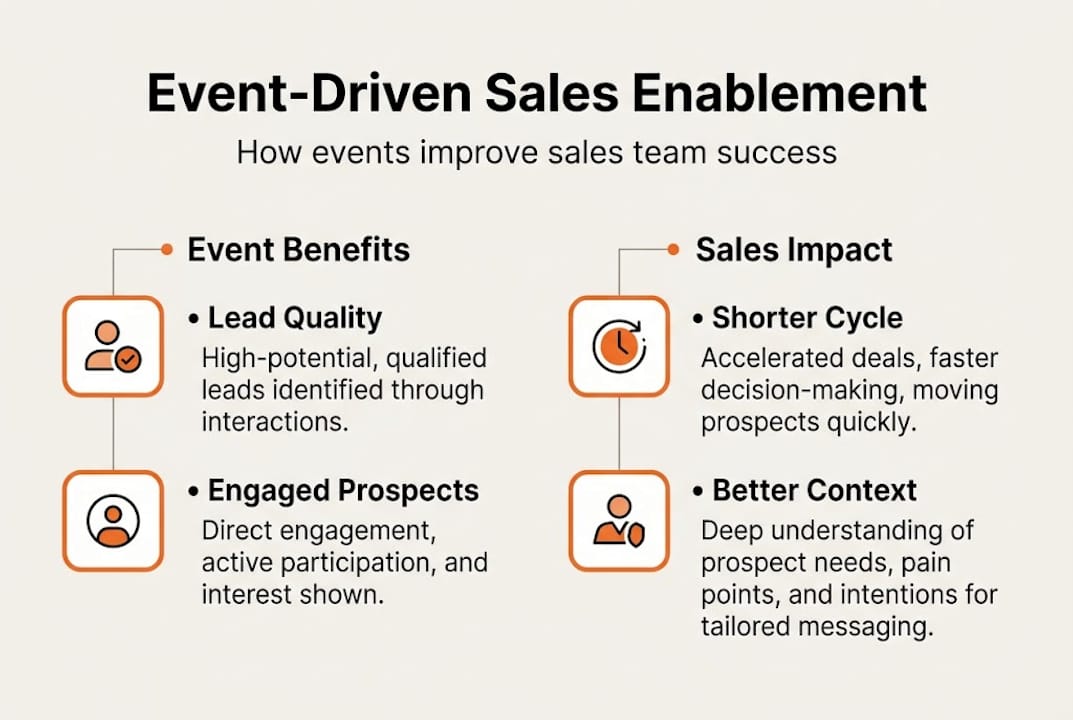
Sales enablement is about giving your team the tools, content, and context they need to close deals faster. Events do all three at once. No other channel lets your reps engage a qualified prospect, gather live feedback, and deliver a personalized pitch in the same 30-minute window.
The data backs this up. Events are a top source for high-quality B2B sales leads, consistently outperforming paid media and cold outreach on lead quality scores. That matters because lead quality directly affects how much time your sales team spends on prospects worth pursuing.
Here's what makes events uniquely powerful for sales enablement:
- 🎯 Direct engagement: Reps can qualify prospects in real time, ask discovery questions, and tailor their pitch on the spot.
- 💡 Real-time feedback: Live conversations reveal objections, buying criteria, and competitive mentions that rarely surface in form fills.
- 🤝 Trust acceleration: Meeting in person or in a focused virtual setting builds credibility faster than a nurture sequence.
- 📋 Content generation: Panel discussions, Q&A sessions, and breakout conversations produce raw material for sales decks, case studies, and battle cards.
- 🔗 Sales and marketing alignment: Events force both teams to agree on messaging, audience, and follow-up, which reduces the handoff friction that kills pipeline.
The event metrics benefits extend beyond lead volume. Events shorten sales cycles because prospects arrive pre-educated. They've attended a session, heard a customer story, or sat through a product demo. By the time your rep follows up, the conversation is already warmer.
"Events are not just a marketing tactic. They are a sales acceleration engine when aligned with the right enablement strategy."
The key insight here is that events don't just generate leads. They generate context. And context is exactly what sales teams need to have better conversations, faster.
Integrating events into your sales enablement strategy
Knowing that events matter is one thing. Building a system that connects event activity to your sales process is another. The gap between those two things is where most B2B teams lose value.
Aligning event workflows with sales processes boosts efficiency and reduces the lag between a prospect showing interest at an event and a rep acting on it. Here's a step-by-step approach to get that alignment right:
- Map event objectives to sales goals. Before planning any event, define what sales outcome you're targeting. Is it pipeline creation? Deal acceleration? Competitive displacement? Each goal requires a different event format and audience.
- Involve sales teams in planning. Reps know which objections come up most often and which customer stories resonate. Bring them into agenda and content decisions early.
- Build your tech stack integration upfront. Connect your event platform to your CRM before the event, not after. This ensures lead data, engagement scores, and session attendance flow directly into your sales workflows.
- Coordinate pre-event outreach. Use targeted personalized outreach after events as a model for pre-event communication too. Warm up prospects before they arrive so reps have context going into conversations.
- Define the lead handoff process. Agree on what a "qualified event lead" looks like, who owns follow-up, and what the SLA is for first contact after the event.
- Run a post-event debrief with sales. Capture what worked, what objections came up, and which content pieces performed. Feed that back into your enablement library.
Pro Tip: Assign a sales rep as an event liaison during planning. They'll flag enablement gaps early and ensure the event agenda supports active deals, not just top-of-funnel awareness.
The post-event engagement strategies you put in place are just as important as the event itself. A strong follow-up sequence, personalized by session attendance and engagement level, can double your conversion rate compared to a generic blast email.

Measuring event impact on sales performance
You can't optimize what you don't measure. And yet many B2B teams still evaluate events on attendance numbers alone. That's like judging a sales rep by how many calls they made, not how many deals they closed.
Measuring event success requires tracking engagement, conversion rates, and qualified pipeline. Here are the metrics that actually matter:
- Lead quality score: How many event leads meet your ideal customer profile?
- Pipeline contribution: What dollar value of opportunities can be attributed to event touchpoints?
- Engagement depth: Which sessions did prospects attend? Did they visit a booth, book a meeting, or download content?
- Sales cycle length: Are event-sourced leads closing faster than non-event leads?
- Influenced revenue: How many closed deals had at least one event interaction in the journey?
Here's a comparison of common event types and their typical sales outcomes:
| Event type | Lead quality | Pipeline impact | Sales cycle effect |
|---|---|---|---|
| In-person conference | High | High | Shortens significantly |
| Virtual webinar | Medium | Medium | Moderate impact |
| Executive roundtable | Very high | Very high | Shortens dramatically |
| Trade show | Medium | Medium | Variable |
| Customer user group | High | High | Strengthens retention |
One of the most common pitfalls is ignoring multi-touch attribution. A prospect might attend a webinar, then a roundtable, then close after a product demo. If you only credit the last event, you're undervaluing the full event program. Use event marketing automation to track the full journey and assign weighted credit across touchpoints.
Tracking event engagement at the session level gives your sales team the context they need to personalize follow-up. Knowing that a prospect spent 45 minutes in your competitive differentiation session is a powerful signal. It tells your rep exactly where to start the conversation.
Maximizing ROI through event-driven sales enablement
Once you have measurement in place, the next step is scaling what works. The teams that get the most from events treat them as repeatable systems, not one-off campaigns.
Automation enhances post-event follow-up and lead nurturing, driving ROI by ensuring no lead goes cold due to slow manual processes. Here's how to build that system:
| Post-event workflow | Tool category | Sales enablement impact |
|---|---|---|
| Automated lead scoring | Marketing automation | Prioritizes rep outreach |
| Personalized follow-up sequences | Email/CRM | Increases response rates |
| Session-based content delivery | Content management | Reinforces buying intent |
| Intent signal routing | Sales intelligence | Speeds up deal progression |
| Pipeline attribution reporting | Analytics | Proves event ROI |
Segmenting your event audience is another high-leverage move. Not every attendee is at the same stage of the buying journey. Use the event intent capture guide to identify which behaviors signal purchase readiness versus early-stage curiosity. Then route those leads into the right sales playbook.
Pro Tip: Use event segmentation tips to build audience tiers before the event. Tier 1 might be active opportunities, Tier 2 is warm pipeline, and Tier 3 is net-new prospects. Each tier gets a different follow-up sequence and sales motion.
Here's a quick checklist of actions to take after every event to maximize sales enablement impact:
- ✅ Upload all lead data to CRM within 24 hours
- ✅ Score leads based on engagement signals, not just attendance
- ✅ Trigger personalized follow-up sequences by audience segment
- ✅ Share session recordings and content with sales for use in outreach
- ✅ Brief sales reps on top conversations and objections heard at the event
- ✅ Update your enablement library with new insights, quotes, and competitive intel
- ✅ Report pipeline attribution to leadership within two weeks
These steps turn a single event into a sustained sales enablement asset that keeps delivering value long after the last session ends.
What most sales enablement guides miss about events
Here's the uncomfortable truth: most guides treat events as a lead generation tactic with a checklist attached. They focus on booth setup, badge scans, and follow-up email templates. That's not wrong, but it misses the bigger opportunity.
The real competitive advantage from events comes from the feedback loop. Every event generates raw signal: what questions buyers are asking, which messages are landing, which competitors are being mentioned, and what objections are slowing deals down. High-performing teams capture that signal and use it to iterate their enablement content within days, not quarters.
Most B2B teams using events for B2B lead generation are still treating events as isolated campaigns. The teams pulling ahead are treating each event as a learning cycle. They run the event, capture the signal, update their playbooks, and show up to the next event sharper.
That iterative loop is what separates event programs that plateau from ones that compound in value. It requires close coordination between marketing, sales, and enablement functions, but the payoff is a sales team that gets better with every event, not just busier.
Take the next step: Empower your sales team with events
If you're ready to stop treating events as a line item and start treating them as a revenue engine, you need the right systems behind them.
Sandbox-GTM helps B2B sales and marketing teams turn event activity into measurable pipeline. From capturing intent signals to automating follow-up workflows, our platform connects every event moment to your GTM motion. Explore our event marketing workflows to see how leading teams are building accountable, scalable event programs. Whether you're launching your first event strategy or optimizing an existing program, we're here to help you make every event worth repeating. 🚀
Frequently asked questions
How do events support B2B sales enablement?
Events bridge sales and marketing to drive high-intent leads by giving sales teams direct access to qualified prospects, real-time objection data, and trust-building interactions that accelerate pipeline progression.
What metrics should I track to measure event-driven sales enablement?
Focus on lead quality, attendee engagement depth, opportunity creation, and event-influenced revenue. Measurement frameworks for event effectiveness go beyond attendance to track the full impact on your sales pipeline.
What are best practices for aligning events with sales processes?
Involve sales teams early in planning, integrate event data into your CRM before the event, and coordinate pre- and post-event outreach. Integrating event workflows with sales boosts ROI by reducing handoff delays and improving lead context.
How does automation enhance sales enablement through events?
Automation is key to scalable event-driven enablement because it streamlines follow-ups, personalizes lead nurturing by engagement level, and ensures no high-intent prospect goes cold after the event ends.