

TL;DR:
- Effective event outreach involves segmentation, multichannel strategies, and immediate follow-up to maximize ROI.
- Continuous relationship-building post-event is crucial for sustained engagement and higher revenue impact.
- Integrating CRM and automation tools enables accurate measurement, segmentation, and pipeline attribution for better outcomes.
Most event marketing teams put enormous effort into planning their events but leave serious revenue on the table when it comes to outreach. Low open rates, missed follow-ups, and unclear ROI are not just frustrating — they signal a broken process. The good news is that each of these problems is fixable with the right approach. This guide walks you through every stage of event outreach optimization, from auditing your current workflow to executing multichannel campaigns and measuring what actually matters. Whether you're managing a single annual conference or a full calendar of programs, these strategies will help you drive real engagement and connect event activity to pipeline.
Table of Contents
- Assessing your current event outreach process
- Strategic preparation: Setting up for outreach success
- Executing optimized outreach campaigns
- Maximizing follow-up and long-term engagement
- Measuring, analyzing, and optimizing event outreach impact
- The overlooked secret: Continuous engagement wins the long game
- Take your event outreach further with Sandbox-GTM
- Frequently asked questions
Key Takeaways
| Point | Details |
|---|---|
| Audit existing workflows | Begin by identifying gaps in your current outreach process to pinpoint improvements. |
| Segment and personalize | Tailoring messages to the right audience segments boosts engagement and results. |
| Automate and track outreach | Leverage automation and analytics to improve efficiency and measure true ROI. |
| Focus on long-term engagement | Ongoing nurturing and follow-up after the event drive the highest returns. |
Assessing your current event outreach process
To start optimizing, you first need to know where you're starting from. Many teams jump straight to new tools or tactics without understanding why their current process is underperforming. That's a costly mistake.
Common warning signs include open rates below 20%, generic messaging sent to your entire list, follow-up emails that go out days after an event ends, and no clear way to connect outreach activity to sales outcomes. If any of these sound familiar, your funnel has a leak worth finding.
Start by asking yourself these audit questions:
- 📋 Are your outreach lists segmented by role, industry, or intent?
- 📧 Do you track open rates, click rates, and reply rates separately?
- 🔗 Can you tie any specific outreach touchpoint to a won opportunity?
- 🕐 How quickly does follow-up go out after an event?
- 🛠️ Do sales and marketing teams share a unified view of event contacts?
These questions surface exactly where your process breaks down. Once you know the weak points, you can prioritize fixes with real impact.
Here's a quick comparison of what traditional outreach looks like versus an optimized approach:
| Factor | Traditional outreach | Optimized outreach |
|---|---|---|
| Audience targeting | One-size-fits-all lists | Segmented by persona and intent |
| Follow-up timing | Days or weeks later | Within 24 hours |
| Channel strategy | Email only | Multichannel (email, social, SMS) |
| Attribution | Not tracked | CRM-linked pipeline attribution |
| Measurement | Open rate only | Full-funnel engagement metrics |
This kind of structured comparison is eye-opening for most teams. You can also check our event metrics guide for a deeper look at which numbers actually matter.
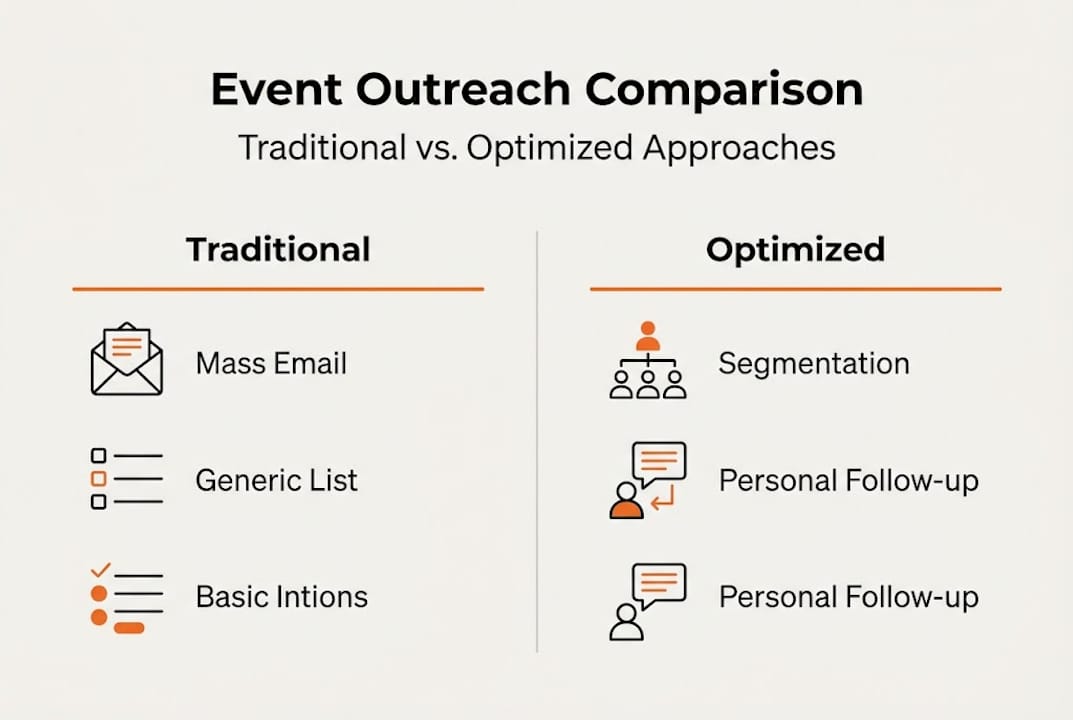
For reference, Intel boosted B2B event ROI significantly by rethinking its engagement model and integrating CRM data across the event lifecycle — a clear signal that auditing your process first pays off.
Pro Tip: Before you add any new tool or tactic, run a gap analysis. Map your current process step by step, then mark each point where leads drop off or data goes dark. That map tells you exactly where to invest.
Strategic preparation: Setting up for outreach success
With a clear audit in hand, you can set yourself up with the right foundation. Preparation is where most of your event ROI is actually won or lost — long before a single email is sent.
The first step is audience segmentation. Not every attendee, prospect, or partner deserves the same message. Segment by job title, company size, buying stage, and past engagement history. This alone can dramatically improve response rates because relevant messaging always outperforms generic blasts.
Next, review your tech stack. The right tools should support your workflow, not create extra work. Here's what to look for:
- ✅ CRM with event contact tracking and pipeline attribution
- ✅ Email automation with behavior-based triggers
- ✅ Analytics dashboards that connect outreach activity to revenue
- ✅ Event platform integrations that push registration and session data automatically
- ✅ A/B testing capability for subject lines and CTAs
See our guide on event marketing automation benefits for a fuller breakdown of what automation can do for your outreach program.
Here's a practical comparison of common event outreach tools:
| Tool type | Best for | Example use case |
|---|---|---|
| CRM (e.g., Salesforce, HubSpot) | Pipeline attribution | Track outreach-to-opportunity conversion |
| Email automation (e.g., Marketo) | Scalable personalization | Trigger follow-ups by attendee behavior |
| Event platform (e.g., Hopin, Splash) | Registration and session data | Sync attendee data directly to CRM |
| Analytics (e.g., Tableau, Looker) | ROI reporting | Visualize outreach impact on revenue |
The Intel case study reinforces this point directly. Year-round CRM integration and pipeline attribution were central to their ROI gains — not just event-day attendance numbers.
For practical advice on slicing your audience effectively, our event segmentation best practices guide is a great starting point.
Pro Tip: Always start with audience segmentation before touching your messaging or channel strategy. Tailored messaging to a well-defined segment will consistently outperform a polished message sent to everyone.
Executing optimized outreach campaigns
With your strategy and tech in place, let's execute best-in-class outreach. Execution is where preparation pays off — but only if you follow a disciplined process.
Here's a proven step-by-step outreach workflow:
- Plan your campaign timeline — set key dates for pre-event, during-event, and post-event outreach.
- Segment your audience — apply the criteria from your preparation phase to group contacts meaningfully.
- Select your channels — choose the right mix based on where each segment engages most (email, LinkedIn, SMS, phone).
- Execute with personalization — use first name, company name, relevant session or topic, and a clear call to action.
- Track every touchpoint — log opens, clicks, replies, and meetings in your CRM as they happen.
Multichannel outreach is not optional anymore. Relying only on email means you're missing contacts who are more active on LinkedIn or more responsive to a direct call. A layered approach that combines email sequences, social engagement, and timely phone outreach consistently outperforms single-channel campaigns.
Personalization at scale is achievable when you combine good segmentation with automation. For example, a prospect who attended a product demo session should receive a very different follow-up than someone who only registered but didn't show up. Use behavioral data from your event platform to trigger the right message automatically.
Learn more about personalizing outreach with practical examples and templates. For tactics that move contacts from engagement to conversion, our event conversion tactics guide covers the full funnel.
Pipeline attribution through CRM integration and personalized engagement was central to Intel's success — a reminder that disciplined execution at each step compounds over time.
Pro Tip: Schedule your follow-up cadences during your initial campaign planning. If you wait until after the event to figure out follow-up timing, you'll lose critical momentum. Build the sequence before you launch.
Maximizing follow-up and long-term engagement
Executing great outreach is step one, but continued engagement separates good from great events. The follow-up phase is where most teams underinvest, and it's also where the biggest revenue gaps appear.

Prompt, personalized follow-up is non-negotiable. Aim to send your first follow-up within 24 hours of an event ending. Contacts are most likely to engage when the experience is still fresh. Late follow-ups feel generic and signal that you didn't prioritize the relationship.
Here are the core types of post-event communication every program should include:
- 🙏 Thank-you messages — personalized notes referencing specific sessions or conversations
- 📊 Surveys — short, focused feedback forms to gather insights and signal continued interest
- 🎥 Content follow-ups — session recordings, key takeaways, or resource links relevant to what they attended
- 🔁 Nurture sequences — automated drip campaigns that keep contacts warm over weeks or months
- 📞 Sales handoffs — warm introductions to the sales team for high-intent contacts
For a complete process walkthrough, check our guide on event follow-up best practices and our deeper look at the post-event engagement process.
Long-term nurturing is where the real ROI compounds. Most buying decisions don't happen the week after an event. Keeping your brand visible and relevant over months through useful content, invitations to future events, and check-in touchpoints dramatically improves conversion rates over time.
Key insight: Year-round engagement after events dramatically improved outcome metrics in Intel's program — proving that sustained follow-through, not just a great event day, drives measurable ROI.
Align your follow-up sequences with sales teams from the start. When marketing and sales share a unified view of who attended, what they engaged with, and where they sit in the funnel, attribution becomes clear and handoffs become smooth.
Measuring, analyzing, and optimizing event outreach impact
Finally, let's make sure your optimized outreach is truly moving the needle. Measurement closes the loop and tells you what to scale and what to cut.
Start with these key outreach metrics:
- Open rates and click rates by segment and channel
- Meeting or demo bookings generated from outreach
- Pipeline influenced (opportunities created or advanced)
- Sales conversion rate from event-sourced contacts
- Engagement rate across post-event nurture sequences
Here's how manual and automated reporting compare:
| Factor | Manual reporting | Automated reporting |
|---|---|---|
| Speed | Days or weeks to compile | Real-time dashboards |
| Accuracy | Prone to human error | Synced directly from CRM |
| Depth | Surface-level metrics | Full-funnel attribution |
| Scalability | Breaks down at volume | Scales with your program |
For a proven structure, our event marketing ROI framework outlines exactly how to connect outreach activity to business results. Our guide on marketing automation for events also covers how to automate your reporting stack.
Here's a simple optimization loop to run after every event:
- Review — pull your core metrics within one week of the event.
- Analyze — identify which segments, channels, or messages performed best.
- Adjust — update templates, timing, and audience criteria based on what you learned.
- Repeat — apply the improvements to your next campaign and track the delta.
Pipeline attribution and ongoing analysis were the specific drivers behind Intel's scalable ROI gains — a clear model for any team serious about making events accountable.
The overlooked secret: Continuous engagement wins the long game
Here's a perspective that most event marketing content skips over. Too many teams treat each event as a standalone campaign with a hard stop at follow-up. The invitation gets crafted carefully. The event runs. A few emails go out. Then it's over, and the team moves on to the next event.
That approach leaves real money on the table. Most of the contacts you meet at events are not ready to buy within 30 days. They need multiple meaningful touchpoints over time before a conversation with sales feels natural. One-and-done outreach simply can't produce that result.
High-performing event brands like Intel invest in year-round engagement and post-event nurturing because they understand that pipeline is built over months, not days. The registration number is a vanity metric. What matters is who you stayed in front of, and for how long.
The shift in thinking is straightforward: stop planning events and start planning relationships. Every event is an entry point into a longer conversation. Build your event marketing automation to support that ongoing conversation, not just the initial campaign blast.
Pro Tip: Map out relationship-building touchpoints for the 90 days after your event before you launch the event itself. If your post-event plan isn't as detailed as your pre-event plan, you're planning to underperform.
Take your event outreach further with Sandbox-GTM
If you're serious about elevating your event outreach, dedicated solutions can help you reach the next level. At Sandbox-GTM, we help event marketing teams turn high-intent event moments into measurable pipeline signal.
Our platform connects outreach activity directly to GTM workflows and revenue outcomes so you always know who to follow up with, why they matter, and what to do next. Explore our in-depth resources on event marketing workflows and how CRM for event ROI can transform your attribution model. Whether you're optimizing your first program or scaling a flagship conference, we have the systems and support to make every event worth repeating. 🚀
Frequently asked questions
What is event outreach and why does it matter for ROI?
Event outreach is how you connect with prospects before, during, and after events to drive attendance, engagement, and sales conversations. Integrated, ongoing outreach is the largest driver of sustained B2B event ROI.
How can I personalize event outreach at scale?
Use segmentation and automation tools to tailor your message for each audience group, increasing relevance without adding manual effort. Personalization and CRM integration drove measurable event ROI improvements in Intel's program.
What's the most common mistake in event outreach?
Focusing only on the initial invitation instead of planning for ongoing, year-round engagement is the biggest pitfall. Ongoing engagement and pipeline tracking are the real keys to ROI, not just registration numbers.
How do I measure if my outreach is successful?
Track open and click rates, follow pipeline influence and sales conversion, and compare engagement before and after optimizing your process. Pipeline attribution and holistic engagement are the metrics that industry leaders prioritize above all others.