

TL;DR:
- Event support systems manage attendee data, automate communications, and connect activities to revenue workflows.
- They significantly increase engagement metrics and enable measurable ROI through smart segmentation and personalization.
- Integrating advanced support tools enhances real-time analytics and attribution, turning events into pipeline drivers.
Harnessing event support systems to boost B2B ROI
Most B2B marketing leaders believe that a well-planned event automatically leads to strong results. The reality is more nuanced. Planning sets the stage, but the systems running behind the scenes are what actually drive engagement, capture intent, and turn attendee activity into pipeline. Event support systems have quietly become the most important layer of any modern B2B event strategy. This guide breaks down what they are, how they work, and exactly how you can use them to maximize engagement and prove measurable ROI at every event you run.
Table of Contents
- Understanding event support systems: Beyond logistics
- Driving audience engagement through smart event technology
- Measuring and maximizing event ROI with advanced support
- From planning to follow-up: Integrating event support into your workflow
- Our take: Why an ROI-first mindset is redefining event support
- Unlock your event potential with advanced support
- Frequently asked questions
Key Takeaways
| Point | Details |
|---|---|
| More than logistics | Event support systems transform engagement strategies and drive measurable results. |
| Boost engagement | Smart event tech empowers personalized outreach and multiplies attendee interactions. |
| Prove ROI | Support systems capture, analyze, and link event activities directly to revenue outcomes. |
| Integrate workflows | Seamless integration with marketing and sales platforms ensures consistent event impact from planning to follow-up. |
Understanding event support systems: Beyond logistics
To truly grasp their ROI potential, it's essential to first understand what modern event support systems actually are. Many teams still confuse event support with event execution — booking venues, managing schedules, or coordinating vendors. These are logistics tasks. Event support systems are something entirely different, and conflating the two is one of the most expensive mistakes a B2B marketing team can make.
An event support system is a technology layer that manages attendee data, automates communications, captures behavioral signals, and connects event activity to downstream marketing and sales workflows. It operates before, during, and after your event, giving you visibility into what your audience actually cares about. Understanding event tracking basics is the foundation for seeing why these systems matter so much for revenue outcomes.
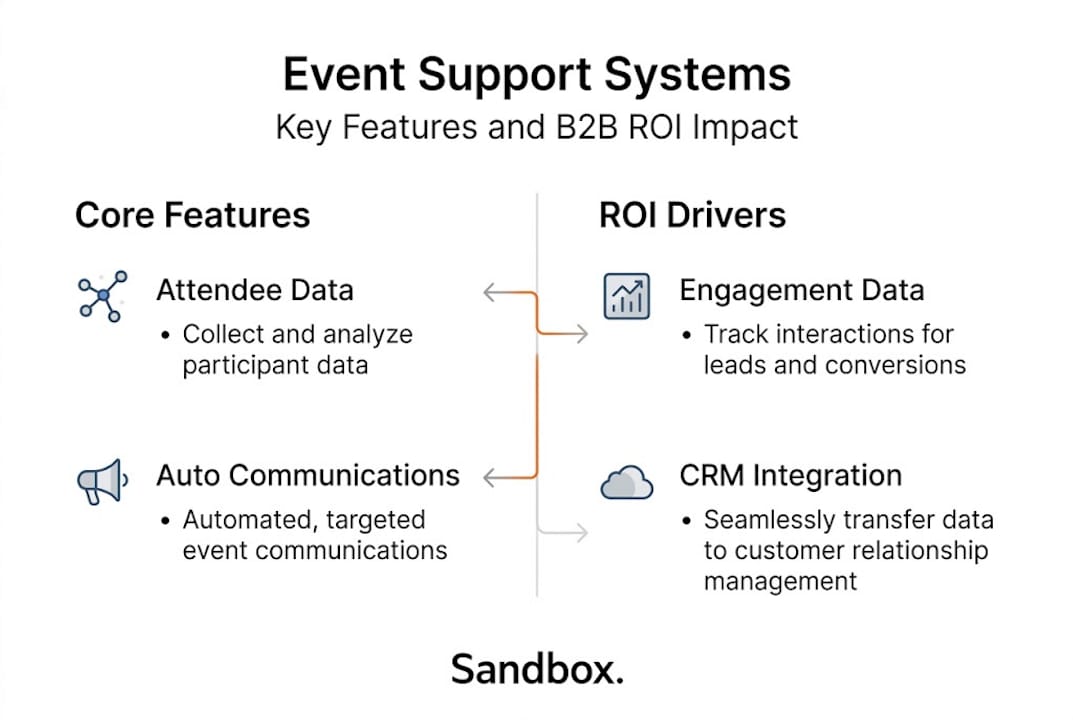
These platforms typically integrate directly with your CRM, marketing automation tools, and reporting dashboards. That means the data captured during a session or networking moment doesn't sit in a silo. It flows directly into the systems your sales team already uses, creating a seamless handoff between event experience and revenue conversation. The benefits of event marketing automation go far beyond saving time — they reshape how your entire go-to-market team engages with prospects.
Here's what a modern event support system typically includes: 🛠️
- Attendee management: Registration, check-in, profile management, and segmentation
- Engagement tools: Live polls, Q&A sessions, chat integrations, and interactive content
- Data capture: Behavioral tracking, session attendance, content interactions, and intent signals
- Reporting and analytics: Real-time dashboards, post-event summaries, and revenue attribution
- Personalization features: Dynamic content delivery, targeted messaging, and segmented follow-up
- Workflow automation: Triggered emails, CRM updates, and sales alerts based on attendee actions
The misconception that event support is purely operational leads organizations to underinvest in these tools. They spend heavily on production and lightly on the systems that actually capture value from all that production spend.
"Teams that automate event workflows report saving an average of 30% of staff time previously spent on manual follow-up tasks, freeing marketers to focus on strategy rather than execution." — Industry analysis on event automation for ROI
That time savings isn't just an efficiency win. It's a competitive advantage. When your team isn't drowning in spreadsheets and manual outreach, they can focus on the conversations and insights that actually move deals forward.
Driving audience engagement through smart event technology
With a clear understanding of what event support systems are, let's explore how they transform audience engagement in practice. Engagement is the currency of events. An attendee who sits passively through three sessions and leaves is not the same as one who participates in a poll, books a meeting, downloads a resource, and connects with two peers. The difference in pipeline value between those two experiences is enormous.
Smart event technology enables you to build the second experience at scale. It starts with segmentation. When you know who your attendees are — their industry, role, company size, and stage in the buying journey — you can deliver targeted content and messaging that feels relevant rather than generic. Learning how to personalize event outreach is what separates good events from great ones.
Engagement features built into modern support systems include:
- 🗳️ Live polls and surveys: Gather real-time audience feedback and surface intent signals mid-session
- 🤝 Attendee networking tools: AI-powered matchmaking that connects the right people based on shared interests or goals
- 💬 Chat and Q&A integrations: Keep attendees active and involved throughout sessions
- 📧 Follow-up automation: Trigger personalized outreach based on specific attendee actions during the event
- 📊 Session analytics: Track attendance, drop-off rates, and content interactions to understand what resonated
- 🎯 Dynamic content delivery: Show different content or offers to different audience segments in real time
Pro Tip: Connect your event platform to your CRM before the event goes live. When a prospect engages with a specific session or downloads a resource, your sales team gets an instant alert with context. That warm outreach happens within hours, not days — and timing matters enormously in B2B sales cycles.
The data is compelling. Events powered by smart support systems consistently outperform those running on basic tools. Here's how the numbers compare:
| Engagement metric | Events without smart support | Events with smart support |
|---|---|---|
| Average session attendance rate | 54% | 78% |
| Attendee interaction rate | 22% | 61% |
| Post-event response rate | 18% | 47% |
| Meeting bookings per 100 attendees | 6 | 19 |
| Net Promoter Score (avg.) | 32 | 58 |
These aren't marginal differences. They represent a fundamentally different attendee experience. And they're driven almost entirely by the systems running behind the scenes, not the quality of the keynote speaker. Applying event segmentation tips early in your planning process gives you the data you need to activate these features effectively from day one.
Measuring and maximizing event ROI with advanced support
While engaging your audience is critical, quantifying the results is what sets exceptional marketers apart. Proving event ROI has historically been one of the hardest challenges in B2B marketing. Advanced event support systems change that equation by making attribution possible, not just plausible.

Real-time reporting is the cornerstone of modern event analytics. Instead of waiting weeks for a post-event wrap-up report, your team can see what's working while the event is still live. Session drop-off rates tell you which content is losing the room. Click-through rates on in-event offers reveal purchase intent. Meeting request volume shows sales momentum. The importance of event metrics cannot be overstated — they turn events from feelings into facts.
Here's a practical numbered process for linking event activity directly to revenue results:
- Define your revenue metrics before the event: Set specific targets for pipeline generated, meetings booked, and opportunities advanced — not just registrations or attendance.
- Tag every touchpoint in your CRM: Every session attended, resource downloaded, or chat initiated should create a trackable activity record linked to the contact.
- Score attendees based on engagement depth: Assign point values to actions — a keynote attendance might be 5 points, a product demo request 25 points.
- Automate sales alerts for high-intent signals: When a contact hits a threshold score, trigger an immediate sales notification with full context.
- Run post-event attribution reports: Compare pipeline created or influenced within 30, 60, and 90 days for event attendees versus non-attendees.
- Feed insights back into planning: Use what you learned to refine your next event's content, targeting, and follow-up strategy.
Pro Tip: Set your success metrics in a shared document that both marketing and sales sign off on before the event. This eliminates the post-event debate about whether the event "worked" and keeps both teams accountable to the same outcomes. Comprehensive event activity reporting tools make this collaborative review much faster.
| Feature area | Basic event support | Advanced analytics-driven support |
|---|---|---|
| Reporting type | Post-event summary only | Real-time dashboards + post-event |
| Attribution capability | Attendance tracking | Multi-touch revenue attribution |
| CRM integration | Manual export | Automated two-way sync |
| Lead scoring | None | Behavior-based dynamic scoring |
| Follow-up automation | Generic email blast | Segmented, triggered sequences |
| ROI visibility | Estimated/anecdotal | Measurable and comparable |
The gap between basic and advanced support is the gap between "we think the event went well" and "the event generated $420K in influenced pipeline." Understanding event conversion optimization helps you connect those data points to actual revenue outcomes your leadership team will respect.
From planning to follow-up: Integrating event support into your workflow
Capturing and interpreting data completes the feedback loop, but the true value comes from seamless integration throughout your entire event process. Event support systems only deliver their full potential when they're woven into every phase of your event lifecycle — not bolted on at the last minute.
Before the event, your support system should be doing heavy lifting. This means building segmented registration flows, sending personalized pre-event content, and warming up attendees so they arrive engaged rather than cold. Applying a structured event marketing framework at the start ensures your support tools align with your broader GTM strategy from day one.
During the event, the system captures intent in real time. Every interaction is logged. Every session attended, poll answered, or conversation initiated becomes a data point your team can act on. Automating these captures removes the human error that leads to lost insights.
After the event — and this is where most teams fall short — the system should be driving a structured follow-up process. The difference between a generic "thanks for attending" email and a personalized follow-up based on what someone actually engaged with is measurable in conversion rates. Learning to optimize post-event engagement is one of the highest-leverage investments you can make in your event program.
Must-have integrations for a fully connected event workflow: 🔗
- CRM (Salesforce, HubSpot, etc.): Two-way sync of attendee data and activity records
- Marketing automation (Marketo, Pardot, etc.): Trigger nurture sequences based on event behavior
- Analytics platforms: Google Analytics, Looker, or custom BI tools for revenue attribution
- Calendar and scheduling tools: Calendly or similar for frictionless meeting booking during and after the event
- Collaboration tools: Slack or Teams integrations for real-time sales alerts and internal communication
- Content delivery platforms: Ensure post-event content is gated and tracked for continued intent capture
Pro Tip: Before your event, audit your data flow end to end. Follow a test attendee record from registration through to your CRM and sales inbox. If there are gaps or manual steps, those are the points where insights will get lost. Fix them before the event, not after. An effective event follow up process depends entirely on clean, connected data flowing through your stack without friction.
Automating your nurture sequences based on post-event engagement signals means your hottest prospects get relevant outreach fast, while lower-intent attendees receive educational content that keeps them warm for future conversations. This tiered approach dramatically improves both conversion rates and resource efficiency across your marketing team.
Our take: Why an ROI-first mindset is redefining event support
Having explored the mechanics, here's a fresh perspective from our experience working with B2B teams. For too long, event support has been treated as a cost center — something you fund to keep the lights on at your conference, not something you invest in to drive revenue. That mindset is genuinely costly.
The B2B teams winning with events in 2026 treat their support systems as profit drivers. They start every event planning conversation with the question: what revenue outcome are we trying to create? Not: what venue should we book? This shifts everything — the technology chosen, the workflows designed, and the metrics tracked.
We've seen organizations transform their event results not by spending more on production, but by investing in smarter support infrastructure. The teams stuck in old habits are the ones who still measure success by badge scans and session headcounts. The teams moving forward measure pipeline influenced, deals accelerated, and customers retained.
The honest signal that your team is behind: if your post-event report is mostly a PDF of attendance stats with no revenue attribution, your support system isn't working hard enough. Understanding the real marketing automation and ROI connection is the first step toward changing that. 📈
Unlock your event potential with advanced support
Ready to put these best practices to work? Sandbox is built for exactly this moment — helping B2B marketing and revenue teams turn event activity into measurable GTM signal. We combine smart workflows, real intent capture, and hands-on execution support so your events stop being logistics exercises and start being pipeline engines.
Whether you're optimizing an existing program or building your event strategy from scratch, our resources and platform are designed to make every event accountable. Explore our event marketing workflows for ROI to see how B2B teams are driving real results. Visit the Sandbox-GTM homepage to learn how we can support your next event from planning through pipeline. 🚀
Frequently asked questions
What is an event support system?
An event support system is a technology platform that manages event logistics, enhances attendee engagement, and provides measurable data to optimize marketing outcomes. It connects event activity to your broader revenue and marketing workflows.
How do event support systems improve ROI?
They automate workflows, personalize attendee experiences, and connect event data to revenue, helping marketers prove and improve event value. Platforms that prioritize events in marketing automation make attribution significantly more accurate and actionable.
Which features are most important in event support systems?
Key features include attendee tracking, targeted communications, engagement analytics, and integrations with CRM or marketing automation tools. These capabilities — especially when you personalize event outreach — directly impact conversion rates and post-event pipeline.
How can B2B teams ensure successful event follow-up using support systems?
Use event support systems to automate post-event follow-up, segment contacts, and personalize outreach for better conversions. A structured event follow-up process that triggers within 24 hours of the event closing dramatically improves response rates.
Do event support systems integrate with marketing automation?
Yes, most modern event support systems offer seamless integration with marketing automation platforms and CRM software. These integrations are a core benefit of event marketing automation and are essential for connecting event signals to revenue workflows.