

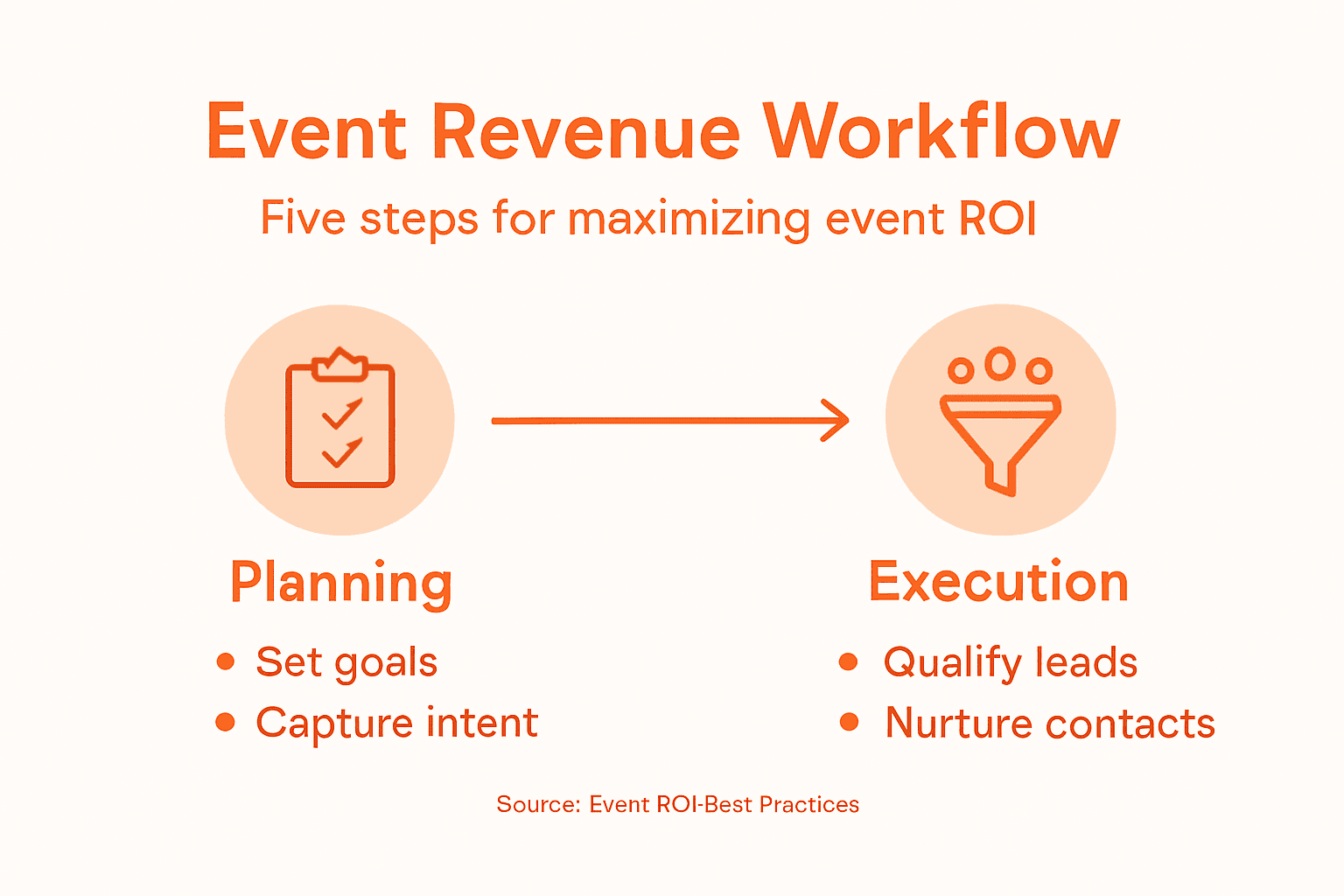
Running an event without well-defined goals is like navigating without a map, leaving revenue potential hidden in plain sight. For American tech startups, connecting every event activity to measurable business outcomes separates successful strategies from guesswork. This guide shows how to build a reliable workflow by focusing on setting specific, measurable outcomes at every stage, supporting clear team alignment and more efficient follow-up that directly drives revenue growth.
Table of Contents
- Step 1: Define Event Goals And Measurable Outcomes
- Step 2: Capture Intent Signals From Event Interactions
- Step 3: Prioritize High-Value Leads For Targeted Follow-Up
- Step 4: Activate Personalized Nurture Workflows
- Step 5: Assess Revenue Impact And Optimize Strategies
Quick Summary
| Key Insight | Explanation |
|---|---|
| 1. Define clear event goals | Specific, measurable goals connected to revenue targets are essential for success and guidance during the event. |
| 2. Identify intent signals | Capture clues from interactions to distinguish between interested buyers and casual attendees for effective follow-up. |
| 3. Prioritize leads effectively | Use lead scoring to focus follow-up efforts on high-value contacts who are most likely to convert. |
| 4. Personalize nurture workflows | Tailored follow-up messages based on attendee interactions increase engagement and conversion rates. |
| 5. Measure revenue impact | Analyze closed deals and conversions to evaluate the success of your event and optimize future strategies. |
Step 1: Define event goals and measurable outcomes
Getting clear on what you want your event to accomplish is the foundation of any successful revenue strategy. Without defined goals, you're essentially running blind, measuring activity instead of actual impact on your bottom line.
Start by identifying what success looks like for your event. Are you trying to generate qualified pipeline? Accelerate deals in your sales cycle? Build brand awareness in a new market segment? Your goals should connect directly to your company's revenue targets, not exist in a marketing vacuum.
Break your goals into time horizons using a logic model approach. Think about what changes you want to see happen:
- Immediate outcomes (during and right after the event): attendee engagement, conversations captured, content consumption
- Short-term outcomes (within 1-3 months): follow-up meetings booked, demo requests submitted, pricing inquiries received
- Mid-term outcomes (3-6 months): deals moving through your pipeline, contract negotiations started
- Long-term outcomes (6+ months): closed revenue, customer retention, repeat event attendance
Each outcome needs measurable criteria. Don't just say "generate leads." Instead, specify exactly what you're measuring: "100 qualified leads with decision-maker intent" or "50 discovery calls scheduled with target accounts." The more specific your metrics, the easier it becomes to track progress and adjust during the event.
Setting specific, measurable outcomes also ensures your team knows exactly what they're working toward. Everyone from booth staff to account executives should understand these numbers.
Your goals are only valuable if they tie directly to revenue impact and align with what your sales team is already trying to achieve.
Consider your audience context too. A regional startup conference has different success metrics than a flagship industry conference with 10,000 attendees. Your goals should be ambitious but realistic for the event type and size.
Pro tip: Use your CRM data from previous events to set realistic benchmarks—this shows you what's actually achievable rather than guessing, and makes it easier to identify improvements in your event revenue workflow.
Here's how outcomes measurement evolves across event stages:
| Outcome Type | Example Metric | Typical Timeframe |
|---|---|---|
| Immediate | Attendee engagement score | During/after event |
| Short-term | Meetings booked | 1-3 months |
| Mid-term | Opportunities created | 3-6 months |
| Long-term | Revenue closed | 6+ months |
Step 2: Capture intent signals from event interactions
Intent signals are the clues that tell you who's actually interested in buying versus who's just collecting swag. They come from conversations, booth visits, content engagement, and questions asked during your event. Learning to spot and capture these signals is what separates a successful event revenue workflow from one that wastes your sales team's time.
Intent shows up in multiple ways at events. Someone asking detailed questions about pricing or implementation has different intent than someone browsing your booth. A person requesting a follow-up meeting has stronger signal than someone who took your business card. The key is capturing all these moments systematically so nothing falls through the cracks.
Start by defining what intent looks like at your specific event:
- Conversation depth: Did the attendee ask clarifying questions about your solution or just make small talk?
- Problem alignment: Did they mention challenges your product solves?
- Buying stage signals: Did they ask about pricing, timelines, demos, or technical specifications?
- Engagement intensity: Did they spend significant time at your booth or content area?
- Direct actions: Did they request a meeting, schedule a demo, or sign up for a trial?
Use advanced intent recognition frameworks that analyze multiple interaction types simultaneously. Modern approaches capture intent from what people say (their words), how they say it (tone and emphasis), and what they do (actions taken). This multimodal view gives you a much clearer picture than relying on a single data point.
In practice, this means your team needs a simple system for recording intent during the event. Whether it's notes in your CRM, a mobile app, or a structured form, make it easy for booth staff and account executives to log what they observe in real time.
The attendees who express specific problems or ask targeted questions are your priority follow-ups. Don't treat all event contacts equally.
Automating some of this capture accelerates your workflow. If attendees scan badges at your booth, visit specific content, or spend time in certain areas, that behavioral data tells you something about their interests.
Pro tip: Train your booth staff to listen for three key phrases: "How much does it cost?", "When could we implement?", and "Does it integrate with [their tool]?" These questions signal someone moving toward a buying decision and deserve immediate follow-up.
Step 3: Prioritize high-value leads for targeted follow-up
Not all event contacts deserve equal attention. Your sales team has limited bandwidth, so you need a system for identifying which leads are actually worth pursuing right now versus which ones need nurturing later. Prioritization separates deals that close from contacts that disappear.

Start by scoring leads based on clear criteria that matter to your business. Intent signals you captured earlier become your scoring foundation, but you'll layer in additional data to get a complete picture of who's ready to buy.
Consider these prioritization factors:
- Fit: Does their company size, industry, and use case match your ideal customer profile?
- Intent strength: How many strong intent signals did they show at your event?
- Buying timeline: Did they mention needing a solution soon or were they exploratory?
- Decision authority: Are they a decision-maker, influencer, or just gathering information?
- Account value: Could this deal size significantly impact your quarterly revenue?
Data-driven prioritization approaches focus your follow-up resources on leads most likely to move forward. Rather than treating every contact equally, you segment them into tiers so your account executives spend time where it counts most.
Create a simple lead scoring system. You don't need anything complicated. A spreadsheet with a scoring rubric works fine. High-fit companies with multiple strong intent signals get immediate follow-up within 24 hours. Mid-tier leads get personalized outreach within a week. Lower-priority contacts go into nurture sequences for later engagement.
Your best leads show multiple signals, not just one. Someone who asked pricing questions, requested a meeting, and fits your ICP is clearly different from someone who took your brochure.
Once you've tiered your leads, assign them to the right people on your team. Your best account executives should work the top tier. SDRs can handle tier two. Automation and email nurturing can manage tier three until they show stronger signals.
Pro tip: Immediately after your event, block time with your sales leadership to review top-tier leads together and align on messaging before those leads hit their inboxes; this prevents conflicting outreach and ensures consistency.
This table summarizes key factors for lead prioritization and their business relevance:
| Priority Factor | Why It Matters | Impact on Revenue Strategy |
|---|---|---|
| Company Fit | Ensures ideal customer alignment | Increases deal conversion likelihood |
| Intent Strength | Indicates purchase readiness | Prioritizes fastest sales paths |
| Buying Timeline | Flags urgency or long-term nurture | Optimizes rep focus and forecasting |
| Decision Authority | Distinguishes influencers vs. buyers | Speeds up deal closure |
| Potential Deal Size | Identifies high-value opportunities | Maximizes ROI per sales effort |
Step 4: Activate personalized nurture workflows
Generic follow-up emails rarely convert. Your leads came to your event for different reasons, asked different questions, and need different next steps. Personalized nurture workflows meet each lead where they are instead of blasting everyone the same message.
Personalization starts with the data you already collected. You know what they asked about, what problems they mentioned, and what buying signals they showed. Use that information to tailor your outreach so it feels relevant, not like a template.
Build your nurture workflows around these segments:
- High-intent, ready-to-buy leads: Direct them to sales conversations immediately with custom messaging about what they asked about
- Mid-intent leads exploring options: Send educational content related to their specific challenges and use cases
- Lower-intent but good-fit contacts: Deliver thought leadership and industry insights to build credibility over time
- Out-of-fit but engaged attendees: Keep them warm with company updates and occasional relevant content
AI-powered personalized workflow systems can automate this at scale by adapting content based on how each lead engages. When someone opens your email about pricing, the system sends them more pricing-related content next. When they download a case study about their industry, follow-up recommendations shift accordingly.
You don't need sophisticated automation to start. A basic setup uses your CRM to tag leads by segment, then manually create four or five workflows that map to those segments. Each workflow includes a sequence of emails timed appropriately for that stage.
Personalization doesn't mean sending a hundred unique emails. It means grouping leads into meaningful segments and crafting relevant sequences for each group.
Timing matters enormously. High-intent leads need outreach within 24 hours while the event is fresh. Mid-tier leads benefit from reaching out within 3 to 5 days when you've had time to prepare a thoughtful message. Lower-priority contacts can enter longer nurture sequences spaced weeks apart.
Test and iterate on your workflows. Track which messages get opened, which calls get booked, and which sequences produce meetings. Double down on what works and retire what doesn't.
Pro tip: Include a specific detail from each attendee's booth conversation in your first email ("You mentioned you're running three different marketing stacks"), which immediately proves you listened and dramatically increases response rates.
Step 5: Assess revenue impact and optimize strategies
You can't improve what you don't measure. Assessing your event's actual revenue impact tells you whether your workflow is working or if you need to make changes. This is where gut feeling stops and data-driven decisions begin.
Start by tracking the complete journey from event attendance to closed deals. You need visibility into how many leads became opportunities, which opportunities turned into customers, and how much revenue those customers generated. This requires connecting your event data to your CRM and accounting systems.
Measure these key metrics:
- Pipeline generated: Total revenue value of opportunities created from event attendees
- Conversion rates: Percentage of leads that became opportunities, then customers
- Average deal size: Revenue per closed deal from event sources
- Sales cycle length: How long it takes event leads to close compared to other sources
- Cost per acquisition: Total event spend divided by number of customers acquired
- Return on investment: Revenue generated minus total event costs
Rigorous data-driven methods help you isolate which parts of your workflow actually drive revenue. Without proper evaluation, you can't tell if your nurture sequences or your sales team's follow-up effort created the results.
Set up attribution tracking so deals credit the event appropriately. Most CRMs let you tag opportunities with their source. Use consistent tagging so reporting is clean and comparable month to month.
The best event metric isn't leads generated. It's revenue closed and customer acquired cost compared to your other channels.
Once you have baseline numbers, look for patterns. Which segments converted best? Which nurture workflows produced the most meetings? Did certain industries respond better to your messaging? These insights become your optimization roadmap.
Compare your event ROI to other marketing channels. If your event generated 200 customers at $500 customer acquisition cost while your paid advertising costs $2,000 per customer, your event workflow is clearly more efficient.
Schedule quarterly reviews to assess performance and test changes. Try different follow-up timing, adjust your nurture messaging, or experiment with new lead scoring criteria. Track results and keep what works.
Pro tip: Create a simple dashboard showing event pipeline, conversion rates, and revenue closed so your entire team sees the impact quarterly; this builds buy-in for continuing the workflow and justifies event budget.
Transform Your Event Revenue Strategy with Sandbox
The challenge of turning event interactions into measurable revenue is real and pressing. This article highlights the need to capture genuine buyer intent, prioritize leads effectively, and personalize follow-up workflows to maximize ROI. If you are struggling with incomplete intent signals, inefficient lead scoring, or generic nurturing sequences that waste time and money, you are not alone. Capturing the right signals from conversations, understanding buying timelines, and aligning with sales priorities are critical steps toward closing more deals from your events.
Sandbox understands these pain points deeply. We treat events as a powerful growth channel and provide a platform that captures real intent across meetings, content, and live interactions. Our system helps you identify who to follow up with, why they matter, and what actions to take next. By integrating proven go-to-market workflows with hands-on execution, Sandbox empowers your team to generate demand, accelerate conversions, and directly link events to pipeline and revenue without guesswork.
Ready to make every event moment count and optimize your event revenue workflow? Discover how Sandbox can turn your high-intent event signals into a steady stream of pipeline at Sandbox home.
Take control of your event success now by exploring our platform at Sandbox. Start building a revenue-impacting event process that your sales and marketing teams will trust and repeat.
Learn more about how Sandbox connects intent to revenue with reliable workflows at Sandbox.
Frequently Asked Questions
What are the first steps in developing an event revenue workflow?
Begin by defining clear goals and measurable outcomes for your event that align with your revenue targets. Specify what success looks like, such as generating qualified leads or accelerating deals, and ensure your team understands these metrics.
How can I capture intent signals effectively during my event?
To capture intent signals, systematically record key interactions such as detailed questions about your product or follow-up requests. Implement a simple system for your team to log these observations in real time, ensuring that you prioritize attendees showing strong buying signals.
What criteria should I use to prioritize leads after an event?
Use a scoring system based on fit, intent strength, buying timeline, decision authority, and potential deal size to prioritize leads. Focus your sales efforts on high-fit leads with multiple strong intent signals, aiming for immediate follow-up within 24 hours for the top-tier contacts.
How do I create personalized nurture workflows for different lead segments?
Segment your leads based on intent and fit, and build tailored workflows that address their specific needs. For instance, direct high-intent leads to immediate sales conversations and provide educational content for mid-intent contacts to keep them engaged over time.
What key metrics should I track to assess the revenue impact of my event?
Measure metrics such as total pipeline generated, conversion rates, average deal size, and cost per acquisition. By tracking these metrics, you can gain insights into your event's performance and make data-driven decisions to optimize future strategies.
How frequently should I review my event revenue strategy?
Conduct quarterly reviews to assess the performance of your event revenue workflow. This allows you to test different approaches, like follow-up timing or nurturing messaging, and adjust your strategies based on measurable outcomes to maximize ROI.