
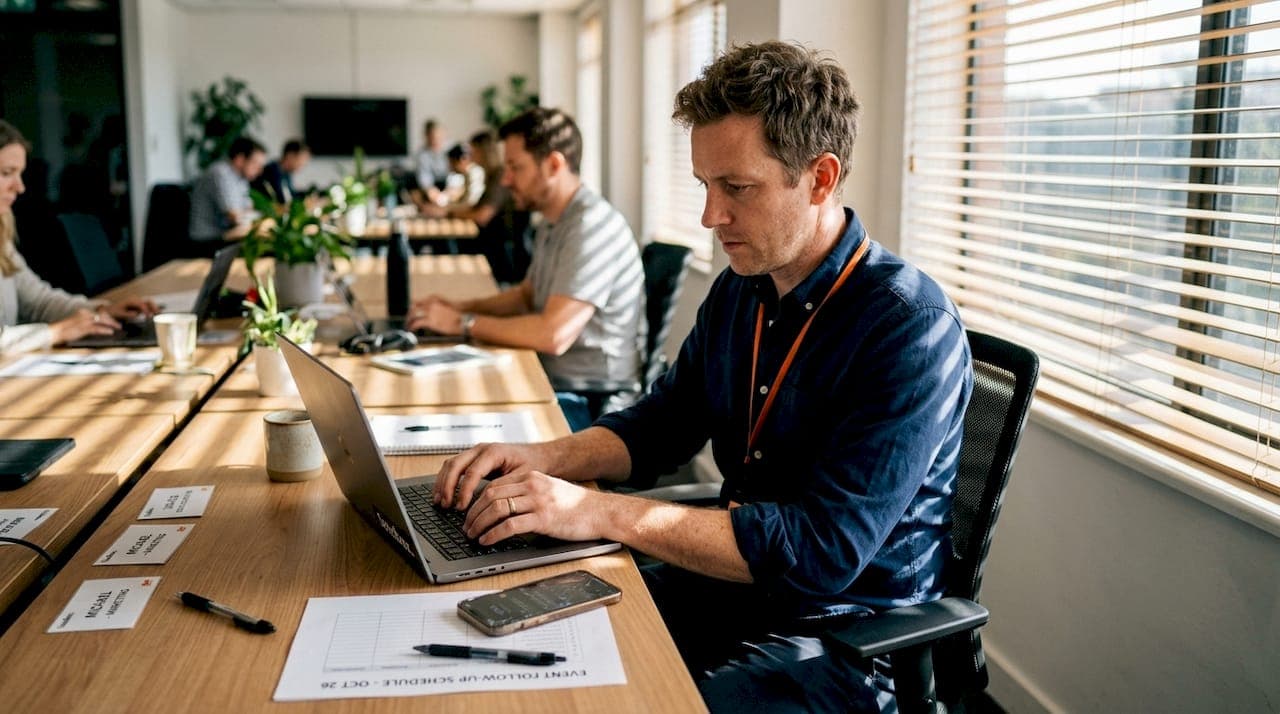
Most event teams put enormous energy into planning and executing their events, then watch the momentum fade within days because follow-up falls flat. Over 50% of marketing leaders struggle with the sales handoff after events, leaving pipeline on the table and attendees feeling forgotten. The good news? A structured, data-driven event follow up process can turn that lost momentum into measurable revenue. This guide walks you through every stage, from pre-event prep to post-event measurement, so you can stop guessing and start converting. 🎯
Table of Contents
- Why every event follow-up process needs an upgrade
- Pre-event foundations: The secret to effective follow-up
- The step-by-step event follow up process
- Segmentation and multi-channel outreach: Maximizing impact
- Measuring success: KPIs and feedback loops
- Unlock more ROI with next-level event follow up solutions
- Frequently asked questions
Key Takeaways
| Point | Details |
|---|---|
| Preparation drives results | Effective post-event follow-up starts with pre-event data capture and segmentation in your CRM. |
| Personalize and segment | Divide leads by engagement and personalize multi-channel outreach to boost conversions. |
| Follow up with strategy | Use a sequenced, timeline-based process to nurture event contacts without overwhelming them. |
| Track what matters | Measure critical KPIs like open rates, pipeline value, and revenue to prove follow-up ROI. |
| Automate for efficiency | Adopt automation tools to scale and optimize consistent follow-up workflows. |
Why every event follow-up process needs an upgrade
Let's be honest: the generic "Thanks for attending!" email blast is not a follow-up strategy. It's a missed opportunity. Most teams default to single-channel outreach with no segmentation, and then wonder why response rates are low and sales teams are frustrated.
The symptoms of a broken follow-up process are easy to spot:
- 📉 Low email open and reply rates after events
- 🤝 Sales teams receiving unqualified or incomplete lead lists
- ⏳ Days or weeks passing before any outreach goes out
- 🔁 No clear handoff between marketing and sales
- 📭 Attendees receiving the same message regardless of their engagement level
The root cause is almost always the same: outreach is treated as an afterthought rather than a planned, strategic motion. Optimizing post-event engagement requires a shift from reactive to proactive, from generic to personalized, and from single-channel to multi-channel.
"Success requires aligned multi-channel, data-driven segmentation over generic blasts." The teams that win post-event are the ones who treat follow-up as a campaign, not a courtesy.
The fix is not complicated, but it does require intention. With the high cost of poor follow-up established, let's identify what you need to execute a modern, effective process.
Pre-event foundations: The secret to effective follow-up
Here's a truth most event marketers overlook: your follow-up strategy should be 80% built before the event starts. The teams that consistently convert attendees into pipeline do the hard work upfront. 🏗️
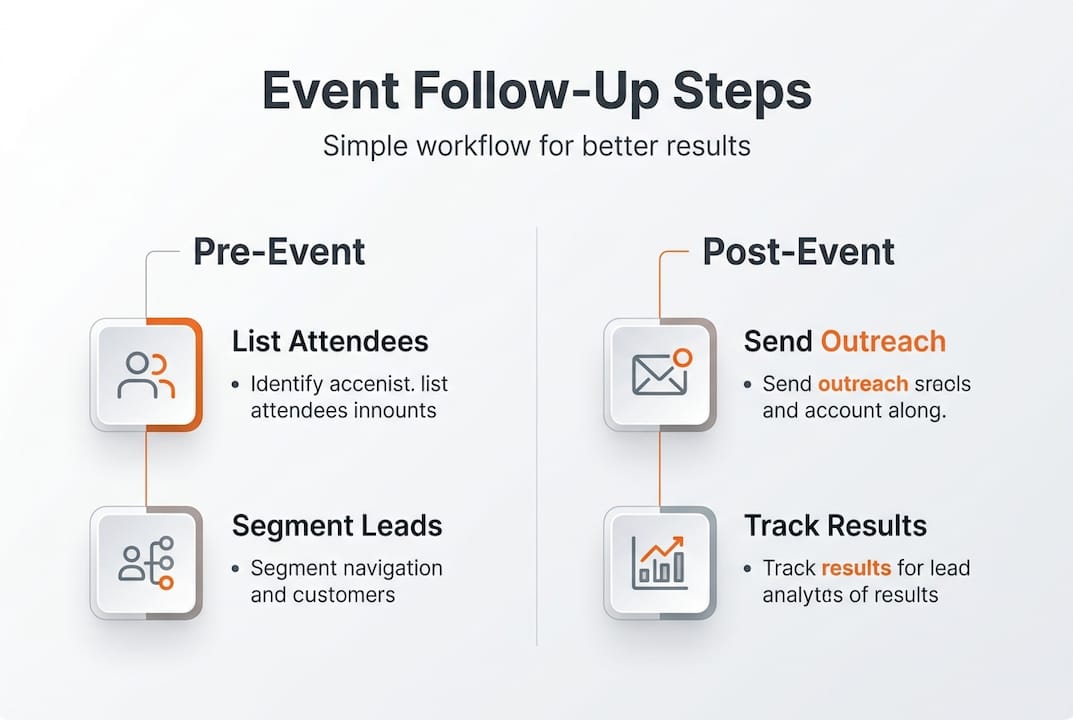
Preparation starts pre-event: build your attendee lists in your CRM, prepare email templates, and segment your audiences before anyone walks through the door. This means you're ready to execute within hours of the event ending, not days.
Here's what your pre-event checklist should cover:
- ✅ CRM setup: Tag attendees by role, company size, interest area, and registration source
- ✅ Lead capture plan: Define what data you'll collect at the event (badge scans, session attendance, booth visits)
- ✅ Content assets: Prepare follow-up emails, resource links, and CTAs for each audience segment
- ✅ Personalization tokens: Set up dynamic fields so emails feel individual, not mass-produced
- ✅ Handoff protocol: Agree with sales on what a qualified lead looks like and when they take over
Use event segmentation tips to build your audience tiers before the event, so you're not scrambling to sort leads afterward. Pair that with event marketing automation to queue up your sequences in advance.
| Pre-event task | Purpose | Recommended timing |
|---|---|---|
| Build CRM attendee list | Enables segmentation and tracking | 2 weeks before event |
| Draft email templates | Speeds up post-event execution | 1 week before event |
| Define lead scoring criteria | Aligns marketing and sales | 1 week before event |
| Prepare content assets | Supports nurture sequences | 1 week before event |
| Set up automation workflows | Ensures timely, consistent outreach | 3 days before event |
Once your pre-event preparation is solid, the next step is flawless execution after the event itself.
The step-by-step event follow up process
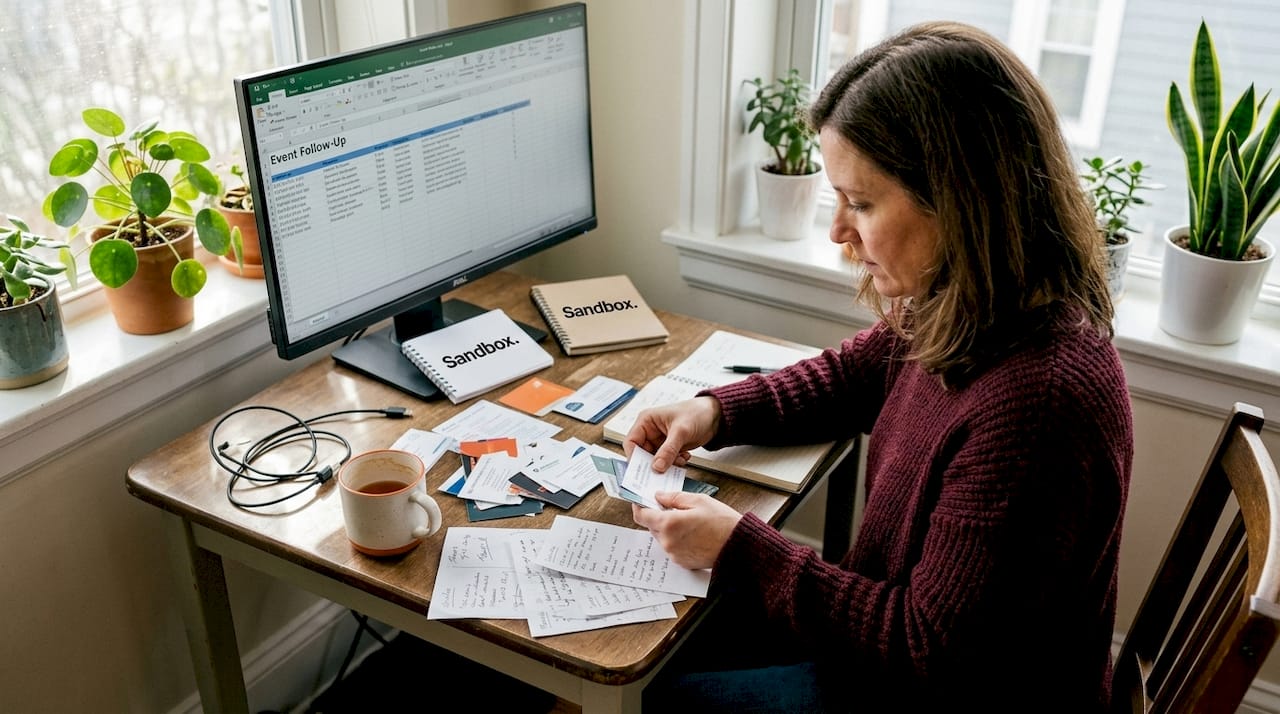
Timing is everything in post-event follow-up. Strike too late and the conversation goes cold. Strike too early with the wrong message and you lose credibility. Here's a proven timeline to follow. 📅
Recommended follow-up timelines give you a clear structure: Day 1-2 for thank-you messages, Day 2-3 for surveys, Week 1 for content delivery, Weeks 2-4 for nurture, and Month 1 onward for next event invites.
- Day 1-2: Send a personalized thank-you. Reference something specific, a session they attended, a conversation at your booth, or a resource they downloaded. Keep it short and warm.
- Day 2-3: Deploy a post-event survey. Ask 3-5 focused questions about their experience and what challenges they're currently facing. This data feeds your segmentation.
- Week 1: Deliver high-value content. Share a recap, a relevant case study, or a resource tied to their stated interests. This is not a sales email. It's a value drop.
- Weeks 2-4: Run a nurture sequence. Use event marketing automation to deliver 2-3 touchpoints that move leads toward a decision. Include a clear CTA at each stage.
- Month 1 onward: Invite to the next event or milestone. Hot leads should be in active sales conversations. Warm leads get invited to webinars, roundtables, or your next flagship event.
Pro Tip: Don't automate everything. For your top 10-20% of leads, have a sales rep send a personal LinkedIn message or make a quick call in the first 48 hours. That human touch dramatically increases response rates for high-value prospects.
Use event conversion optimization strategies to sharpen your CTAs and landing pages so every touchpoint has a clear next step.
Segmentation and multi-channel outreach: Maximizing impact
Not every attendee deserves the same follow-up. Treating a keynote speaker the same as someone who briefly visited your booth is a waste of resources and a missed opportunity. Smart segmentation changes everything. 🎯
Segment your leads into hot, warm, and cold tiers based on their event engagement. Hot leads (active conversations, demo requests, high session attendance) need outreach within 24 hours. Warm leads get a 4-6 week nurture sequence. Cold leads receive value-driven content, not sales pitches.
Here's how to approach each channel in your mix:
- 📧 Email: Your primary channel for nurture sequences. Personalize subject lines and body copy based on event behavior.
- 📞 Phone: Reserve for hot leads only. A timely call from a knowledgeable rep can accelerate deals significantly.
- 💼 LinkedIn: Great for warm leads. Comment on their posts, send a connection request with context, or share relevant content.
- 📱 Social: Use retargeting ads to stay visible to attendees who haven't responded to direct outreach.
Multi-channel outreach that combines email, social, LinkedIn, and phone with clear CTAs consistently outperforms single-channel approaches. The key is avoiding overcommunication: 1-2 touchpoints per week is the sweet spot for most audiences.
Pro Tip: Reference specific event interactions in your outreach. "We spoke about your Q3 pipeline challenges at the booth" is infinitely more compelling than "Hope you enjoyed the event!" Use your segmenting event leads data and event lead generation strategies to make every message feel relevant.
Measuring success: KPIs and feedback loops
You can't improve what you don't measure. The best event teams build a measurement cadence into their follow-up process from day one, tracking performance at 30, 60, and 90 days post-event. 📊
Key KPIs to track include open and click rates, survey response rates, MQL and SQL conversion rates, pipeline value generated, revenue attributed to event activity, and attendee retention for future events.
Here's your must-track KPI list:
- 📬 Email open and click rates: Benchmark against your industry average to gauge message relevance
- 📋 Survey response rate: A low rate signals your outreach timing or messaging needs adjustment
- 🏆 MQL and SQL rates: How many event leads are progressing through your funnel?
- 💰 Pipeline value: Total deal value sourced or influenced by event activity
- 📈 Revenue attributed: Closed-won deals tied back to event touchpoints in your CRM
- 🔄 Retention rate: Are attendees returning to your next event? This is a strong signal of overall program health
Use event KPIs and automation tools to build dashboards that surface these numbers automatically. Pair that with tracking post-event engagement data to understand which touchpoints are driving the most conversions.
"What gets measured gets improved." Build a 90-day review cadence into your event program so every follow-up cycle is smarter than the last.
Review your event metrics guide to make sure you're capturing the right data points at every stage of the funnel. With measurement in place, you're set to continuously refine and improve post-event outcomes.
Unlock more ROI with next-level event follow up solutions
You now have a complete framework for building a follow-up process that actually converts. But knowing the steps and having the systems to execute them consistently are two different things. That's where Sandbox comes in. 🚀
Sandbox is built for event marketing teams who want to turn high-intent event moments into measurable pipeline. Our platform captures real intent signals across meetings, content, and live interactions, then feeds them directly into automated event follow-up workflows that your team can actually execute. Whether you're running a small hosted dinner or a flagship conference, Sandbox-GTM solutions give you the systems, signal, and support to make every event accountable and worth repeating. Explore our resources or book a conversation with our team today.
Frequently asked questions
What is the single most important step in an event follow up process?
Prompt, segmented outreach within 24-48 hours of the event is the single biggest driver of higher engagement and conversions. Speed and relevance together are what separate high-performing teams from the rest.
How often should I contact event leads after an event?
Best practice is 1-2 emails per week for the first two weeks, then taper contact based on engagement signals. Overcommunicating early is one of the fastest ways to lose a warm lead.
How do I handle leads who did not engage at all post-event?
Send value-driven content rather than sales pitches, and consider re-segmenting or pausing outreach for completely inactive leads after 4-6 weeks. Not every attendee is ready to buy right now, and that's okay.
Which metrics prove if our event follow-up worked?
Key KPIs are opens, clicks, survey results, MQL and SQL rates, pipeline value, and revenue attributed to event activity. Track these at 30, 60, and 90 days for a complete picture of follow-up performance.