

Most B2B event marketers celebrate sellout crowds, but here's the uncomfortable truth: 45% focus mainly on headcount rather than interaction depth. A packed room doesn't guarantee pipeline impact. The gap between attendance and genuine engagement often determines whether your event drives revenue or just consumes budget. Understanding how to measure and optimize engagement metrics transforms events from cost centers into accountable growth channels.
Table of Contents
- Understanding Event Engagement Metrics In B2B Marketing
- How Engagement Metrics Influence Event Outcomes
- Common Misconceptions About Event Engagement Metrics
- Frameworks For Measuring And Applying Engagement Metrics
- Using Engagement Metrics To Enhance Event Strategy And Drive Revenue
- Conclusion: Making Events Accountable Through Engagement Metrics
- Enhance Your B2B Events With Engagement-Driven Solutions
Key takeaways
| Point | Details |
|---|---|
| Engagement transcends attendance | Quality interactions and buyer intent reveal true event value better than headcount alone. |
| Composite scoring predicts outcomes | Integrating multiple engagement signals identifies high-intent prospects more accurately than single metrics. |
| Common misconceptions hurt ROI | Equating attendance with engagement leads to flawed follow-up prioritization and missed revenue opportunities. |
| Structured frameworks drive results | Three-tiered models measuring volume, quality, and intent enable actionable sales alignment. |
| Engagement insights accelerate pipeline | Data-driven prioritization and real-time adjustments boost conversion rates and revenue growth. |
Understanding event engagement metrics in B2B marketing
Engagement metrics capture how attendees interact with your event beyond simply showing up. For marketing to businesses, these measurements reveal genuine buyer interest and intent signals that attendance figures mask.
Core engagement metrics include:
- Session participation: Which presentations attendees choose and how long they stay
- Interaction depth: Questions asked, polls answered, and conversations initiated
- Content consumption: Downloads, booth visits, and demo requests
- Post-event actions: Follow-up responses, meeting requests, and continued engagement
Quality matters more than quantity. An attendee who attends three targeted sessions, downloads two whitepapers, and schedules a follow-up meeting shows stronger buying intent than ten passive badge scanners. B2B marketers often over-rely on attendance count, neglecting interaction depth despite its stronger correlation to event return on investment.
Pure attendance counts create false confidence. A thousand registrants might sound impressive until you realize only 200 engaged meaningfully with your content. Those 200 represent your actual opportunity, but traditional measurement obscures this distinction.
How engagement metrics influence event outcomes
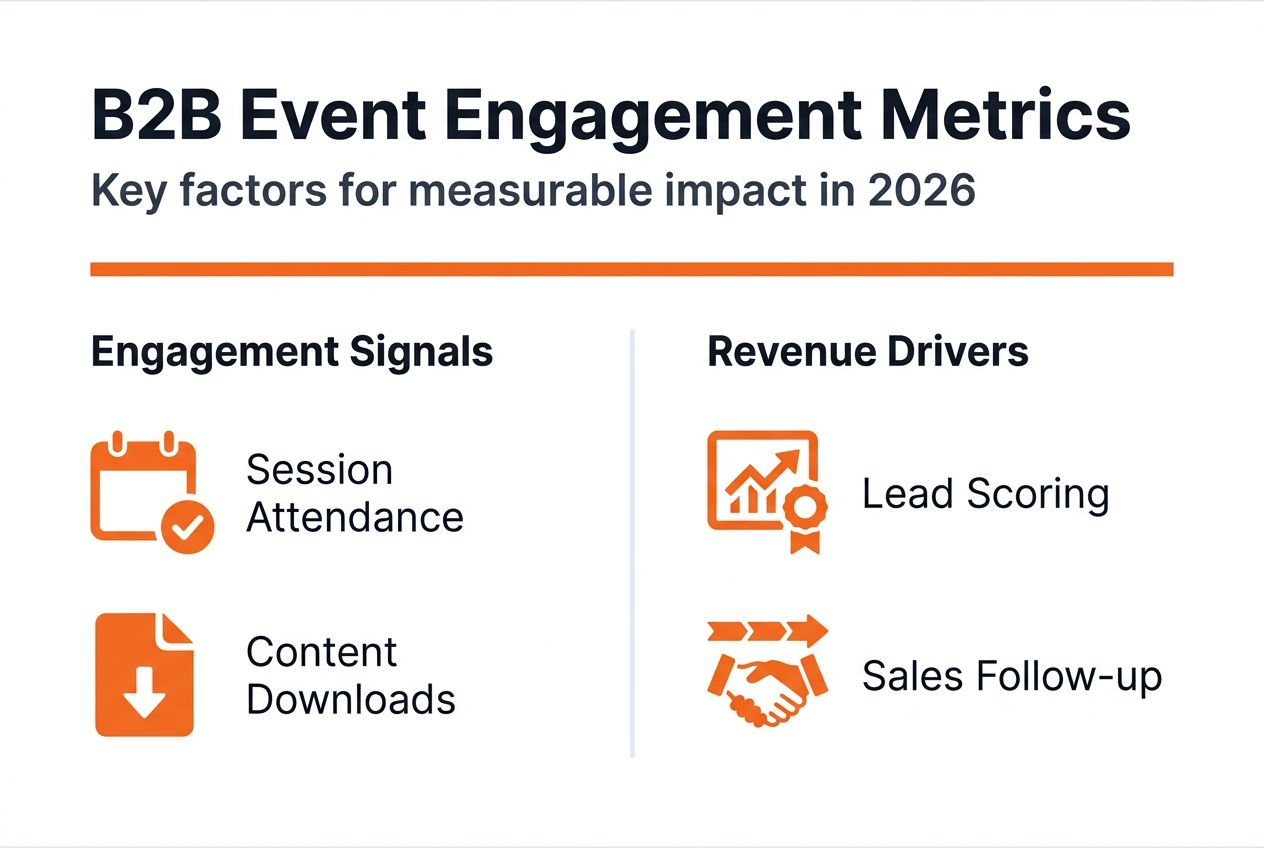
Composite engagement scoring combines multiple behavioral signals into unified lead quality assessments. This approach integrates session attendance, booth interactions, content downloads, and networking activity to predict which attendees most likely convert.
The scoring mechanism works through weighted algorithms. High-value activities like attending product demos or requesting technical documentation score higher than passive behaviors like brief booth visits. Real-time monitoring tracks these signals during the event, enabling dynamic response.

Pipeline impact becomes measurable when engagement data flows into sales workflows. Aligning engagement metrics with sales follow-up workflows accelerates pipeline velocity by identifying high-intent contacts for prioritization. Sales teams receive enriched context about each lead's specific interests and engagement level.
Key mechanisms include:
- Predictive lead scoring: Algorithms identify prospects most likely to convert based on engagement patterns
- Automated prioritization: Customer Relationship Management systems flag high-engagement contacts for immediate follow-up
- Behavioral triggers: Specific actions like multiple session attendances automatically initiate sales workflows
- Real-time adjustments: Live engagement monitoring allows event teams to redirect resources toward high-performing activities
This integration transforms events from lead generation exercises into precise demand capture mechanisms. Understanding linkedin outreach best practices higher response rates helps teams convert event engagement into sustained conversations.
Common misconceptions about event engagement metrics
Attendance doesn't equal engagement. This fundamental confusion undermines return on investment measurement across B2B events. Many marketers treat registration numbers and badge scans as success indicators, missing the critical distinction between physical presence and active participation.
Common pitfalls include:
- Volume over value: Prioritizing headcount growth without assessing interaction quality
- Passive presence assumption: Treating all attendees as equally engaged regardless of behavior
- Single-metric reliance: Using attendance alone to calculate event return on investment
- Follow-up misallocation: Contacting all attendees equally instead of prioritizing high-engagement prospects
The data reveals this problem's scale. Studies show ignoring engagement quality leads to 15% lower conversion from event leads compared to companies measuring quality indicators. This conversion gap directly impacts revenue outcomes.
High headcount can actually dilute return on investment metrics by inflating denominator values while failing to improve pipeline contribution. Consider an event with 1,000 attendees where only 150 engage meaningfully. Traditional return on investment calculations divide total event cost by 1,000, artificially deflating per-lead cost and masking the true acquisition expense for quality leads.
"The biggest mistake event marketers make is celebrating full rooms while ignoring empty conversations. True engagement happens in the interactions, not the headcount."
Misinterpreting passive attendees creates cascading problems. Sales teams waste time on low-intent contacts while high-value prospects receive delayed follow-up. This prioritization failure extends sales cycles and reduces conversion rates, ultimately undermining the event's pipeline contribution.
Frameworks for measuring and applying engagement metrics
Structured measurement frameworks organize engagement data into actionable insights. The three-tiered model categorizes metrics by strategic value:
- Volume metrics: Basic attendance, registration counts, and session capacity utilization
- Quality metrics: Interaction depth, session duration, content consumption, and participation rates
- Intent metrics: Follow-up requests, demo bookings, buying committee engagement, and conversion likelihood scores
Composite scoring combines these tiers into unified lead quality ratings. A prospect attending five sessions, downloading three resources, and requesting a demo receives significantly higher scores than someone who registered but attended nothing.
Implementation requires integration between event platforms and sales systems. Customer Relationship Management connections enable automatic lead enrichment with engagement data. Real-time dashboards visualize engagement patterns as they develop, supporting tactical adjustments.
Pro Tip: Start with three core metrics rather than tracking everything. Session attendance, content downloads, and follow-up requests provide sufficient signal for most B2B events without overwhelming your measurement infrastructure.
Comparison of engagement measurement approaches:
| Approach | Data Capture | Sales Integration | Real-Time Visibility | Scalability |
|---|---|---|---|---|
| Manual tracking | Spreadsheets, surveys | Minimal | None | Low |
| Basic automation | Event app analytics | Limited | Delayed | Medium |
| Integrated platform | Automatic across touchpoints | Full CRM sync | Live dashboards | High |
| Enterprise solution | Multi-event aggregation | Advanced workflows | Predictive analytics | Very high |
Technology choices determine measurement reliability. Event platforms with native Customer Relationship Management integration eliminate manual data transfer and reduce lag between engagement actions and sales visibility. Implementations of engagement-based follow-up increased pipeline velocity by 30% within six months by aligning engagement metrics with sales workflows.
Scalability matters for growing event programs. Frameworks that work for 100-person workshops must adapt to 5,000-attendee conferences without proportional resource increases. Cloud-based platforms with automated scoring handle this scaling naturally.
Using engagement metrics to enhance event strategy and drive revenue
Engagement data transforms from measurement to action through systematic application. High-intent prospects identified by composite scoring receive immediate, personalized follow-up while lower-engagement contacts enter nurture sequences.
Prioritization starts during the event itself. Real-time dashboards flag attendees exhibiting strong engagement patterns, enabling on-site teams to initiate conversations before prospects leave. This immediacy capitalizes on peak interest moments.
Post-event application includes:
- Tiered follow-up sequences: High-engagement contacts receive sales outreach within 24 hours; medium engagement enters email nurture; low engagement receives brand awareness content
- Content personalization: Follow-up messaging references specific sessions attended and topics explored
- Sales enablement: Account executives receive detailed engagement summaries including behavioral intent signals
- Strategy refinement: Session-level engagement analysis identifies high-value topics for future events
Dynamic adjustments improve outcomes during multi-day events. If morning sessions show low engagement, afternoon programming can shift toward more interactive formats. Real-time monitoring reveals these opportunities for tactical pivots.
Pro Tip: Create engagement thresholds that trigger automatic workflows. For example, any attendee visiting three or more booths automatically receives a personalized email within two hours highlighting relevant resources.
Revenue impact becomes measurable through pipeline attribution. Tracking which engaged attendees progress through sales stages reveals engagement metric correlation with closed revenue. This analysis proves event value in financial terms executives understand.
Case examples demonstrate tangible results. Organizations implementing engagement-led follow-up strategies report conversion rate improvements of 20 to 40 percent compared to generic post-event campaigns. Pipeline velocity increases as sales teams focus efforts on prospects demonstrating genuine buying intent.
Continuous iteration amplifies results over time. Each event generates engagement data that refines scoring models, improves content strategies, and sharpens targeting for future programs. This learning loop compounds event effectiveness across your annual calendar.
Conclusion: making events accountable through engagement metrics
Engagement metrics fundamentally change how B2B organizations approach event marketing by connecting activities to revenue outcomes. Moving beyond attendance to measure interaction quality and buyer intent transforms events into accountable growth channels.
Structured frameworks combining volume, quality, and intent metrics provide the foundation for this transformation. Integration with sales workflows ensures engagement insights drive immediate action rather than sitting in isolated reports. Real-time monitoring enables tactical adjustments that maximize participation and pipeline impact.
Ongoing refinement matters as much as initial implementation. Each event generates data that improves scoring accuracy, sharpens follow-up strategies, and identifies high-value programming. Organizations that embed engagement measurement into their event operations build sustainable competitive advantages in pipeline generation.
The path forward requires commitment to measurement discipline and technology investment. But the payoff arrives quickly. Better lead quality, faster pipeline velocity, and stronger return on investment justify the effort while establishing events as genuine revenue drivers rather than marketing expenses.
Enhance your B2B events with engagement-driven solutions
Measuring engagement is just the starting point. Translating those insights into pipeline growth requires integrated systems that capture intent signals and connect them directly to your go-to-market workflows.
Sandbox specializes in transforming high-intent event moments into actionable sales intelligence. Our platform captures engagement across meetings, content, and live interactions, then delivers that signal to your team with clear next steps. Real-time dashboards show who matters and why, while automated workflows ensure no high-value prospect falls through the cracks. Whether you're optimizing your first conference or scaling a flagship event series, event engagement solutions provide the systems and support to make your events genuinely accountable and repeatable.
Frequently asked questions
What are the most important engagement metrics in B2B events?
The most valuable metrics include session participation rates, interaction depth through questions and polls, content downloads, booth visit duration, and post-event follow-up intent signals like meeting requests. Composite scores combining these indicators predict buyer intent more accurately than any single metric.
How can event marketers accurately measure engagement quality rather than just volume?
Implement composite scoring systems that weight multiple engagement signals including session attendance, interaction frequency, content consumption patterns, and participation duration. Real-time monitoring tools integrated with Customer Relationship Management systems provide comprehensive measurement beyond simple headcount. Quality measurement requires tracking behavioral depth, not just presence.
What tools or technologies best support engagement metric tracking?
Look for engagement platforms offering real-time dashboards, native Customer Relationship Management integration, and composite scoring capabilities. The best solutions automate data capture across all event touchpoints, sync engagement signals directly to sales workflows, and scale from small workshops to large conferences. Cloud-based platforms with predictive analytics provide the most comprehensive measurement.
How do engagement metrics directly impact sales pipeline velocity?
High engagement scores identify prospects demonstrating genuine buying intent, enabling sales teams to prioritize follow-up for contacts most likely to convert. Organizations aligning engagement data with sales workflows report up to 30 percent faster pipeline velocity. Accurate lead qualification based on engagement patterns reduces sales cycle length and improves conversion rates by focusing resources on high-intent opportunities.