

TL;DR:
- Most teams collect event data without activating it effectively. Utilizing event data strategically improves engagement and ROI. Integration, clear goals, and personalized follow-up are essential for success.
Most event marketing teams believe they're using their event data. In reality, they're collecting it. There's a big difference. Tracking registrations and counting attendees tells you who showed up, but it doesn't tell you who's ready to buy, which sessions drove the most intent, or what follow-up will actually convert. True event data utilization is a strategic tool for engagement and ROI, not just a reporting exercise. This guide breaks down what real event data utilization looks like, the frameworks that drive results, and the pitfalls that quietly undermine your growth programs. 📊
Table of Contents
- Understanding event data utilization
- Framework: The four phases of event data utilization
- How event data drives personalization and engagement
- Best practices and pitfalls in event data utilization
- Our perspective: Why effective event data utilization is a game-changer
- Next steps: Unlock more value with expert event data solutions
- Frequently asked questions
Key Takeaways
| Point | Details |
|---|---|
| Go beyond attendance | True event data utilization means using all event interactions to drive engagement and ROI, not just measuring who showed up. |
| Follow a four-phase framework | Organize your strategy into pre-event, real-time, post-event, and predictive phases for maximum impact. |
| Centralize and integrate data | Breaking down data silos with integrated platforms unlocks full-funnel analytics and effective personalization. |
| Prioritize actionable metrics | Shift focus to strategies that directly influence pipeline and revenue, not vanity metrics alone. |
| Apply expert best practices | Consistent naming, privacy compliance, and activation of data are key to realizing measurable growth. |
Understanding event data utilization
Event data utilization means systematically collecting, organizing, and activating the data your events generate to improve marketing outcomes. It's not just storing numbers in a spreadsheet after a conference. It's using those numbers to make better decisions, faster.
Here's what event data actually includes:
- Registration data: Who signed up, when, and from what channel
- Session engagement: Which sessions were attended, for how long, and what questions were asked
- Interaction data: Booth visits, meeting bookings, app activity, and live polls
- Feedback and surveys: What attendees valued, what they didn't, and what they want next
- Post-event behavior: Email opens, page visits, and demo requests following the event
Understanding why event metrics matter goes well beyond vanity metrics like total attendee count. Real utilization connects each of those data points to a marketing or revenue outcome.
Here's a quick breakdown of how event data types map to business value:
| Data type | What it captures | Business outcome |
|---|---|---|
| Registration | Audience profile | Audience segmentation |
| Session attendance | Topic interest | Content personalization |
| Interactions | Engagement depth | Lead scoring |
| Feedback | Satisfaction signals | Program improvement |
| Post-event behavior | Purchase intent | Pipeline acceleration |
The gap between collecting data and activating it is where most teams lose value. Systematic activation of event data is what drives both engagement and measurable ROI. Yet research shows that nearly 40% of teams still struggle to prove event ROI with confidence. That number signals a clear problem: data is being gathered but not put to work.
If your events generate data that only lives in an attendance report, you're leaving significant pipeline opportunity on the table. The goal is to move from passive collection to active decision-making. 🎯
Framework: The four phases of event data utilization
With a clear definition in place, let's explore how event data utilization actually unfolds throughout the event lifecycle. Event data utilization follows four phases: pre-event planning, real-time capture, post-event analysis, and predictive optimization.
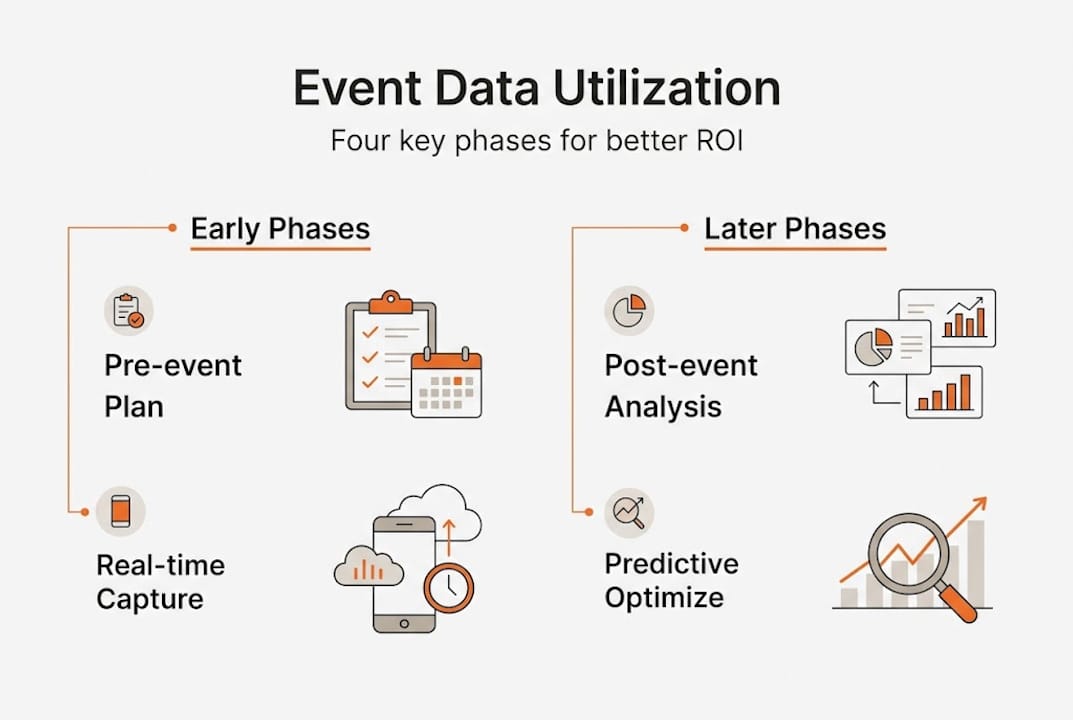
1. Pre-event planning Define what success looks like before anything happens. Which audience segments do you want to reach? What intent signals matter most? Set your tracking plan and make sure every data point has a purpose.
2. Real-time capture During the event, collect behavioral signals as they happen. Session check-ins, meeting logs, content downloads, and interaction data all feed your live picture of who's engaged and why.
3. Post-event analysis This is where most teams start, and it should be where they go deeper. Combine event activity reporting with CRM data to identify high-value leads and next best actions.
4. Predictive optimization Use historical patterns and event data optimization tools to forecast future performance, refine targeting, and improve program design before your next event.
Here's how pre-event and post-event priorities compare:
| Focus area | Pre-event | Post-event |
|---|---|---|
| Primary goal | Targeting and setup | Activation and learning |
| Key data input | Registration profiles | Engagement and behavior |
| Action | Segment and personalize outreach | Score leads and trigger follow-ups |
| Tool alignment | CRM, marketing automation | Analytics, sales enablement |
Best practices across all four phases include:
- Establishing a centralized data structure from the start
- Enforcing consistent naming conventions across platforms
- Applying data governance standards so teams trust what they're seeing
- Using AI-powered tools to surface insights at scale
- Connecting event marketing automation tools to reduce manual reporting work
Pro Tip: Prioritize integrated platforms over point solutions. When your event platform, CRM, and marketing automation tools share data in real time, you eliminate silos before they form and every team acts on the same picture. 💡
How event data drives personalization and engagement
Understanding the process sets you up for success. Here's how event data utilization creates direct, measurable impact on your customer engagement.

When you personalize event outreach using behavioral signals rather than demographic assumptions, the results shift significantly. Attendees who receive session recommendations based on their interests show up more, stay longer, and convert at higher rates. Teams using event segmentation tips to build targeted post-event sequences see dramatically better pipeline velocity compared to generic follow-up campaigns.
The numbers back this up. Integrated platforms and personalization can boost engagement and sales by 20 to 49%. That's not a marginal improvement. That's a strategic advantage.
Here's what data-powered personalization looks like in practice:
- Segment by session attendance: Follow up with messaging aligned to what each attendee actually engaged with
- Score leads by interaction depth: Prioritize prospects who booked meetings, attended multiple sessions, or downloaded content
- Trigger real-time offers: Use live engagement signals to surface the right content or conversation at the right moment
- Customize post-event nurture paths: Build separate sequences for attendees, no-shows, and on-demand viewers
"The biggest shift we see is when teams stop treating all attendees the same. Once you segment by actual behavior, follow-up becomes a conversation, not a broadcast."
The common challenges that block this kind of personalization are real. Data silos prevent sales and marketing from working from the same signal. Privacy regulations require careful consent management. And high data volume can overwhelm teams without the right tooling.
Pro Tip: Shift your reporting framework from vanity metrics (total attendees, open rates) to revenue impact metrics (pipeline influenced, deals accelerated, cost per qualified conversation). That single shift changes how leadership views event investment and how your team prioritizes effort. 🚀
Best practices and pitfalls in event data utilization
To maximize results, it's crucial to know what works well and what common traps to avoid. Here are practical dos and don'ts.
Top five best practices:
- Align data to outcomes from day one. Every metric you track should connect to a business question you're trying to answer.
- Standardize naming conventions. Consistent naming and CRM integration are among the most cited expert best practices for clean, actionable data.
- Integrate with CRM and GA4. Disconnected tools create blind spots. Unified data creates clear signal.
- Focus on signal tracking for leads. Not every attendee deserves equal follow-up. Prioritize based on intent signals.
- Build a repeatable review process. Use a structured event conversion guide to turn each event's data into improvements for the next one.
Common pitfalls to avoid:
- Data silos: When event data lives in a separate system from your CRM or marketing tools, activation becomes slow and inaccurate
- Inconsistent naming: One team calls it "registration," another calls it "sign-up." This breaks reporting across tools
- Limited integration: Collecting data in one platform and manually exporting it to another kills speed and accuracy
- Measuring the wrong things: 40% of companies struggle to prove event ROI, and average attendance rates hover around 52%. Both numbers reflect teams measuring activity instead of impact
"The organizations that consistently prove event ROI are not the ones with the most data. They're the ones with the clearest connection between data and decisions."
Explore event marketing workflows that formalize these connections across your team. When measurement is built into the workflow, not bolted on afterward, everything runs smoother. ✅
Our perspective: Why effective event data utilization is a game-changer
Having covered best practices, let's reflect on what actually drives big shifts for modern event marketers.
Most teams think the problem is data volume. It's not. The real problem is data inaction. We've seen organizations with sophisticated analytics dashboards that still can't tell you which attendee is ready to talk to sales. The dashboard shows activity. It doesn't show intent.
The teams that see real gains are the ones who connect event data to marketing, sales, and product in a live, actionable way. Not after a two-week debrief. During and immediately after the event.
The uncomfortable truth is that most organizations collect event data out of habit, not strategy. They track because it feels responsible. But without a clear activation plan, that data sits unused while high-intent prospects go cold.
Focus on bottom-line influence, not just reporting. Ask: what decision did this data enable? If you can't answer that, the data isn't working for you. Learn how measuring event success with CRM closes this gap between collection and conversion. 💼
Next steps: Unlock more value with expert event data solutions
Ready to apply these insights? Here's how you can take meaningful next steps.
Knowing the framework is one thing. Operationalizing it is another. Sandbox is built specifically for event marketing teams who want to turn event activity into measurable GTM signal. We help you identify who to follow up with, why they matter, and what action to take, all grounded in real behavioral data from your events.
Explore how CRM-driven event ROI works in practice, or dive into our event marketing workflows insights to see how leading teams structure their programs. When you're ready to move from strategy to execution, Sandbox-GTM is the platform built to make that shift fast and measurable. 🎯
Frequently asked questions
What types of data are typically collected during an event?
Common event data includes registrations, check-ins, session engagement, attendee interactions, and feedback surveys. Each data type, from registrations to feedback, plays a role in building a complete picture of attendee behavior and intent.
How does event data utilization improve event ROI?
Proper utilization links event activity to revenue impact, supports better targeting, and enables real-time personalization. Systematic activation of event data drives measurable ROI, and data-driven personalization can boost engagement and sales by 20 to 49%.
What are the biggest barriers to utilizing event data effectively?
Data silos, inconsistent naming, privacy regulations, and limited integration are the top challenges. Silos and unification gaps are consistently cited as the barriers that most organizations struggle to overcome.
How do hybrid and virtual events affect event data strategies?
Hybrid and virtual formats generate more diverse data streams across digital and in-person channels. A unified data strategy is essential to combine these streams into cohesive insights and reliable ROI measurement.
What is the attendance benchmark for modern events?
Current benchmarks report that average attendance rates hover around 52%, making it critical to measure impact beyond raw headcount and focus on engagement quality instead.
Recommended
- Unlock key benefits of event marketing automation in 2026
- Optimize your post-event engagement process for conversions
- Why personalize event outreach? Boost engagement and ROI fast
- Unlock event signal tracking: boost B2B leads and revenue
- Data insights – Nu Life Digital
- Maximizing Visibility: Top Strategies for Creating Impactful Branding at Your Next Event - Blucat Group Inc