

Event marketers face mounting pressure to prove event impact. Surprising new data reveals 77% of marketers now consider events their most effective marketing channel, yet most struggle to translate event activity into measurable pipeline. The difference? Event data mastery. Organizations that capture and analyze attendee behavior across registration, engagement, and follow-up touchpoints unlock personalization at scale, real-time optimization, and direct pipeline attribution that transforms events from cost centers into revenue engines.
Table of Contents
- Introduction To Event Data In Marketing
- How Event Data Enhances Personalization And Engagement
- Quantifying The Impact Of Event Data On Event Roi And Pipeline
- Real-Time Event Data Capture And Analysis For Strategy Optimization
- Common Misconceptions About Event Data And How To Avoid Them
- Framework For Integrating Event Data Into Gtm Workflows
- Using Event Data To Drive Effective Follow-Up Strategies
- Conclusion: Harnessing Event Data For Sustainable Growth
- Turn Event Moments Into Revenue With Sandbox
Key Takeaways
| Point | Details |
|---|---|
| Event data powers measurable growth | Capturing behavior across touchpoints enables personalization and direct pipeline attribution |
| Real-time analytics drive engagement | Live insights allow dynamic adjustments that boost attendee satisfaction and operational efficiency |
| Personalization increases conversions | Data-driven customization improves lead conversion rates up to 30% |
| Integration links events to revenue | Embedding event data in GTM workflows connects activity directly to pipeline growth |
| Misconceptions block progress | Real-time dashboards and unified platforms overcome complexity and scalability concerns |
Introduction to Event Data in Marketing
Event data encompasses all information collected from registration systems, engagement tracking, feedback surveys, and event technology platforms. This data reveals who attended, which sessions they prioritized, how they engaged with content, and what actions they took during and after your event.
Modern event marketers collect several data types:
- Registration details including job titles, company size, and geographic location
- Session attendance patterns showing content preferences and engagement depth
- Engagement metrics from polls, Q&A participation, and networking activity
- Feedback surveys capturing satisfaction scores and improvement suggestions
- On-site app usage tracking booth visits, document downloads, and meeting requests
Hybrid events expanded data collection opportunities significantly. 45% of corporate events now use hybrid formats, creating richer datasets by combining in-person behaviors with digital engagement signals. This shift lets marketers track both physical booth visits and virtual session replays.
Event data became critical because marketers must demonstrate ROI to justify growing budgets. Traditional event metrics like attendance counts fail to show business impact. Modern marketing attribution demands proof that events generate qualified pipeline.
Event technology platforms enable sophisticated data capture. These systems integrate with CRM tools, creating unified views of attendee journeys. Data-driven marketing insights transform raw event activity into actionable intelligence that guides follow-up strategies and future event planning.
How Event Data Enhances Personalization and Engagement
Behavioral data powers customized experiences that resonate with individual attendees. Session attendance patterns reveal content interests, while engagement heatmaps show which topics spark the most interaction. Smart marketers use these signals to craft targeted messaging.
AI scales personalization beyond what manual segmentation achieves. AI and real-time analytics boost productivity by up to 76% and increase engagement by over 52% at hybrid and large-scale events. Machine learning algorithms identify micro-segments based on dozens of behavioral variables simultaneously.
Personalization directly impacts satisfaction and conversion. Attendees who receive relevant content recommendations stay engaged longer. Post-event follow-ups tailored to specific session attendance convert at significantly higher rates than generic campaigns.
Real-time analytics enable live adjustments during events. Monitoring engagement dashboards lets event teams spot declining interest in specific sessions and pivot content delivery. Push notifications can redirect attendees to higher-value activities based on their profile and behavior.
Key personalization strategies include:
- Agenda recommendations based on role and industry vertical
- Networking suggestions connecting attendees with shared interests
- Content sequencing that builds on previously consumed materials
- Follow-up timing optimized for individual engagement patterns
Pro Tip: Start with small pilot segments to test personalization approaches before scaling across your entire attendee base. This lets you refine messaging and validate impact metrics.
Quantifying the Impact of Event Data on Event ROI and Pipeline
Data proves events drive measurable business outcomes. 77% of marketers see events as their top channel, with 73% increasing budgets reflecting confidence in event data's ability to demonstrate clear ROI. This budget shift follows proof that events generate qualified pipeline.
Event-led growth companies using data are 22% more likely to meet revenue goals.
Companies that adopt data-driven event strategies achieve 22% higher revenue goal attainment compared to organizations treating events as logistics exercises. The difference lies in connecting event activity to pipeline stages.

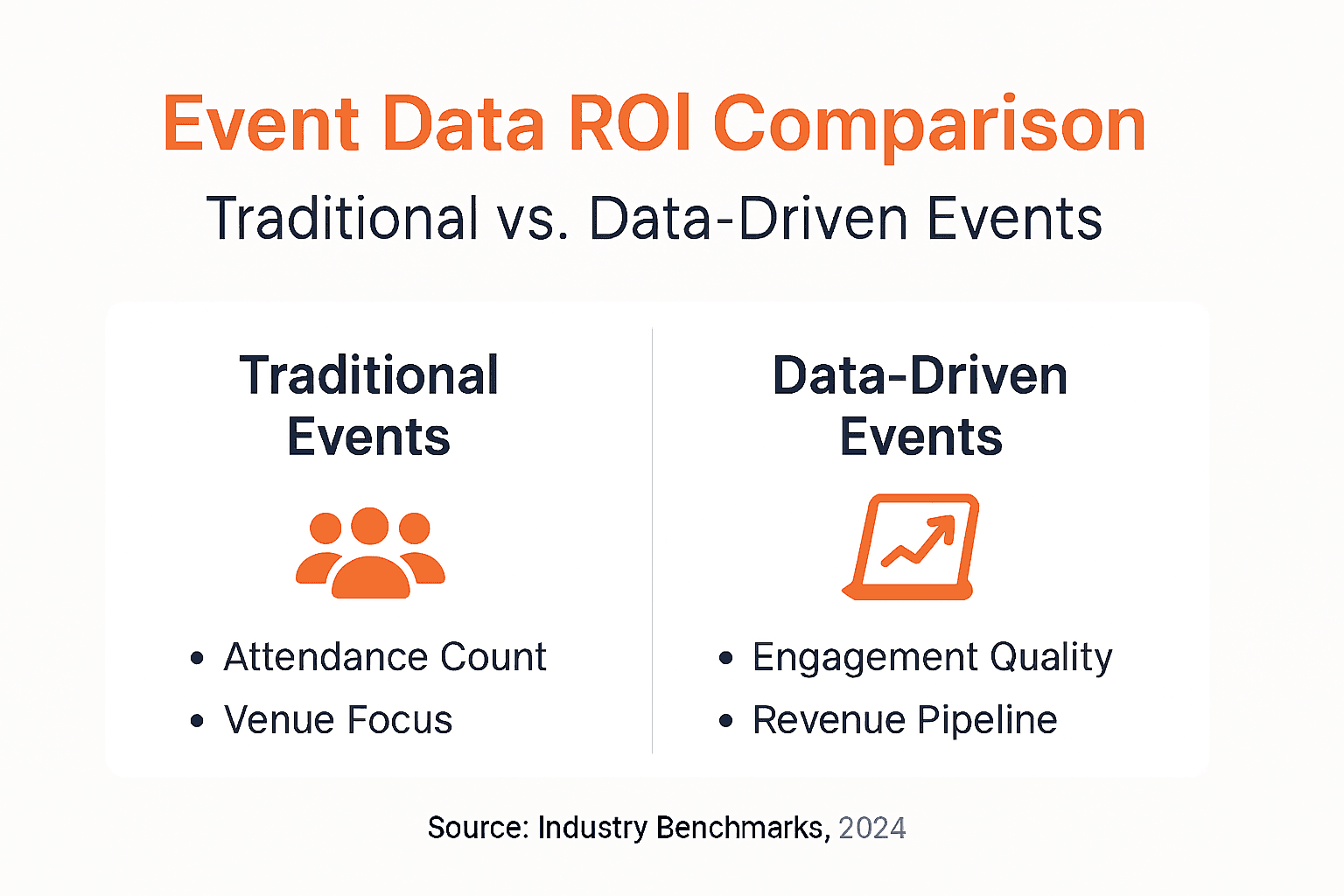
Traditional approaches focus on attendee counts and venue logistics. Data-driven models prioritize engagement quality and follow-up precision. This table contrasts the two:
| Traditional Events | Data-Driven Events |
|---|---|
| Measure attendance volume | Track engagement depth and intent signals |
| Generic post-event emails | Personalized follow-up based on behavior |
| Disconnected from CRM | Integrated with sales workflows |
| Unclear pipeline impact | Direct attribution to opportunities |
Personalized follow-ups leveraging event data generate stronger results. Sales teams armed with session attendance data and engagement scores prioritize high-intent leads. Marketing nurtures lower-funnel prospects with content matching their demonstrated interests.
Companies achieving revenue goals share common traits. They capture comprehensive behavioral data, analyze it in real time, and embed insights directly into GTM workflows. This systematic approach transforms events from brand exercises into predictable growth channels.
Real-Time Event Data Capture and Analysis for Strategy Optimization
Real-time analytics platforms provide live visibility into event performance. Modern dashboards aggregate data from registration systems, mobile apps, and engagement tools into unified views. Event teams monitor key metrics as they unfold.
Popular real-time capabilities include:
- Live attendance tracking across sessions and activities
- Engagement heatmaps showing content popularity
- Sentiment analysis from chat and Q&A interactions
- Networking activity monitoring and connection recommendations
- Booth visit tracking and lead capture metrics
AI and real-time analytics adoption drives 76% productivity gains and 52% engagement increases by enabling immediate response to attendee behavior. Event teams adjust session content, extend popular activities, and redirect attendees to underutilized experiences.
Live data empowers operational decisions. Noticing a session exceeding capacity? Open overflow rooms instantly. Seeing low booth traffic? Push targeted notifications to relevant attendee segments. Identifying networking bottlenecks? Facilitate introductions through the event app.
Aligning data insights with event objectives maintains strategic focus. Define success metrics before the event, then monitor those specific indicators. Avoid analysis paralysis by prioritizing metrics directly tied to pipeline generation and attendee satisfaction.
Pro Tip: Train your entire event team on dashboard interpretation at least one week before the event starts. Rapid response requires everyone understanding data signals and having authority to act.
Common Misconceptions About Event Data and How to Avoid Them
Myth one: event data only provides value after events end. Reality: real-time insights drive live adjustments that boost engagement and satisfaction during events. Waiting until post-event analysis means missing optimization opportunities.
Myth two: event data overwhelms teams with complexity. Truth: unified dashboards simplify analysis by consolidating multiple data sources into intuitive visualizations. Modern platforms require minimal technical expertise.
Myth three: personalization doesn't scale to large events. Fact: AI enables customization across thousands of attendees simultaneously. Machine learning algorithms process behavioral signals and deliver tailored recommendations faster than manual segmentation.
Successful event data strategies align collection with marketing and sales objectives. Random data gathering creates noise without insight. Define pipeline metrics first, then instrument data capture supporting those goals.
Common pitfalls and corrections:
- Collecting excessive data without clear purpose → Focus on metrics tied directly to revenue objectives
- Ignoring real-time signals during events → Establish monitoring protocols and response playbooks
- Failing to integrate with CRM systems → Choose platforms with native integrations or robust APIs
- Neglecting team training on data tools → Invest in comprehensive onboarding before event launch
- Overlooking data privacy compliance → Implement consent mechanisms and secure data handling
Event marketers who clear these misconceptions unlock data's full potential. The key is treating data as strategic intelligence rather than administrative byproduct.
Framework for Integrating Event Data Into GTM Workflows
Successful integration follows a structured approach across four stages: data capture, real-time analysis, post-event prioritization, and GTM embedding. Each stage builds on the previous, creating a systematic path from raw data to revenue impact.
Implementation steps:
- Design data capture aligned with pipeline stages and buyer journey mapping
- Configure real-time dashboards monitoring engagement and intent signals
- Establish lead scoring models incorporating event behavioral data
- Create automated workflows routing high-intent leads to sales immediately
- Build nurture sequences tailored to specific engagement patterns
- Measure pipeline attribution and optimize based on conversion data
This comparison highlights workflow differences:
| Traditional Workflow | Data-Driven Workflow |
|---|---|
| Event treated as isolated campaign | Event embedded in continuous GTM motion |
| Sales receives attendee lists | Sales gets scored leads with context |
| Marketing sends batch emails | Marketing delivers personalized sequences |
| Attribution unclear | Direct pipeline tracking |
Technology consolidation matters. Platforms that integrate event data with CRM, marketing automation, and sales engagement tools eliminate manual data transfers. This integration ensures behavioral insights flow directly into existing workflows.
Personalization workflows leverage event insights. Someone attending competitor sessions gets different nurture content than attendees focused on product demos. Session attendance automatically triggers relevant case studies and solution briefs.
Prerequisites for success include cross-functional collaboration between marketing, sales, and event teams. Platform capabilities must support real-time data sync and behavioral tracking. Training ensures everyone interprets data consistently and acts on insights promptly.
Using Event Data to Drive Effective Follow-Up Strategies
Engagement heatmaps and session attendance create powerful lead scoring inputs. Attendees spending significant time in product demos signal higher purchase intent than those browsing general sessions. Booth visit duration and content download patterns reveal buying stage.
Personalized messaging outperforms generic campaigns dramatically. Event data-driven follow-ups can boost lead conversion by up to 30% by delivering content matching demonstrated interests. Someone asking pricing questions receives ROI calculators while technical attendees get architecture documentation.
Effective follow-up strategies:
- Immediate outreach to high-engagement attendees within 24 hours
- Personalized email sequences referencing specific sessions attended
- Sales enablement with behavioral context and engagement scores
- Retargeting campaigns showing content aligned with event interests
- Automated nurture paths triggered by engagement thresholds
Timing dramatically impacts conversion rates. The engagement window closes quickly after events end. Leads contacted within 48 hours convert at significantly higher rates than those reached a week later. Real-time data capture enables this speed.
Channel selection matters too. High-intent leads warrant direct sales calls while earlier-stage attendees respond better to educational content via email. Mixing channels based on engagement depth optimizes resource allocation.
Tracking follow-up impact closes the loop. Monitor which behavioral signals correlate with closed deals. Refine lead scoring models based on conversion data. This continuous optimization improves targeting precision over time.
Conclusion: Harnessing Event Data for Sustainable Growth
Event data transforms traditional event marketing into a measurable growth engine. Organizations capturing behavioral signals across touchpoints unlock personalization, real-time optimization, and direct pipeline attribution that justify increasing event investments.
The future amplifies these advantages. AI capabilities continue advancing, enabling even more sophisticated personalization at scale. Hybrid formats expand, creating richer datasets combining physical and digital behaviors. Marketers mastering event data gain competitive advantages in demonstrating clear ROI.
Adopting comprehensive data strategies requires commitment. Invest in platforms supporting real-time capture and CRM integration. Train teams on data interpretation and rapid response protocols. Align data collection with specific revenue objectives rather than gathering metrics randomly.
Cross-functional collaboration accelerates success. Marketing, sales, and event teams must share insights and coordinate follow-up strategies. Continuous learning from each event's data improves future performance systematically.
Event marketers who embrace data-driven approaches position events as first-class growth channels. The tools and frameworks exist today. The question is whether you'll leverage them to drive measurable pipeline growth in 2026 and beyond.
Turn Event Moments into Revenue with Sandbox
The strategies outlined above require platforms purpose-built for event data capture and GTM integration. Sandbox transforms high-intent event moments into measurable signal by capturing real interactions across meetings, content engagement, and live activities.
Our platform combines opinionated GTM workflows with hands-on execution support. Event teams gain real-time dashboards, automated lead scoring, and personalized follow-up sequences that connect event activity directly to pipeline. Whether you're launching your first event program or scaling a flagship conference, Sandbox provides the systems and signal to make events accountable and repeatable. Marketing and sales teams finally see which event moments drive revenue, not just attendance.
Pro Tip: Organizations achieving fastest time-to-value start with a single high-priority event to validate the platform, then scale learnings across their entire event portfolio.
FAQ
What types of event data should marketers prioritize?
Prioritize registration information, session attendance, engagement metrics, and feedback surveys. These data types directly support personalization and ROI measurement. Focus collection efforts on signals aligning with your specific pipeline goals rather than capturing everything possible.
How does real-time event data improve attendee engagement?
Real-time analytics enable live content adjustments and networking facilitation based on actual attendee behavior. Event teams monitoring engagement dashboards can redirect attendees to higher-value activities instantly. This responsiveness keeps satisfaction high and maximizes the value attendees extract from your event.
What are common mistakes in using event data?
Relying solely on post-event reports instead of leveraging real-time insights during events. Collecting excessive data without clear strategic focus causes analysis paralysis. Failing to align data capture with specific marketing and sales objectives produces metrics that don't drive decisions.
How can event data be integrated into existing GTM workflows?
Use a staged approach: capture behavioral data, analyze for intent signals, prioritize leads through scoring, then integrate into CRM and marketing automation. Choose platforms offering native integrations with your existing tech stack. This eliminates manual data transfers and ensures behavioral insights flow directly into sales and marketing workflows.