

TL;DR:
- Repurposing event content across 3 to 5 targeted channels significantly increases reach and ROI.
- A systematic distribution process involves timely asset review, strategic channel assignment, and performance tracking.
- Personalizing follow-up content based on audience segmentation boosts attendee engagement and long-term growth.
Most event teams invest months planning a conference or webinar, then watch the content quietly disappear after the final session ends. Leads go cold. Recordings sit unwatched. Follow-up emails feel generic. The result is a massive gap between the effort you put in and the revenue you actually see. Repurposing event content can multiply reach by up to 15x while cutting creation costs by as much as 90%. That kind of leverage is only possible with a systematic distribution process. This guide walks you through every stage, from diagnosing your current gaps to building a scalable, repeatable workflow that connects event activity directly to pipeline.
Table of Contents
- Assessing your current event content distribution process
- Defining your goals and audience for post-event content
- Choosing distribution channels and repurposing strategies
- Implementing your event content distribution workflow
- A smarter approach to event content distribution in 2026
- Take your event content distribution to the next level
- Frequently asked questions
Key Takeaways
| Point | Details |
|---|---|
| Focus on 3-5 channels | Distribute content deeply on a few audience-matched channels for higher engagement and efficiency. |
| Repurposing boosts reach | Transforming event assets can increase reach up to 15x and deliver significant cost savings. |
| Personalization drives growth | Personalized follow-up after events brings in more new attendees and nurtures leads more effectively. |
| Use automation wisely | AI tools streamline distribution, but require human oversight for authentic brand messaging. |
Assessing your current event content distribution process
Before you can improve your distribution process, you need an honest look at where it stands today. Most teams discover their approach is more reactive than strategic, and that gap costs them real revenue.
Here are the most common signs your current process is underperforming:
- 📉 Post-event engagement drops sharply within 48 hours
- 🎥 Content is only viewed by live attendees, with no reach beyond the room
- 📧 Follow-up emails are generic and sent to everyone on the same list
- 🗂️ Content assets are created once and never repurposed
- 📊 No tracking exists to measure which content drives pipeline
If two or more of those sound familiar, your process needs structure. A useful starting point is comparing where you are against where you want to be:
| Criteria | Ad hoc process | Systematic process |
|---|---|---|
| Reach | Limited to live attendees | Extended across 3-5 channels |
| Efficiency | Manual, inconsistent | Templated, repeatable |
| Scalability | Hard to replicate | Built to scale |
| ROI | Difficult to measure | Tracked and optimized |
| Attendee growth | Flat or unpredictable | Steady and compounding |
The difference is not just operational. It directly affects your ability to grow. Hybrid and virtual events require content repurposing with accessibility in mind, which means your process needs to account for diverse formats and audience needs from the start.
To diagnose your gaps, ask yourself these core questions:
- Are your content assets actively repurposed after each event?
- Have you identified and prioritized 3 to 5 distribution channels?
- Is your content refreshed with new data or insights over time?
- Do you track event performance metrics at the channel level?
- Have you tried to segment your event audience before sending follow-up content?
Pro Tip: Pull your last event's follow-up sequence and map every touchpoint against the channel used and the audience segment targeted. Patterns will emerge quickly, and they will tell you exactly where your process breaks down.
Defining your goals and audience for post-event content
Understanding your baseline is step one. The next step is to focus your content for maximum relevance and impact. Without clear goals and defined audience segments, even well-produced content gets ignored.
Start by identifying what you actually want your post-event content to accomplish. Common goals include:
- 🎯 Generating net-new leads from content discovery
- 📅 Driving registrations for upcoming webinars or events
- 🔄 Nurturing warm leads toward a conversion or demo
- 🔍 Growing your SEO footprint with long-form recaps and transcripts
- 🤝 Strengthening relationships with existing customers and partners
Each goal requires a different content format and a different distribution approach. A lead generation goal might prioritize gated video replays and paid social. An SEO goal calls for detailed blog posts built from session transcripts. Mixing these without intention leads to content that serves no one well.
Next, define your audience groups clearly. Here are the core segments to plan for:
- Attendees who were present and need deeper follow-through
- No-shows who registered but did not attend and need a reason to re-engage
- New prospects who discovered the event after the fact
- Media and analysts who may amplify your content further
- Internal teams such as sales and customer success who need event context to do their jobs
Segmenting your event audience before you distribute content is one of the highest-leverage moves you can make. Personalized content post-event drives 7% more new attendees, which compounds over time as your audience grows.
The key is to connect your personalized outreach strategies to specific audience behaviors. Someone who attended three sessions has different intent signals than someone who only opened your registration confirmation. Use that data to tailor what you send and when.
Pro Tip: Build two or three content variations per audience segment in advance. Batch your personalization work before the event ends so you can distribute quickly while attention is still high.
Choosing distribution channels and repurposing strategies
With a clear target in mind, it is time to choose how and where to distribute your event content for maximum effect. Channel selection is where many teams either over-invest in the wrong places or spread themselves too thin.
Here is a breakdown of channel types and how they fit different goals:
| Channel type | Typical ROI | Best fit for |
|---|---|---|
| Owned (email, blog, website) | High, long-term | Nurturing, SEO, retention |
| Earned (PR, social shares, partnerships) | Variable, high reach | Brand awareness, credibility |
| Paid (social ads, search, sponsorships) | Fast, scalable | Lead generation, retargeting |
The smartest sequencing is to start with owned channels first. Build traction organically before investing in paid amplification. This approach protects your budget and gives you real performance data to guide paid decisions.
Repurposing boosts reach 5 to 15x, cuts costs 70 to 90%, and drives up to 677% SEO growth when done consistently. That is not a marginal improvement. It is a fundamentally different return on the content you already created.
The most effective repurposing formats include:
- 🎬 Short video clips from keynotes or panel highlights
- 💬 Expert quote cards optimized for LinkedIn and social sharing
- 📝 In-depth session recaps formatted as blog posts
- 📊 Infographics summarizing key data or frameworks
- 🎙️ Audio excerpts for podcast distribution
To refresh and amplify your content after the event, follow these steps:
- Review all raw assets within 48 hours of the event
- Identify the top five to ten moments worth repurposing
- Assign each asset to a specific channel and audience segment
- Schedule distribution across a four to six week calendar
- Monitor engagement and double down on what performs
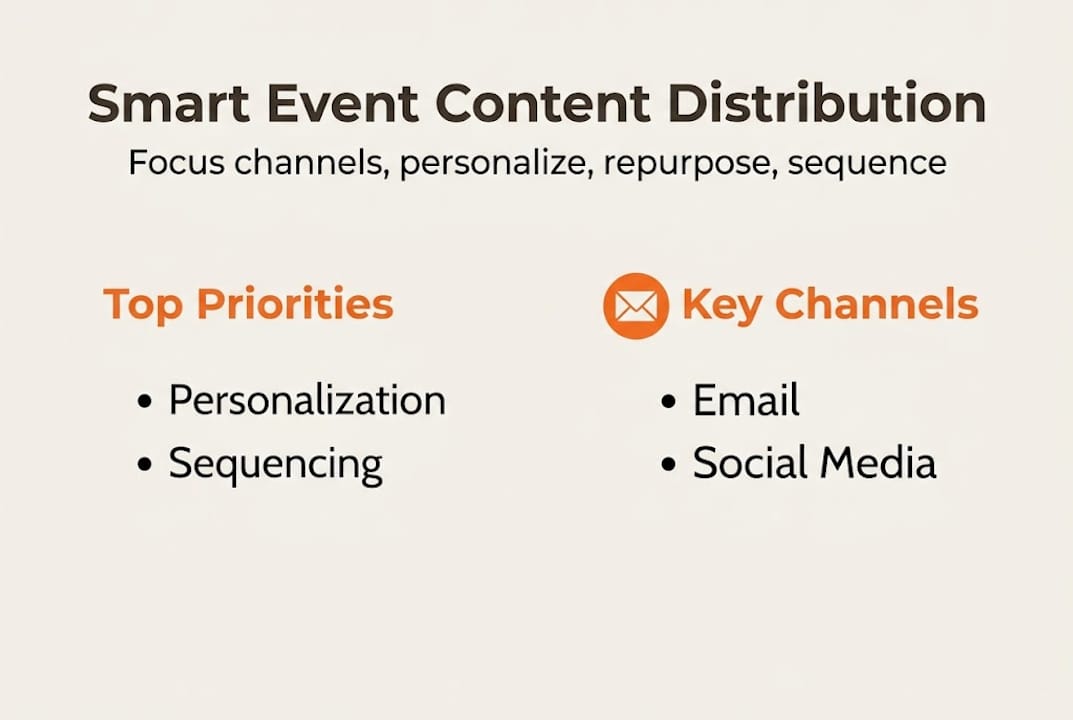
Prioritize 3 to 5 audience-matched channels over shallow broad distribution for superior results. Chasing every platform dilutes your effort and makes it nearly impossible to build momentum anywhere. Pair this focus with event automation ROI tools and conversion optimization tips to make your channel investments work harder.
Implementing your event content distribution workflow
Armed with your channel plan and repurposing strategies, here is how to bring your distribution process to life in a way that is repeatable and scalable.
A strong workflow removes guesswork and keeps your team aligned from asset creation through final follow-up. Here is the sequence that works:
- Asset review: Catalog all recordings, slides, chat logs, and Q&A within 24 hours post-event
- Repurposing: Clip, edit, and reformat assets into channel-ready content pieces
- Channel assignment: Match each content piece to the right channel and audience segment
- Scheduling: Load content into your distribution calendar with clear publish dates
- Tracking: Set up UTM parameters and engagement tracking before anything goes live
- Follow-up optimization: Review performance at two weeks and four weeks, then adjust
Automation plays a real role here, but it is not a full replacement for human judgment. AI can automate transcription and content clipping, but still needs human polish for brand voice and narrative accuracy. Use AI to handle the repetitive, time-consuming tasks. Keep your team focused on story, tone, and quality control.
Specific areas where automation adds the most value:
- Transcribing session recordings into draft blog posts
- Generating highlight reels from longer video content
- Scheduling and publishing across multiple channels simultaneously
- Sending triggered follow-up emails based on attendee behavior
For the human side, prioritize brand consistency, emotional resonance, and contextual accuracy. Those are the elements that build trust and drive conversions over time. Explore event marketing automation tools that integrate with your existing stack, and invest in a strong post-event engagement process to keep momentum alive.
Pro Tip: Build a master template for your event content distribution checklist, a publishing calendar, and channel briefs. Reuse and refine these templates after every event. Over time, your setup time shrinks and your output quality grows.
A smarter approach to event content distribution in 2026
Here is an uncomfortable truth most event teams avoid: the biggest distribution problem is not a lack of content. It is a lack of discipline about where and how that content gets used.
The old mindset treats events as one-time moments. You run the event, send a recap email, and move on. That approach leaves the majority of your content's potential value on the table. The better mindset treats every event as a content engine with a lifecycle that extends weeks or months beyond the live date.
Deep activation in three to five core channels consistently outperforms scattered presence across ten platforms. Video ROI remains extremely strong, with 89% of marketers saying video content pays off in event marketing. That is not a trend. It is a signal to go deeper on video, not broader across every format.
Over-distribution is a real risk. Flooding your audience with content across too many channels creates fatigue and dilutes the impact of your best material. Metrics-driven iteration, not volume, is what builds long-term audience trust and pipeline contribution. Track what works, cut what does not, and refine your approach event by event.
For teams focused on B2B event lead generation, this disciplined approach is especially important. Quality signal from the right channels converts. Noise from everywhere does not.
Take your event content distribution to the next level
You now have a clear picture of what a high-performing event content distribution process looks like. The next step is putting it into practice with the right tools and workflows behind you.
Sandbox is built for exactly this kind of work. Our platform captures high-intent event signals and connects them directly to your GTM workflows, so your team always knows who to follow up with, why they matter, and what content to send. Explore our event marketing workflow guide to see how leading teams structure their distribution process for repeatable results. Ready to see it in action? Visit the Sandbox-GTM platform to request a demo and start turning your event content into measurable pipeline. 🚀
Frequently asked questions
What is the most effective way to repurpose live event content?
The most effective repurposing transforms key moments into short videos, expert highlight reels, and search-optimized blog posts, with focus on 3 to 5 channels for deeper engagement and up to 15x reach.
How many channels should I distribute post-event content on?
Focus on 3 to 5 channels where your audience is most active. Audience-matched channels deliver significantly better engagement and ROI than spreading content across too many platforms.
How does content personalization post-event impact attendee growth?
Personalized follow-up content can bring in 7% more new attendees by increasing relevance and engagement, which compounds as your event program grows over time.
Can AI fully automate event content repurposing?
AI handles tasks like transcription and clip creation efficiently, but human review remains essential to maintain brand voice, narrative accuracy, and contextual quality in your final content.