

Most event teams measure success by headcount. Fill the room, hit the registration target, call it a win. But reaching more people rarely translates to better outcomes if those people aren't the right fit for your content, offers, or follow-up. Event audience profiling is the discipline that fixes this, turning a broad crowd into distinct groups you can actually speak to. In this article, we'll break down what profiling is, how to build it, where teams go wrong, and what the data says about its real impact on engagement and revenue.
Table of Contents
- What is event audience profiling?
- Core segments and data sources for profiling
- Key benefits of event audience profiling
- Expert techniques: advanced profiling and AI
- Pitfalls to avoid and compliance essentials
- Level up your event marketing with smarter profiling
- Frequently asked questions
Key Takeaways
| Point | Details |
|---|---|
| Segment for better results | Organizing attendees by distinct traits is proven to drive personalized marketing and higher event engagement. |
| Use diverse data sources | Combining behavioral, demographic, and survey data leads to more precise and actionable profiles. |
| Avoid common pitfalls | Clean your data and don't over-segment; balance compliance with effectiveness for successful profiling. |
| Leverage advanced methods | AI and lookalike modeling unlock deeper insights and real-time adjustments for maximum ROI. |
What is event audience profiling?
At its core, event audience profiling is the process of segmenting potential and past attendees into groups based on shared characteristics. The goal is to understand who is in your audience so you can tailor messaging, content, and follow-up to match what each group actually cares about. It sounds straightforward, but most teams confuse it with generic targeting.
Generic targeting asks: "Who might attend this event?" Profiling asks: "What does each type of attendee need to hear, see, and experience to show up, engage, and convert?" That shift in question changes everything about how you plan, promote, and measure.
A strong profile is built from multiple layers of shared characteristics:
- Job role and seniority (are they a decision-maker or an influencer?)
- Industry and company size (enterprise buyer vs. startup founder)
- Past behavior (did they attend last year, open your emails, visit your pricing page?)
- Goals and pain points (what problem are they trying to solve right now?)
- Content preferences (workshops vs. keynotes, in-person vs. hybrid)
"Profiling isn't about labeling people. It's about understanding context well enough to make every touchpoint feel relevant."
For a deeper look at how segmentation connects to campaign performance, explore these event segmentation tips that tie directly to marketing ROI.
Core segments and data sources for profiling
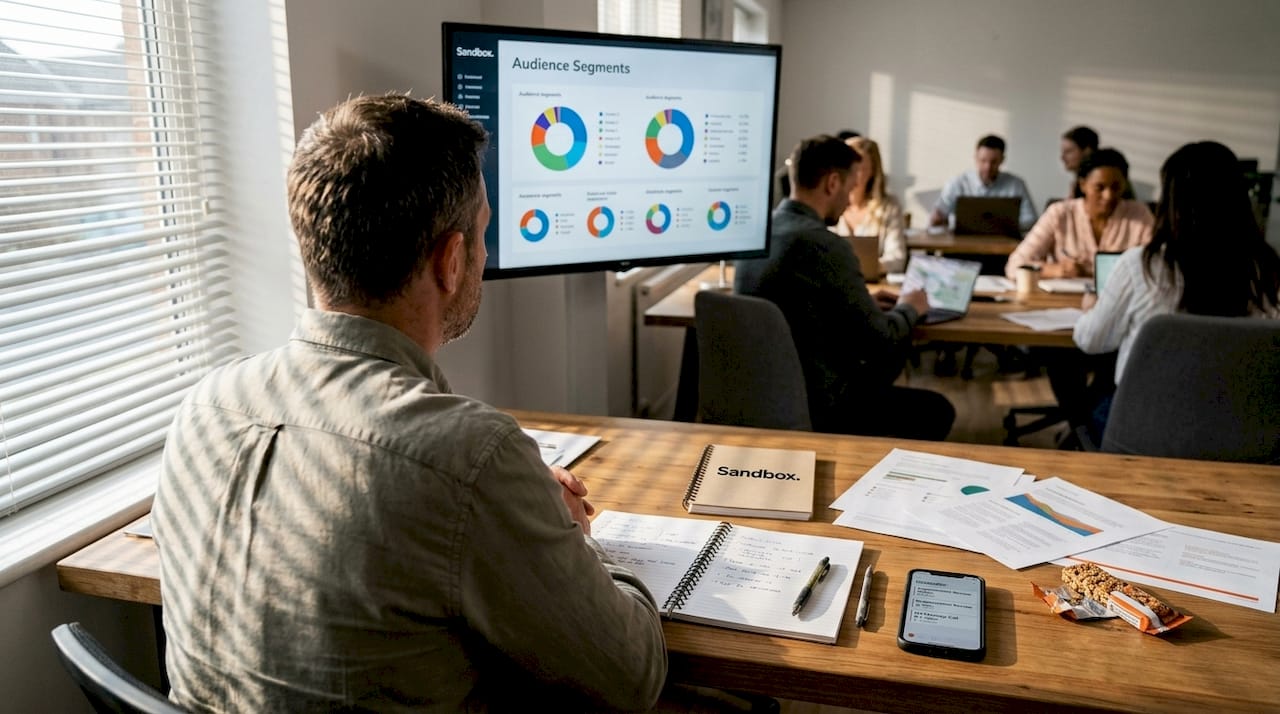
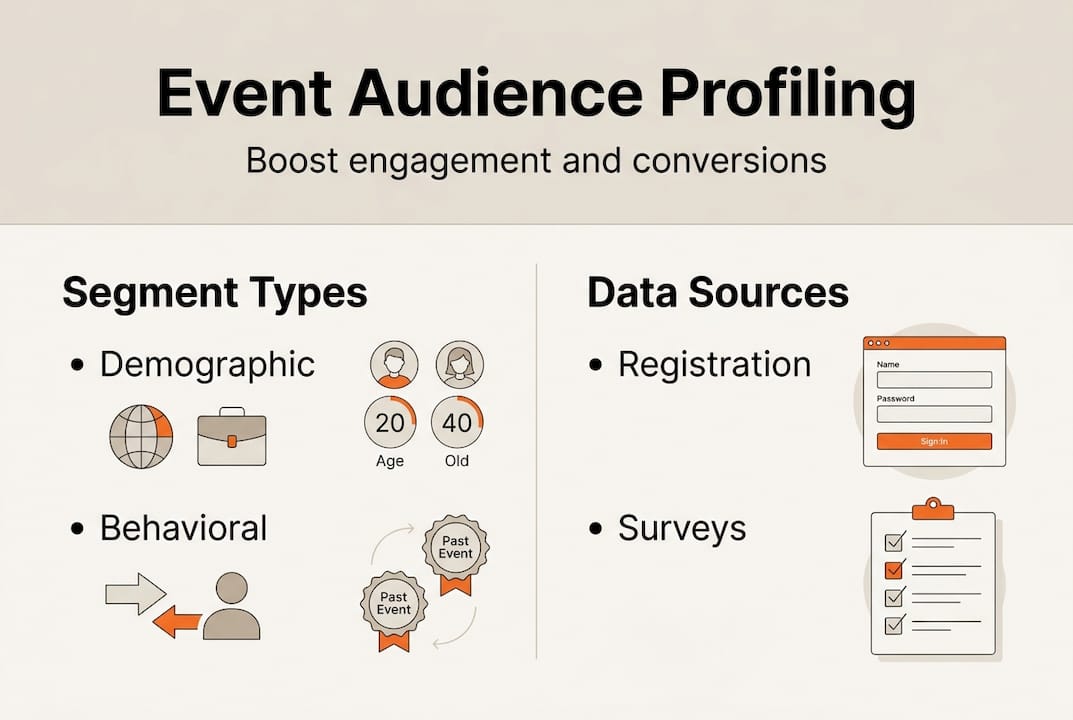
Knowing what a profile is and knowing how to build one are two different things. Key methodologies include demographic, psychographic, behavioral, and firmographic segmentation, each pulling from different data sources. Here's how they break down in practice:
| Segment type | What it captures | Primary data source |
|---|---|---|
| Demographic | Age, gender, location, job title | Registration forms |
| Psychographic | Values, motivations, interests | Surveys, social listening |
| Behavioral | Past attendance, clicks, session views | CRM, marketing pixels |
| Firmographic | Industry, company size, revenue | Enrichment tools, LinkedIn |
Each axis adds a layer of precision. Demographic data tells you who someone is. Behavioral data tells you what they've done. Psychographic data tells you why they make decisions. Firmographic data tells you what organizational context they're operating in. Used together, they produce a profile that's actually useful.
The most reliable data sources for event profiling include:
- Registration forms (capture role, company, and intent at the point of sign-up)
- Post-event surveys (surface satisfaction, content preferences, and future interest)
- Social media engagement (identify who's talking about your event and what resonates)
- Past event data (attendance patterns, session choices, and no-show rates)
- Marketing pixels and tracking (behavioral signals from your website and email campaigns)
Pro Tip: Before you segment, clean your data. Duplicate records, outdated job titles, and missing fields will corrupt your segments before you even start. Run an enrichment pass first, then split.
Connecting your profiling workflow to event marketing automation tools makes the enrichment and sorting process far more scalable. And once your segments are live, tracking the right event metrics for marketing ensures you're measuring what actually matters.
Key benefits of event audience profiling
Profiling isn't a nice-to-have. The outcomes it drives are measurable, and the gap between profiled and unprofiled campaigns is significant. Let's look at what the data actually shows.
SXSW used AI-driven audience insights to achieve a 40% sponsor engagement increase and 35% higher conversions. Primavera Sound Barcelona ran AI-powered lookalike modeling and saw a 33% lift in transactions alongside a 63% improvement in ROAS. Ticketek applied personalization at scale and recorded a 49% sales per email uplift. These aren't edge cases. They're repeatable results from teams that treated profiling as a core growth lever.
Here's how profiled campaigns compare to unprofiled ones across key performance areas:
| Metric | Unprofiled campaign | Profiled campaign |
|---|---|---|
| Email open rate | Average | 20-40% higher |
| Session attendance | Scattered | Matched to interest |
| Sponsor ROI | Hard to prove | Tied to audience data |
| Post-event conversion | Low follow-up rate | Prioritized by intent score |
| ROAS | Baseline | Up to 63% improvement |
The benefits extend beyond marketing metrics:
- Sponsors pay more when you can show them exactly who will be in the room and why those people are relevant to their offer.
- Content teams build better agendas when they know which topics each segment cares about most.
- Sales teams follow up smarter when attendees are scored by intent before the event ends.
- Retention improves because attendees who felt the event was relevant to them are far more likely to return.
For a full breakdown of how to turn these insights into pipeline, the event conversion optimization strategies guide walks through the tactical steps.
Expert techniques: advanced profiling and AI
Basic segmentation gets you started. But the teams producing outsized results are using a more sophisticated stack. Advanced techniques involve AI-driven real-time analysis, lookalike modeling, and post-event analytics for lead scoring and future segmentation. Here's how to apply them in sequence:
- Real-time segment updates. AI tools can monitor attendee behavior during an event, updating segments as people interact with sessions, booths, or content. Someone who visits three product demos in a row is a different prospect than someone who only attended the opening keynote.
- Lookalike modeling. Once you've identified your highest-value attendees from past events, machine learning can find new prospects who share the same behavioral and firmographic fingerprint. This is how Primavera Sound drove that 63% ROAS gain.
- Predictive lead scoring. Post-event, AI can rank every attendee by their likelihood to convert based on their full behavioral trail. Sales teams stop guessing and start prioritizing.
- Post-event analytics loops. Every event generates data that should feed back into your next profiling cycle. Which segments converted? Which dropped off? What content drove the most follow-up meetings?
"The best profiling systems don't just describe your audience. They predict what each person will do next and tell your team exactly how to respond."
Pro Tip: Don't wait until after the event to start scoring leads. Set up behavioral triggers during the event so your sales team gets real-time alerts when a high-value attendee hits a key engagement threshold.
For teams building out their follow-up systems, post-event engagement strategies and B2B lead generation for events are two resources worth bookmarking before your next program.
Pitfalls to avoid and compliance essentials
Even well-resourced teams make predictable mistakes in audience profiling. Most of them come down to three categories: bad data, bad structure, and bad compliance.
Bad data is the most common. If your registration form has 20 optional fields and most people skip them, your demographic and firmographic segments will be full of holes. Enrich your data with third-party tools before you segment, not after. Messy data that hasn't been cleaned or enriched will produce segments that look precise but perform poorly.
Over-segmentation is the structural trap. Teams get excited about profiling and create 15 micro-segments, each too small to market to efficiently. A segment with 40 people in it isn't actionable. Start with 3 to 5 core profiles and expand only when you have enough data to justify it.
Compliance failures are the most costly. GDPR, CCPA, and similar regulations require that you collect data with clear consent, store it securely, and give people the ability to opt out. Violating these rules doesn't just create legal exposure. It destroys trust with the exact audience you're trying to build a relationship with. Review your audience definitions documentation and make sure your data collection practices are airtight.
Here's a quick checklist to keep your profiling program on track:
- Start with your business objective, not your data. Define what a successful attendee looks like before you start segmenting.
- Audit your data sources for completeness and accuracy before building segments.
- Limit your initial segment count to 3 to 5 clearly differentiated profiles.
- Document your data collection consent process and review it against current regulations.
- Test your segments with a small campaign before rolling out to your full list.
Pro Tip: Map each segment back to a specific business outcome. If you can't answer "what do we want this segment to do?" then the segment isn't ready to use.
For teams focused on capturing intent signals during the event itself, the B2B event intent capture guide covers how to build that layer into your program from the start.
Level up your event marketing with smarter profiling
Audience profiling is only as powerful as the systems behind it. Knowing your segments is one thing. Activating them across your marketing, sales, and event workflows is where the real lift happens.
Sandbox is built for exactly this. We help event teams capture real intent signals across every touchpoint, from registration through post-event follow-up, and connect that data directly to pipeline. Our event marketing workflows are designed to make profiling actionable, not just analytical. Whether you're building your first segmentation model or scaling a multi-event program, Sandbox-GTM gives you the systems and support to turn audience data into measurable revenue. Events should be accountable. We make that possible.
Frequently asked questions
What data do I need for effective event audience profiling?
You need a mix of registration data, surveys, past attendance records, behavioral tracking, and social engagement signals. Demographic, psychographic, behavioral, and firmographic inputs together produce the most accurate and actionable profiles.
How does AI help with event audience profiling?
AI enables real-time segment updates, lookalike modeling, and predictive lead scoring so your team can personalize at scale and prioritize the highest-intent attendees before and after the event.
What are the biggest mistakes in audience profiling for events?
The top mistakes are using uncleaned or incomplete data, creating too many micro-segments that are too small to activate, and failing to meet GDPR or CCPA consent requirements when collecting attendee information.
Does audience profiling really increase event ROI?
Yes. Case studies show 40% sponsor engagement gains at SXSW, 33% more transactions at Primavera Sound, and a 63% ROAS improvement, all driven by structured audience profiling and AI-powered segmentation.