

TL;DR:
- Event activity reporting captures attendee behaviors, providing deeper insights for ROI beyond headcount.
- Effective systems rely on tracking technology, data models, and reporting tools, with attention to data quality.
- Using event data year-round as revenue infrastructure enhances growth and maximizes event impact.
Most event organizers celebrate a sold-out registration list. But here's the uncomfortable truth: attendance numbers alone tell you almost nothing about whether your event actually worked. Real business impact lives in the details — who showed up, what they engaged with, which sessions kept them glued to their seats, and where they dropped off. Event activity reporting is the discipline that captures all of it. This guide breaks down exactly what event activity reporting covers, why it matters for proving ROI, and how you can use it to make smarter decisions before, during, and after every event you run. 🎯
Table of Contents
- Defining event activity reporting: What it is and why it matters
- Core components of effective event activity reporting
- Common challenges and advanced considerations
- From insight to action: How event activity reporting fuels growth
- A new mindset: Events as revenue infrastructure, not one-offs
- Elevate your event ROI with Sandbox-GTM
- Frequently asked questions
Key Takeaways
| Point | Details |
|---|---|
| Deeper metrics matter | Event activity reporting shows attendee engagement beyond simple sign-ups, powering real ROI calculations. |
| Data fuels growth | Well-tracked event data equips you to improve strategy, boost conversion, and prove business impact. |
| Year-round strategy wins | Treating event activity as ongoing infrastructure, not one-off campaigns, unlocks the greatest ROI. |
| Address challenges proactively | Prepare for attribution, privacy, and data noise issues to maximize the value of your event reporting. |
Defining event activity reporting: What it is and why it matters
Before diving into how to actually track and report activities, it's crucial to understand what event activity reporting covers.
Event activity reporting refers to the process of capturing, analyzing, and reporting on attendee behaviors and interactions during events — such as check-ins, session attendance, app usage, networking, and exhibitor engagements — using platform tools to measure engagement and support ROI calculation. It's a significant step beyond simply counting heads at the door.
Traditional event metrics focus on surface-level outputs: registrations, total attendees, and maybe a post-event survey score. Event activity reporting goes deeper. It tracks how people engage, not just that they showed up. This shift matters because engagement is where intent lives — and intent is what drives pipeline.
"Event activity reporting is the cornerstone of ROI measurement in modern event marketing."
This kind of reporting directly supports your ability to calculate marketing ROI and prove event value internally. When your CFO asks whether the conference was worth the budget, you need more than a headcount. You need data that connects event activity to business outcomes.
Event activity reporting also supports both in-person and virtual or hybrid event strategies. Whether you're running a live expo or a digital summit, the principles are the same: capture the right touchpoints, organize the data, and extract actionable insights.
Here's a quick look at the key activities typically tracked:
- ✅ Check-ins (arrival time, no-show patterns)
- 📱 App opens and feature usage (engagement depth)
- 🏢 Booth and exhibitor visits (interest signals)
- 🎤 Session attendance and time spent (content resonance)
- 📊 Polls, surveys, and Q&A participation (active engagement)
- 🤝 Networking interactions (relationship-building activity)
When you pair this data with event-driven marketing automation, you create a feedback loop that continuously improves your event strategy. And when you know what capturing event intent really looks like, you stop guessing about follow-up priorities and start acting on real signals.
Pro Tip: Always align your event activity reporting framework with your event's specific business objectives before you set up any tracking. If your goal is pipeline generation, prioritize booth visit and session attendance data over app gamification scores.
Core components of effective event activity reporting
Now that we've defined event activity reporting, the next step is understanding what makes up a robust reporting system.
Every strong event activity reporting setup rests on three pillars: tracking technology (the tools that capture data), data models (what you actually log and how you structure it), and reporting tools (how you interpret and present findings). Miss one pillar and your entire system wobbles.

Platforms like Constant Contact's event activity reports and Eventbrite's check-in reports track attendee check-in times and engagement patterns, giving organizers a practical starting point for analysis. More sophisticated setups layer in CRM integrations and marketing automation platforms for centralized reporting.
One of the most important decisions you'll make is whether to use real-time or batch data reporting. Here's how they compare:
| Feature | Real-time reporting | Batch reporting |
|---|---|---|
| Data latency | Seconds to minutes | Hours to days |
| Best use case | Live event adjustments | Post-event analysis |
| Cost | Higher infrastructure cost | Lower cost |
| Insight depth | Immediate but surface-level | Deeper trend analysis |
| Risk | Data gaps if system lags | Delayed decision-making |
Real-time reporting lets you pivot on the fly — say, redirecting attendees to an underattended session. Batch reporting gives you the cleaner, richer dataset you need for strategic planning after the event wraps.
Here's the standard workflow from action to insight:
- Attendee takes an action (scans badge, opens app, visits booth)
- Tracking tool captures the event (RFID, app SDK, QR code scanner)
- Data flows into your reporting platform (CRM, event tech stack)
- Reports are generated (dashboards, exports, automated summaries)
- Team reviews insights and assigns follow-up actions
Following event tracking best practices at each step ensures your data stays clean and actionable. It's also worth exploring the key benefits of event marketing automation to understand how automation can reduce manual reporting work significantly.
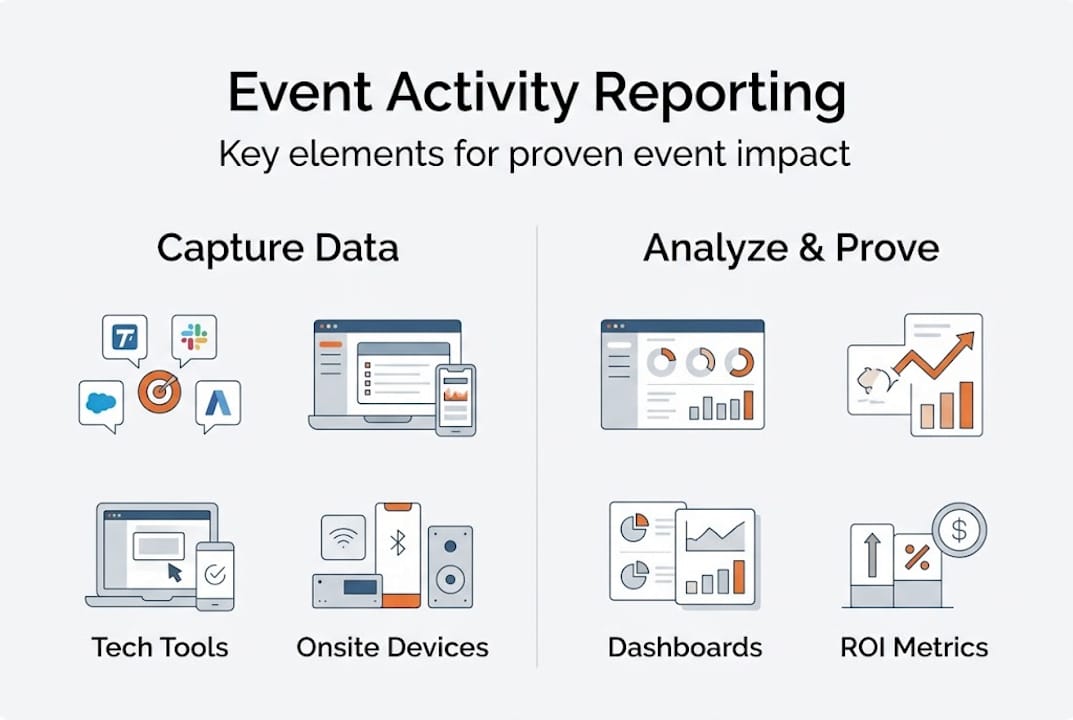
Pro Tip: Use platform integrations wherever possible. Connecting your event registration tool, CRM, and email platform creates a centralized data flow that eliminates manual exports and reduces reporting errors.
Common challenges and advanced considerations
A robust system is only as strong as its ability to handle real-world complexity.
Even well-designed event activity reporting setups run into friction. Knowing the pitfalls ahead of time helps you build systems that hold up under pressure. Here are the most common pain points event teams face:
- 🔒 PII compliance: Collecting attendee behavior data means handling personally identifiable information, which triggers GDPR, CCPA, and other privacy regulations
- 🌐 Hybrid attribution: Attributing engagement across in-person and virtual touchpoints is genuinely hard — especially when virtual tools have limited tracking depth
- ⏱️ Data latency: The gap between real-time vs. batched data can cause teams to act on outdated information
- 📈 High-cardinality noise: Tracking too many granular properties creates data clutter that makes it hard to spot meaningful patterns
"Data quality and proper attribution make or break overall event ROI calculations."
Here's a practical breakdown of challenges and how to address them:
| Challenge | Symptom | Best-practice solution |
|---|---|---|
| PII compliance | Legal exposure, data deletion requests | Anonymize where possible; use consent-first tracking |
| Hybrid attribution | Incomplete engagement picture | Use unified event IDs across platforms |
| Data latency | Stale dashboards during live events | Set clear SLAs for data refresh rates |
| High-cardinality data | Noisy, unusable reports | Limit tracked properties to 10-15 key signals |
Strong event segmentation tips can help you cut through the noise by organizing attendees into meaningful groups before you even start analyzing. And when your event ends, optimizing post-event engagement becomes much easier when your data is clean and well-attributed from the start.
The biggest mistake teams make is over-collecting. More data is not always better data. Focus on the signals that connect directly to your business goals, and you'll avoid the most common reporting traps.
From insight to action: How event activity reporting fuels growth
Once challenges are addressed, the most impactful use of reporting comes in applying insights for continuous growth.
Here's a number worth sitting with: mature B2B event programs average 25 events per year, 412 registrations per event, and a 52% attendance rate — with B2B ROI ranging from 20% to 40%. High performers push that to 300% or more through year-round engagement strategies. The difference between average and exceptional isn't the event itself. It's what teams do with the data afterward.
Translating report insights into real growth follows a clear sequence:
- Segment your audience based on engagement signals (high-intent vs. passive attendees)
- Prioritize follow-up by matching content consumed to sales conversations
- Personalize outreach using session attendance and booth visit data as conversation starters
- Refine content strategy by identifying which sessions drove the most engagement
- Benchmark performance across events to build a continuous improvement loop
Boosting B2B growth with engagement tracking starts with treating every event data point as a signal, not just a statistic. An attendee who visited three product demos and downloaded two whitepapers is telling you something important. Act on it.
Personalizing outreach for better ROI is one of the highest-leverage moves you can make with event activity data. Generic follow-up emails get ignored. Personalized messages that reference specific sessions or interactions get responses.
Pro Tip: Treat your event data as a year-round asset, not a one-off campaign artifact. Build a living database of attendee engagement that informs your next event's content, speaker selection, and audience targeting. The compounding effect over multiple events is significant.
A new mindset: Events as revenue infrastructure, not one-offs
Most marketers treat events like campaigns — you run one, measure it, and move on. That mindset is exactly what keeps event ROI stuck at average. The real differentiator for high-performing programs is treating event data as year-round revenue infrastructure, not a snapshot in time.
"Events are not spikes in your revenue graph — they're the foundation of your relationship-building architecture."
AI tools can surface patterns in your event data faster than any analyst. But AI can't define what "meaningful engagement" looks like for your specific audience and business model. That's a human job. Teams that let algorithmic defaults drive their metric strategy end up chasing vanity numbers that look impressive but don't connect to revenue.
The fix is maintaining a living metrics dictionary — a shared document that defines exactly what each tracked activity means, why it matters, and how it connects to a business outcome. Pair that with event marketing workflows that operationalize your insights, and you have a system that compounds in value over time.
Pro Tip: Audit your event metrics dictionary at least once per quarter. As your business goals shift, your definition of a high-value attendee interaction should shift with them. Letting it drift is how teams end up optimizing for the wrong things.
Elevate your event ROI with Sandbox-GTM
Ready to put these strategies into practice? Sandbox-GTM is built for exactly this kind of work. Our platform captures high-intent event moments and turns them into measurable GTM signal — so you always know who to follow up with, why they matter, and what to do next.
From seamless data capture across in-person and virtual touchpoints to opinionated event marketing workflows that connect activity directly to pipeline, the Sandbox-GTM platform gives your team the systems and support to make every event accountable. Stop leaving event data on the table. Start turning it into revenue. 🚀
Frequently asked questions
What types of activities does event activity reporting track?
Event activity reporting tracks attendee check-ins, session attendance, app usage, networking interactions, and exhibitor engagements. These touchpoints together create a full picture of attendee behavior and intent.
How does event activity reporting improve ROI?
It uncovers valuable attendee behaviors that help you target follow-ups, boost engagement, and justify event budgets with measurable results. High-performing programs achieve 300% or more ROI through year-round engagement driven by strong data practices.
What challenges come with event activity reporting?
Data latency, privacy compliance, hybrid event attribution, and high-cardinality data are the most common obstacles to accurate reporting. Addressing them early in your setup prevents costly gaps later.
How often should event activity data be reviewed?
You should review and act on event activity data after every event and as part of your ongoing marketing analysis cycle. Building a regular review cadence ensures insights stay fresh and actionable.
Can event activity reporting work for both in-person and virtual events?
Yes — modern tools capture interactions in both settings, though some virtual tools like basic Zoom check-ins may have limited tracking depth. Using a unified event platform helps bridge the gap between in-person and virtual data.