
Did you know that 88% of marketers view events as key revenue drivers, with over half reporting events influence at least 50% of their closed deals? Yet many B2B companies still treat events as isolated brand awareness exercises rather than core demand generation engines. This disconnect leaves massive pipeline opportunities on the table. When event and marketing teams align around shared goals, data integration, and coordinated follow-up, events transform into accountable revenue channels that deliver measurable ROI and repeatable growth.
Table of Contents
- Why Aligning Events And Marketing Drives Measurable Demand Generation
- Conceptual Framework For Event-Marketing Alignment
- Strategic Approaches To Event-Marketing Alignment
- Operationalizing Event-Marketing Alignment For Revenue Accountability
- Common Misconceptions About Event-Marketing Alignment
- Conclusion: Making Events Accountable And Worth Repeating
- Turn Event Moments Into Measurable Pipeline With Sandbox
Key takeaways
| Point | Details |
|---|---|
| Events drive majority pipeline | Over 50% of closed deals are influenced by events for many B2B marketers, making alignment critical for revenue accountability. |
| Alignment shifts focus | Moving from lead volume metrics to pipeline quality and revenue attribution enables predictable growth. |
| Follow-up determines ROI | Structured post-event SDR sequences and marketing automation turn attendee lists into qualified pipeline. |
| Smaller events excel | Targeted gatherings deliver higher lead quality and engagement compared to large conferences. |
| Operational frameworks enable measurement | Integrating event data with CRM systems creates clear attribution from event activity to closed revenue. |
Why aligning events and marketing drives measurable demand generation
The strategic integration of event and marketing functions fundamentally transforms how B2B organizations generate and convert pipeline. When these traditionally siloed teams operate with unified objectives, events shift from being one-off brand activities to becoming repeatable engines that drive accountable revenue growth.
The data tells a compelling story. 88% of marketers view events as key revenue drivers, with over half reporting events influence at least 50% of their closed deals. This isn't just correlation. Events create high-intent moments where prospects actively seek solutions, making them uniquely valuable for demand generation strategies when properly executed.
Looking at 2026 specifically, 60% of B2B marketers plan to use in-person events as a core marketing channel. This sustained investment reflects recognition that face-to-face interactions build trust and accelerate deal cycles in ways digital channels alone cannot match.
However, most organizations hemorrhage ROI through one critical failure point: post-event follow-up. Without structured SDR sequences and coordinated marketing automation, attendee lists become stale lead databases rather than active pipeline opportunities. This is where alignment delivers immediate impact.
When event and marketing teams collaborate from planning through execution and follow-up, several measurable improvements emerge:
- Lead qualification happens in real time during events rather than weeks later
- Sales teams receive warm, contextualized handoffs with clear next actions
- Attribution models connect specific event interactions to pipeline movement and revenue
- Budget allocation becomes data-driven rather than based on subjective brand value
- Event strategies become repeatable playbooks rather than one-off experiments
"The biggest ROI leak in event marketing isn't booth design or speaker quality. It's the gap between collecting a badge scan and making a relevant, timely follow-up call."
Alignment transforms this gap into a coordinated handoff where marketing nurtures interest captured at events while SDRs engage high-intent prospects with personalized outreach. This operational synchronization is what converts event attendance into actual pipeline growth.
Conceptual framework for event-marketing alignment
Successful alignment requires more than good intentions. It demands a structured framework that guides how teams collaborate, share data, and measure outcomes. This framework consists of four interconnected elements that work together to create accountability.
First, establish shared goals aligned with business KPIs. Event teams must move beyond attendance metrics to track pipeline created, opportunity acceleration, and revenue influenced. Marketing teams need visibility into which event formats and audience segments produce the highest conversion rates. When both teams optimize for the same outcomes, natural collaboration follows.
Second, integrate data capture systems to enable real-time lead qualification and seamless handoffs. This means connecting event registration platforms, badge scanning tools, and engagement tracking directly to your CRM and marketing automation systems. The goal is eliminating manual data entry that creates delays and errors.
Third, coordinate post-event follow-up between SDR teams and marketing automation workflows. High-intent prospects need immediate, personalized outreach. Medium-intent contacts enter nurture sequences. Low-intent attendees receive educational content that builds awareness over time. This tiering only works when event teams provide rich context about each interaction.

Fourth, continuously measure event-sourced pipeline, conversion rates, and revenue attribution. Over 70% of organizations now use event-sourced pipeline metrics, shifting focus from lead volume to relationship quality and revenue impact. This measurement discipline enables optimization and proves ROI to executives.
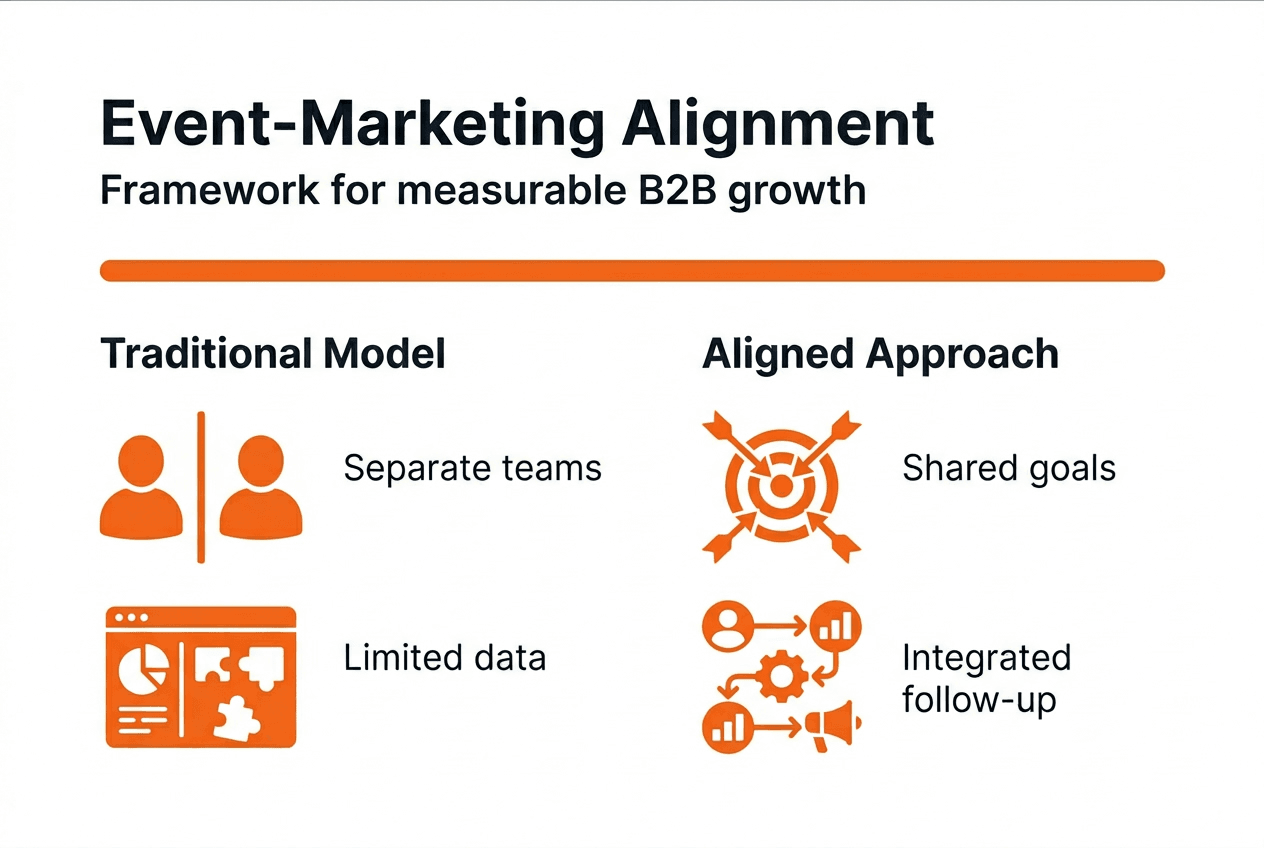
Comparing traditional versus aligned approaches highlights the operational differences:
| Traditional Event Marketing | Aligned Event-Marketing Approach |
|---|---|
| Events owned by separate team with distinct budget | Events integrated into demand generation strategy with shared ownership |
| Success measured by attendance and booth traffic | Success measured by pipeline created and revenue influenced |
| Lead lists exported weekly to marketing | Real-time lead sync with scoring and immediate routing |
| Generic post-event email blast | Coordinated SDR outreach plus tiered nurture sequences |
| ROI calculated on cost per lead | ROI tracked through full funnel to closed revenue |
To operationalize this framework, teams need clear processes for data flow. Event registration should trigger lead creation in your CRM with source attribution. Badge scans should update lead scores and notify SDRs of high-value interactions. Session attendance should inform content recommendations in nurture emails.
Pro Tip: Prioritize sales and marketing data synchronization before your next major event. A linkedin content strategy workflow b2b that connects event insights to social engagement can amplify follow-up effectiveness, but only if your systems talk to each other in real time.
Strategic approaches to event-marketing alignment
Beyond operational frameworks, alignment requires making smarter strategic choices about which events to run, how to activate them, and who handles follow-up. These decisions directly impact lead quality and conversion rates.
The conventional wisdom says bigger conferences deliver more leads. The data tells a different story. Smaller, hyper-focused events yield better lead quality and deeper engagement compared to massive trade shows. When you host 50 qualified prospects for a workshop, you can have substantive conversations. When you sponsor a booth among 200 vendors, you collect badge scans.
This doesn't mean large conferences lack value. It means your activation strategy must match your goals. If you need top-of-funnel awareness, a sponsored booth makes sense. If you need qualified pipeline, invest in private dinners or exclusive roundtables with target accounts.
The sponsorship versus owned event decision illustrates this tradeoff:
| Sponsorships at Large Events | Owned Smaller Events |
|---|---|
| Higher reach and brand visibility | Deeper engagement with qualified prospects |
| Lower control over attendee quality | Full control over guest list and experience |
| Passive lead capture through booth traffic | Active relationship building through curated interactions |
| Moderate cost per lead collected | Higher cost per attendee but better conversion |
Another critical strategic element is SDR and sales involvement in event execution and follow-up. When account executives attend your events, they build relationships that accelerate deals. When SDRs receive real-time alerts about prospect engagement, they can strike while interest is hot.
Budget allocation also signals alignment maturity. 73% of B2B marketers anticipate event marketing budget increases in 2026, reflecting growing recognition that events drive measurable revenue when properly integrated with marketing strategies.
Here are strategic tips to enhance event-marketing alignment:
- Match event format to funnel stage: use large conferences for awareness, workshops for consideration, executive dinners for decision stage
- Build sales into event design: let account executives co-host sessions or facilitate discussions with their accounts
- Create tiered follow-up playbooks: define what high, medium, and low intent looks like and assign appropriate next actions
- Invest in fewer, better events: prioritize quality of engagement over quantity of attendees
- Use events to accelerate existing pipeline: invite prospects already in your funnel to deepen relationships
Pro Tip: Choose event types based on your pipeline gaps, not industry trends. If you need more top-of-funnel volume, sponsor visibility plays. If you need to accelerate stuck deals, host exclusive experiences for target accounts already in consideration.
Operationalizing event-marketing alignment for revenue accountability
Translating alignment strategy into daily operations requires methodical implementation across systems, processes, and team behaviors. Follow these steps to build an integrated event-marketing machine.
-
Define shared KPIs that matter to both teams and the business. Move beyond vanity metrics like booth visits. Track event-sourced pipeline created, opportunity progression rate, average deal size from event leads, and revenue influenced by event touchpoints. Get agreement from sales, marketing, and event teams on these definitions before your next event.
-
Integrate technology platforms to enable seamless data flow. Connect your event management software to your CRM so registration automatically creates or updates lead records. Link badge scanning to lead scoring so high-engagement contacts get prioritized. Sync session attendance to your marketing automation platform so nurture content reflects actual interests expressed at the event.
-
Implement structured SDR sequences for post-event follow-up. Create templated outreach cadences that reference specific event interactions. Brief SDRs on event context before they make calls. Provide talk tracks that connect event conversations to next steps. Track response rates and meeting conversion to optimize messaging.
-
Measure outcomes rigorously and share results across teams. Build dashboards that show event-sourced pipeline movement in real time. Calculate ROI by comparing event costs to influenced revenue, not just initial pipeline created. Review performance monthly and adjust strategies based on what converts.
-
Establish regular collaboration rituals between event, marketing, and sales teams. Host pre-event planning sessions to align on target accounts and desired outcomes. Conduct post-event debriefs to capture what worked and what needs improvement. Create shared Slack channels or communication spaces for real-time coordination during events.
The technical integration deserves special attention. Your CRM and marketing automation platform must sync bidirectionally so event data enriches existing records and informs segmentation. 88% of marketers recognize events as key revenue drivers, but only those with proper sales alignment and SDR outreach realize that potential.
Disciplined ROI tracking separates mature event programs from experimental ones. Calculate cost per pipeline dollar created, not just cost per lead. Track how event-sourced opportunities progress compared to other channels. Measure deal velocity for prospects who attended events versus those who didn't.
Sales collaboration makes or breaks event ROI. When account executives attend your events and engage their accounts, close rates improve dramatically. When SDRs receive context-rich handoffs with clear next actions, conversion rates double or triple compared to cold outreach.
Pro Tip: Prioritize speed of follow-up over perfection of messaging. Prospects forget event conversations within days. An SDR call within 24 hours, even with a simple message, outperforms a perfectly crafted email sent a week later.
Common misconceptions about event-marketing alignment
Several persistent myths prevent organizations from fully integrating their event and marketing functions. Clearing these misconceptions accelerates adoption of accountable event strategies.
Myth: Events serve primarily for brand awareness and can't be measured for direct pipeline impact. Reality: Events create high-intent moments that directly influence buying decisions. When properly instrumented with tracking and attribution, you can connect specific event interactions to pipeline created and revenue closed. The challenge isn't measurement capability but implementation discipline.
Myth: Lead volume matters more than lead quality, so larger events always deliver better ROI. Reality: The shift toward relationship quality over quantity reflects market maturity. A list of 1,000 booth visitors who don't remember your company delivers less value than 50 engaged prospects who had meaningful conversations with your team. Conversion rates and pipeline quality determine ROI, not raw lead counts.
Myth: Event ROI can be measured without involving sales teams. Reality: Attribution only works when sales teams tag opportunities with event influence and provide feedback on lead quality. SDRs and account executives must actively participate in follow-up and record outcomes in your CRM. Without this collaboration, you're guessing at impact rather than measuring it.
Myth: Digital events replace in-person gatherings for demand generation. Reality: Virtual events serve different purposes and stages in the buyer journey. In-person interactions build trust and accelerate decisions in ways webinars cannot replicate, which is why B2B investment in physical events continues growing in 2026.
Clearing these misunderstandings helps teams focus on what actually drives event ROI: strategic alignment around shared goals, integrated data systems, coordinated follow-up, and rigorous measurement.
Conclusion: Making events accountable and worth repeating
Events represent one of the highest-ROI channels in B2B marketing when integrated properly with demand generation strategies. The combination of face-to-face interaction, concentrated buyer intent, and relationship building creates unique opportunities to accelerate pipeline and close revenue.
Alignment transforms events from isolated brand exercises into predictable, measurable growth engines. By establishing shared goals, integrating data systems, coordinating follow-up, and measuring outcomes rigorously, you create accountability that proves value to executives and enables continuous optimization.
The organizations winning with events in 2026 treat them as first-class growth channels, not logistics projects. They invest in fewer, more strategic gatherings. They involve sales teams in design and execution. They follow up fast with context-rich outreach. They measure what matters: pipeline created, opportunities accelerated, and revenue influenced.
Start small if needed. Pick one upcoming event to instrument fully with integrated tracking, coordinated SDR follow-up, and rigorous ROI measurement. Use the learnings to build repeatable playbooks that scale across your event portfolio. The path from brand awareness to revenue accountability runs through operational alignment.
Turn event moments into measurable pipeline with Sandbox
Aligning event and marketing strategies requires more than good intentions. You need systems that capture high-intent signals, workflows that route opportunities to the right teams, and measurement that connects event activity to revenue.
Sandbox treats events as a first-class growth channel by turning live interactions into actionable GTM signal. Our platform integrates event data with your existing marketing automation and CRM systems, enabling real-time lead qualification and seamless handoffs to sales teams. We provide opinionated workflows for post-event follow-up that ensure no opportunity gets lost in the gap between badge scan and qualified conversation.
Whether you're running your first targeted workshop or scaling a flagship conference series, Sandbox gives you the systems, signal, and support to make events accountable and worth repeating. Explore how leading B2B companies use Sandbox to connect event moments directly to pipeline growth and closed revenue.
FAQ
What are the main benefits of aligning event and marketing strategies?
Alignment converts events from isolated brand activities into integrated demand generation engines that drive measurable pipeline. You gain clear ROI visibility, improved lead quality, faster sales cycles, and the ability to prove how events contribute to revenue. This accountability enables smarter budget allocation and repeatable growth.
How can I measure the ROI of my events effectively in 2026?
Use integrated systems that connect event registration, engagement tracking, and badge scanning directly to your CRM and marketing automation platforms. Track event-sourced pipeline created, opportunity progression rates, and revenue influenced by event touchpoints. Coordinate closely with sales and SDR teams to capture outcome data and calculate true ROI based on influenced revenue, not just initial lead counts.
What is the biggest challenge in aligning events with marketing?
Poor post-event follow-up represents the largest ROI leak in event marketing. Without structured SDR sequences and coordinated marketing automation workflows, most event leads go cold within days. Solving this requires clear handoff processes, real-time data integration, and disciplined execution of tiered outreach based on engagement level.
Are smaller events better for alignment than large conferences?
Smaller, targeted events typically foster deeper engagement and deliver higher quality leads compared to massive trade shows. However, the best choice depends on your specific business goals and buyer journey stage. Use large conferences for top-of-funnel awareness and smaller gatherings for mid-funnel relationship building and deal acceleration with target accounts.