

TL;DR:
- Actionable event insights connect attendee behavior to specific follow-up actions and business goals.
- Improving data integration and analysis reduces the event marketing data gap and enhances ROI measurement.
- A mindset shift is needed from focusing on simple metrics to understanding full attendee journeys for better targeting.
Event marketing budgets keep growing, yet proving what those investments actually produce remains one of the hardest problems in B2B marketing. The gap between effort and evidence is real, and it frustrates even experienced teams. Here's the encouraging part: satisfaction is climbing as more organizers adopt event tech and data practices that surface genuinely useful signals. The difference between teams that struggle and teams that thrive often comes down to one thing: actionable insights.
Table of Contents
- What are actionable event insights?
- The impact of actionable insights on event ROI
- Common barriers to gaining actionable insights
- Practical strategies for capturing actionable insights
- A fresh perspective on actionable event insights
- Drive event growth with actionable insights
- Frequently asked questions
Key Takeaways
| Point | Details |
|---|---|
| Insights drive ROI | Actionable event insights help marketers prove event value and elevate ROI through targeted engagement. |
| Overcome data gaps | Solving reporting and CRM limitations is critical for reliable, actionable insights. |
| Leverage automation | Automation accelerates analysis and empowers rapid decision-making for event growth. |
| Focus on attendee journey | Mapping attendee behaviors uncovers key drivers behind conversion and engagement at events. |
What are actionable event insights?
Not all data is created equal. 📊 Raw event data tells you what happened. Actionable insights tell you what to do about it. That distinction matters enormously when you're managing follow-up pipelines, planning future programs, and reporting to leadership.
An actionable insight connects a behavior or outcome to a clear next step. For example, knowing that 200 people attended your session is raw data. Knowing that 47 of those attendees also visited your product demo booth, engaged with two pieces of sponsored content, and represent accounts in active deal cycles is an actionable insight. It tells you exactly who to prioritize, why they matter, and what message to send next.
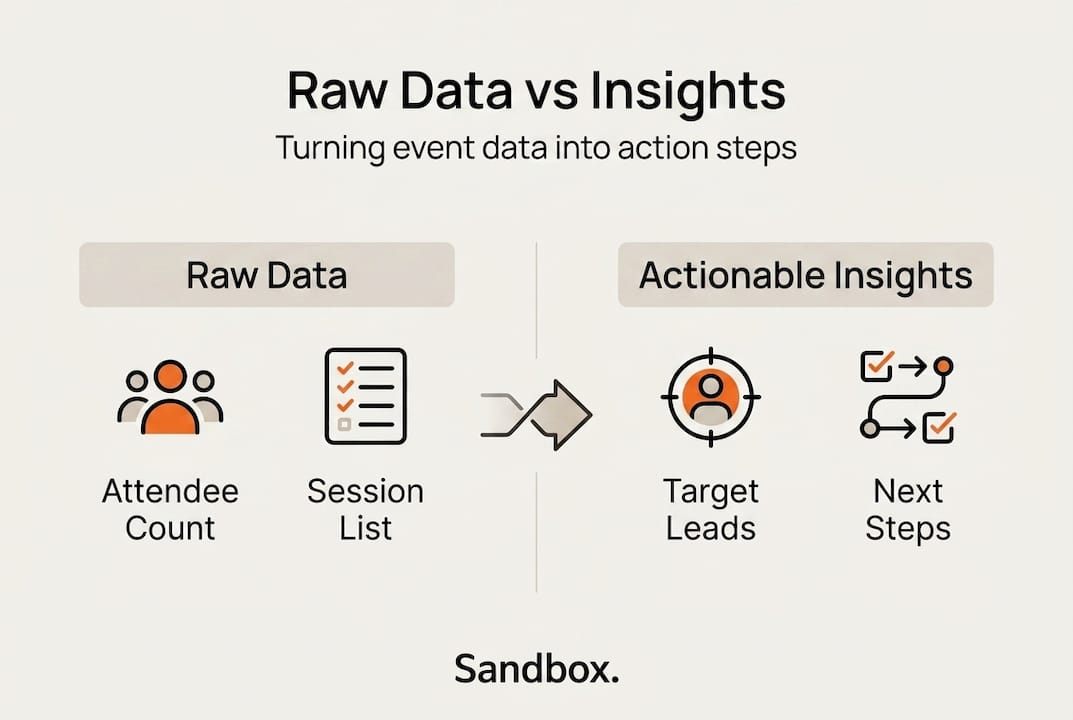
The event marketing data gap is a real structural problem. Many organizers collect attendance figures, session ratings, and lead scan counts without connecting those signals to business context. The result is a stack of spreadsheets that nobody acts on.
Actionable insights, by contrast, emerge when you combine three ingredients:
- Data analysis: Processing raw inputs to find patterns
- Contextual relevance: Matching those patterns to your sales cycle, personas, and funnel stage
- Goal alignment: Ensuring every insight ties back to a business objective, whether that's pipeline, revenue, or retention
Here's a quick comparison to make this tangible:
| Raw event data | Actionable insight |
|---|---|
| 500 badge scans at booth | 120 scans from target accounts in active pipeline |
| 85% session attendance rate | Sessions on Topic X drove 3x more demo requests |
| 200 post-event survey responses | Attendees rating content "highly relevant" converted at 2x the rate |
| 1,200 app logins | Top 15% of engaged app users match your ICP exactly |
You can use our event metrics guide to build a baseline measurement framework before you start layering in more sophisticated insight generation. Once you know which metrics matter most to your goals, turning them into actionable insights becomes much more systematic.
Here are practical ways actionable insights show up in real event marketing work:
- 🎯 Identifying high-intent attendees for immediate sales outreach
- 📋 Prioritizing follow-up sequences based on session topic engagement
- 🔁 Adjusting session formats mid-program based on real-time drop-off rates
- 💬 Personalizing post-event nurture tracks by content consumption patterns
- 📈 Reporting revenue attribution by tying event touchpoints to closed deals
The shift from data collection to insight generation is not just a technical upgrade. It changes how your entire team thinks about events.
The impact of actionable insights on event ROI
Now that actionable event insights are clearly defined, let's explore how they tangibly drive stronger ROI and event success. 💡
The numbers here are striking. Organizers struggling to prove ROI dropped from 70% to 40%, a significant shift that correlates directly with improved event tech adoption and better data practices. That's not coincidence. Teams that invest in capturing and acting on meaningful signals are pulling ahead, and the gap between high-performing and average event programs is widening as a result.
Stat callout: 40% of event organizers still struggle to prove ROI, but that's down from 70%. The teams closing that gap share one common trait: they turn event data into decisions.
Here's how the improvement in satisfaction and ROI measurement plays out across event types:
| Metric | 2023 benchmark | 2025 benchmark | Change |
|---|---|---|---|
| Organizers struggling with ROI proof | 70% | 40% | 30% improvement |
| Attendee satisfaction scores | Moderate | High | Positive trend |
| Tech integration adoption | Low | Growing | Significant increase |
Improved outcomes don't happen automatically. They follow a deliberate process. Here's a step-by-step path from insight capture to measurable ROI improvement:
- Capture intent signals at every touchpoint. This means badge scans, app engagement, session attendance, content downloads, and meeting bookings. Every interaction is a data point.
- Analyze patterns against your ICP and pipeline. Cross-reference engagement data with your CRM to identify which accounts are showing meaningful intent signals.
- Act quickly with personalized outreach. The half-life of event interest is short. Insights only generate ROI when your team acts on them within 24 to 72 hours of the event.
- Measure outcomes and close the loop. Track which follow-up actions led to meetings, opportunities, and revenue. Feed that data back into your next event plan.
Building a solid event marketing ROI framework is essential before you expect insights to move the needle. Without a clear measurement model in place, even the best insights get lost in post-event chaos. A well-designed event conversion process connects insight to action to revenue in a way that leadership can see and trust.
Following a data-driven marketing approach means treating every event as a learning opportunity. Each program you run should generate insights that make the next one more effective. Teams that do this well build compounding advantages over time.
Common barriers to gaining actionable insights
Despite proven ROI benefits, many marketing teams still face systemic hurdles. Here's where breakdowns occur and how to get past them. 🚧
The event marketing data gap is not just a technology problem. It's a process and prioritization problem. Even teams with decent tools often fail to turn data into decisions because they haven't built the workflows to make it happen consistently.
"Independent organizers are flying blind because data sits in disconnected systems with no clear path from collection to action."
Here are the most common barriers and practical solutions for each:
- 🔴 Data silos between event tech and CRM: Solve this by implementing native integrations or middleware tools that push event activity directly into your CRM in real time.
- 🔴 Slow post-event reporting cycles: Solve this by setting up automated dashboards that surface key signals within hours, not days, of your event closing.
- 🔴 Lack of context in CRM records: Solve this by enriching contact records with session attendance, content engagement, and meeting history before your follow-up team touches them.
- 🔴 No clear ownership of insight analysis: Solve this by assigning a dedicated event intelligence owner who is accountable for turning raw data into prioritized action lists.
- 🔴 Over-reliance on lagging indicators: Solve this by tracking behavioral signals during the event, not just post-event survey scores, so you can act while intent is still high.
Pro Tip: Automation is your fastest path out of the reporting bottleneck. Instead of manually pulling data from five platforms after every event, invest in marketing automation for events that consolidates signals automatically. This frees your team to focus on analysis and action rather than data wrangling.
Solid event activity reporting is the foundation for everything else. If you can't see what happened clearly and quickly, you can't act on it effectively. Many teams underinvest here because reporting feels less exciting than campaign execution. That's a mistake. A good automated marketing observability setup catches data quality issues before they corrupt your analysis and ensures your insights are built on solid ground.

Practical strategies for capturing actionable insights
Having covered what slows teams down, let's look at actionable steps you can take to ensure event insights reliably drive real-world impact. 🛠️
The good news is that the barriers covered in the previous section are solvable with the right systems and discipline. Event tech integration boosts satisfaction, and the teams that invest in connected tech stacks consistently outperform those operating with fragmented tools. Here's a practical framework to get there:
- Define your insight goals before the event. Know exactly what decisions you want your data to inform. Are you trying to identify high-intent prospects? Measure content resonance? Prove pipeline influence? Your goal shapes what you measure.
- Integrate your tech stack ahead of time. Event app, badge scanning system, CRM, marketing automation, and analytics tools should all talk to each other before day one. Last-minute integrations create data gaps.
- Track engagement throughout the event, not just at the end. Monitor session attendance, app activity, booth visits, and networking interactions in real time. This lets you make adjustments and prioritize outreach before the event even ends.
- Analyze signals through a business lens. Layer engagement data on top of account and opportunity data from your CRM. Focus your analysis on signals that indicate purchase readiness, not just general interest.
- Apply findings within 48 hours. The event follow up process is where insights turn into revenue. Prioritize outreach to the highest-intent attendees first, with personalized messages that reference their specific engagement at the event.
- Measure, learn, and iterate. Track which insight-driven actions led to pipeline and revenue. Use that data to refine your next event's measurement framework.
Pro Tip: Leverage the power of analytics platforms that offer real-time dashboards and automated alerts. When a high-value account shows three or more intent signals during your event, your sales team should know immediately, not two weeks later in a debrief deck.
There are also pitfalls worth avoiding explicitly. Don't measure everything just because you can. Tracking too many signals without a clear framework creates noise, not insight. Don't rely solely on self-reported data like surveys. Behavioral data is far more reliable than what attendees say they found valuable. And don't let insights sit in a presentation deck. The event marketing automation benefits only materialize when your team has clear workflows that move from insight to action automatically.
The best event marketers treat each program as a data-gathering system as much as an experience. Every session, interaction, and touchpoint is an opportunity to learn something that improves your next move.
A fresh perspective on actionable event insights
Here's something most articles on this topic won't tell you: the insight problem is not primarily a data problem. It's a mindset problem. 🧠
Most event teams are trapped by legacy metrics because those metrics are easy to collect and familiar to report. Badge scans, registration counts, and NPS scores feel like evidence of success, so teams keep measuring them. But familiar metrics are often the least actionable ones.
The uncomfortable truth is that insights only matter when they connect to behaviors, not to reporting numbers. A session rating of 4.2 out of 5 tells you almost nothing useful. Knowing that the 23 attendees who stayed for your entire technical deep-dive session include six accounts in late-stage pipeline conversations is genuinely actionable. One of those insights drives a follow-up email. The other drives a sale.
There's also an underused strategy that we see consistently overlooked: attendee journey mapping. Most teams look at event engagement in isolated snapshots. They check who visited the booth, who attended which session, who booked a meeting. But they rarely stitch those touchpoints together into a complete picture of each attendee's event journey.
When you map the full journey, patterns emerge. Some attendees consistently move from educational content to product-focused sessions to one-on-one conversations. That sequence is a behavioral fingerprint for high purchase intent. Other attendees engage heavily with content but never seek out product conversations. They're great candidates for nurture, not direct sales. Understanding these patterns lets you build genuinely personalized event lead nurturing workflows that feel relevant rather than generic.
The teams that win at event ROI are not the ones with the most data. They're the ones who have built the discipline to ask better questions of their data, act faster on the answers, and continuously refine their approach based on what actually moved the needle.
Drive event growth with actionable insights
Turning event insights into pipeline is not a one-time fix. It's a system. And building that system takes the right workflows, tools, and expertise working together. 🚀
Sandbox is built specifically for teams that want to treat events as a real growth channel, not just a line item on the marketing calendar. Our platform captures high-intent signals across every event interaction, connects them to your GTM motion, and surfaces the prioritized actions your team needs to drive follow-up that actually converts. From your first program to your flagship conference, our event marketing workflows give you the systems and support to make every event measurably worth running. When you're ready to stop guessing and start connecting event activity directly to revenue, Sandbox is where that journey starts.
Frequently asked questions
How do actionable event insights help increase engagement?
Insights drawn from attendee behavior and content interaction help you tailor event experiences in real time and personalize follow-up, which directly increases relevance and participation. Improved tech adoption is already showing measurable gains in attendee satisfaction as a result.
What technologies are essential for capturing actionable event insights?
Tight integration between your event tech platform, CRM, and analytics tools is the foundation. Without connected systems, data gaps and slow reporting prevent even good data from becoming useful decisions.
Why do marketers still struggle to prove event ROI despite using data?
The core issue is that collecting data and turning it into decisions are two different disciplines. CRM limitations and data silos strip event signals of the context needed to connect them to business outcomes.
How can event marketers apply insights to drive conversion rates?
Segment your attendees by behavioral signals, personalize outreach based on their specific event journey, and act within 48 hours while intent is still high. Teams that follow this approach, supported by improved event tech, consistently see stronger conversion rates from event-sourced leads.